
Semi Trailer Maintenance Guide: Tips for Long-Term Durability
Published Jan 20, 2026
25 engineers · ISO 9001 · 3C certified · Liangshan factory since 2001
Updated 2026-05-11
7 min read
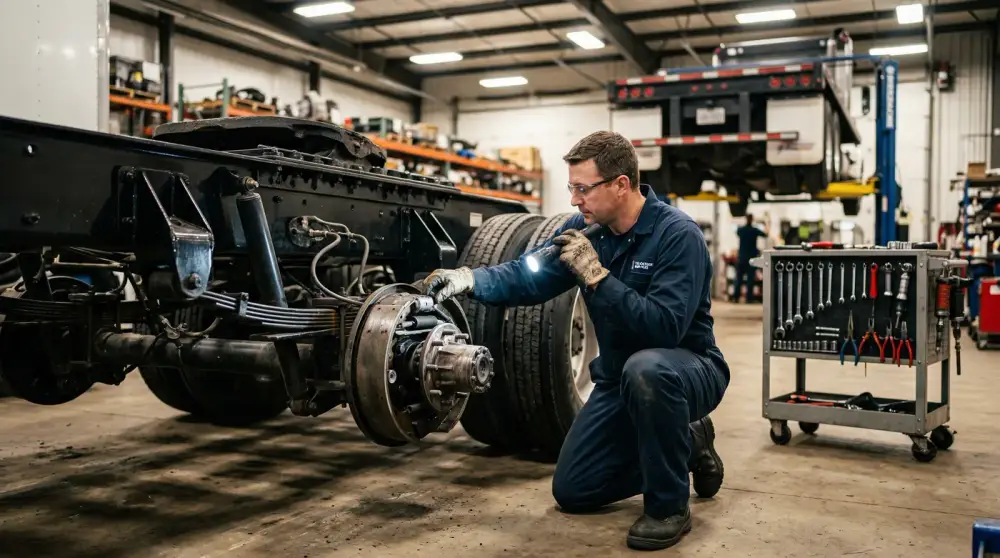
Your trailer rolls off the production line in perfect condition. Everything is tight, greased, and aligned. Fast-forward 50,000 km of loaded highway driving with no maintenance, and you're replacing brake drums, burning through tires twice as fast as you should, and watching surface rust eat into frame steel that was painted just months ago.
We build around 10,000 trailers annually, and our after-sales team hears the same problems repeat. Most of them come down to maintenance items that take 30 minutes per week to check and a few hours per quarter to service. Here's what to focus on, ordered by what causes the most expensive problems if ignored.
Brakes: Check Them or Replace Them — Your Choice
Brake system failures are the single most expensive preventable problem on a semi trailer, and they carry safety consequences that make the repair cost secondary.
Pad and lining inspection: Look at your linings every 20,000–30,000 km. Under heavy-load conditions or on mountain routes with long descents, cut that interval to 15,000 km. When the lining material reaches the manufacturer's minimum thickness mark, replace it. Running worn linings doesn't save money — it just transfers the cost to drum replacement, which runs 3–5 times the price of linings.
Air leak test: Apply the brakes with the engine off and listen. Walk the full length of the trailer. A hissing brake chamber means reduced stopping force on that wheel and uneven braking across the axle. Check every hose connection for cracking or chafing where hoses pass through frame brackets — vibration wears through rubber faster than most operators expect.
Slack adjusters: Automatic slack adjusters should compensate for lining wear without manual intervention. But "automatic" doesn't mean "maintenance-free." Verify their operation during each service. A stuck slack adjuster is the single most common cause of uneven braking and premature drum wear that we see reported from the field.
Tires: Your Biggest Recurring Cost After Fuel
In most of the markets where our trailers operate — across Africa and the Middle East — import tires cost $300–$500 each. A tri-axle trailer running 12 tires can burn through a full set in under 12 months if inflation and alignment aren't monitored.
Check pressure weekly. Always when cold, before the day's first trip. Underinflation causes sidewall flex, heat buildup, and accelerated shoulder wear. Overinflation reduces the contact patch and causes center wear. Both shorten tire life. The correct pressure is printed on the tire sidewall for the rated load — not a round number your driver remembers from a previous truck.
Read the wear patterns. Tires tell you what's wrong before anything else shows symptoms:
- Cupping or scalloping on the tread → worn shock absorbers or imbalanced wheels
- One-sided wear → axle misalignment
- Center strip wear → chronic overinflation
- Both shoulder wear → chronic underinflation
- Flat spots → brake lock-up (check that ABS is functioning)
Rotate per the manufacturer's schedule. On a tri-axle, the rearmost axle scrubs the hardest in turns and wears tires fastest. Moving rear tires to the middle position on a rotation schedule extends total set life by 15–20%.
Lubrication: Grease Is Cheap, Seized Parts Aren't
Moving components need regular grease to prevent metal-on-metal wear. The specific intervals depend on the component, but here's what we specify for our trailers:
| Component | Grease interval | What happens if you skip it |
|---|---|---|
| Landing gear gears and screws | Every 3 months or 10,000 km | Gears seize, landing gear won't crank. Field repair is difficult |
| Fifth wheel plate and king pin | Every coupling | Accelerated king pin wear, rough articulation under load |
| Suspension pivot points | Every 20,000 km | Bushing failure, alignment shifts, uneven tire wear |
| Brake camshaft bushings | At each brake inspection | Stiff cam rotation, uneven brake application |
| Door hinges and latches | Monthly (enclosed trailers) | Door won't seal, cargo damage from weather |
Use the lubricant grade specified by each component manufacturer. JOST landing gear and FUWA axles both publish specific grease specifications in their maintenance documentation. Substituting a different grade isn't a shortcut — it's a gamble with the component warranty.
One more thing: over-greasing causes real problems. Excess grease migrates toward brake components and contaminates friction surfaces. Apply the specified amount, not more.
Frame and Corrosion: Treat It Early or Replace It Later
Steel frames corrode. The question is how fast, and the answer depends almost entirely on how you maintain the coating.
Inspect at every service interval. Check the main beams, cross-members, and suspension brackets for surface rust. Focus on water trap areas — inside channel sections, around bolt holes, and at welded joints where moisture sits and doesn't drain.
Treat surface rust immediately. Wire brush down to clean metal and apply touch-up paint or rust converter. A 15-minute touch-up in the yard prevents a problem that, left for a year, becomes structural corrosion requiring section replacement.
Coastal and tropical operators face accelerated corrosion from salt air and humidity. If your trailers run near the coast — Lagos, Dar es Salaam, Manila, Karachi — request enhanced coating at time of purchase. Zinc-rich primer with marine-grade topcoat adds to the upfront cost but extends frame life by years. We offer this as a standard option on all our side wall and flatbed models.
After washing, let the trailer drain and dry before parking for extended storage. Standing water inside frame channels corrodes from the inside — where you can't see it until there's already serious material loss.
Axle Bearings: The Failure You Won't See Coming
Wheel bearing failure doesn't give much warning. By the time you notice excessive wheel play or heat at the hub, the bearing is already damaged. A seized bearing at highway speed generates enough heat to start a wheel-end fire.
Service interval: Repack with fresh grease every 100,000 km or annually, whichever comes first. FUWA publishes specific intervals in their axle maintenance manual — follow those rather than general guidelines.
During service, inspect closely. Look at bearing rollers and races for pitting, spalling, or blue discoloration from overheating. Replace any bearing showing surface damage. Bearings are cheap enough that running a questionable one never makes financial sense.
Check axle alignment annually, or immediately after any curb strike, dock impact, or reported pull to one side. Misaligned axles create a chain reaction: accelerated tire wear on one side, higher rolling resistance that burns more fuel, and stress on suspension components leading to bushing and bracket failures down the line.
Electrical: Five Minutes Before Every Trip
This is the fastest check on the list and the one most often skipped.
Walk around the trailer before each trip. Confirm all marker lights, brake lights, turn signals, and reflectors are working. A burned-out marker light takes 2 minutes to replace in the yard. The fine for operating without functioning lights in most jurisdictions costs more than a month's supply of spare bulbs.
Check the wiring harness where it passes through frame holes and near suspension components — vibration abrades insulation over time. Secure any loose sections with cable ties. Inspect the trailer connector (7-pin or 15-pin) for corrosion or bent pins, and clean the contacts with electrical contact cleaner regularly.
For trailers with ABS: connect the trailer and watch the dash warning light. It should illuminate briefly, then go out within a few seconds. A light that stays on means a sensor, modulator, or wiring fault that needs diagnosis before the trailer goes out loaded.