Dump Truck vs Tipper vs Dumper: What's the Difference?
Published Jun 8, 2026
25 engineers · ISO 9001 · 3C certified · Liangshan factory since 2001
Updated 2026-06-08
17 min read
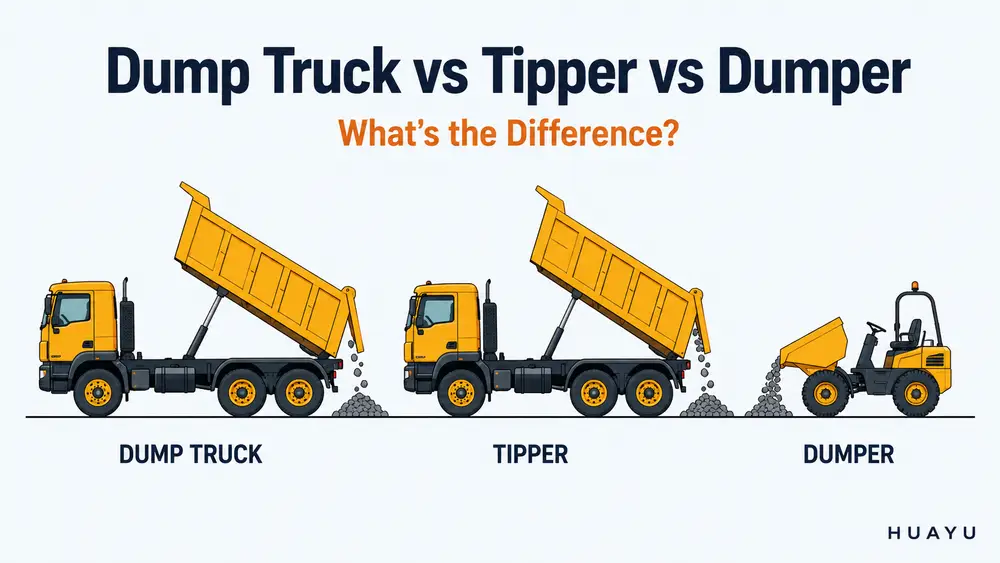
Dump truck, tipper, dumper — three words that send buyers in circles. A supplier in China quotes a "tipper", a contractor in Texas wants a "dump truck", and a site foreman in Manchester is talking about a "dumper" that looks nothing like either. Same machine? Sometimes. Not always.
Here is the short version, and the rest of this guide proves it out. Dump truck and tipper are the same road vehicle under two regional names. Dumper is the odd one — in British usage it's a separate, smaller machine. The catch is that the words trade places between countries, "tipper" can mean a truck or a trailer, and almost every comparison online stops after two of the three terms.
This article settles all three. It maps what each market calls them, breaks down the types and the real payloads, and points to the one distinction that actually changes your purchase order: whether you need a truck or a trailer.
The Short Answer: Same Machine, Different Word (Mostly)
Dump truck and tipper are two names for one vehicle — a road truck, or a trailer, with a hydraulic body that lifts at the front and tips its load out the back. North America says dump truck. Britain and most of the Commonwealth say tipper. A dumper breaks the pattern: in British English it's a small, off-road site machine with the skip mounted ahead of the driver, not a highway truck at all.
The whole picture fits in one table.
| Dump Truck | Tipper | Dumper | |
|---|---|---|---|
| Also called | dumper (US, loosely), dumping truck | tipper truck, tipper lorry, tip truck | dumper truck, site dumper |
| Default term in | USA, Canada | UK, Ireland, Australia, NZ, South Africa, India, Europe | UK, Ireland, Europe |
| What it is | road truck or trailer, body tips at the rear | road truck or trailer, body tips at the rear | small off-road machine, skip at the front |
| Typical payload | 9–24 t on road, up to 400 t in mining | 12–70 t depending on axles | up to 10 t |
| Road-legal | yes (mining versions are not) | yes | no — site use only |
| Self-powered | truck yes, trailer no | truck yes, trailer no | yes |
Two rows in that table cause most of the trouble. The dumper sits in a different category, and both "dump truck" and "tipper" can point at either a powered truck or an unpowered trailer. The sections below take each word in turn.
Dump Truck: The North American Term
A dump truck is the standard North American name for a vehicle that hauls loose bulk material — sand, gravel, rubble, ore — and unloads it by raising the front of an open, rear-hinged body so the load slides out under gravity. The term covers a wide family, and the gap between the smallest and largest members is enormous.
The main types of dump truck
Most dump trucks fall into a handful of layouts:
- Standard (rigid) dump truck — cab and body on one frame, a single steering axle up front. A European four-axle "eight-wheeler" tops out near 32 tonnes gross.
- Articulated dump truck (ADT) — a permanent pivot joint between cab and body, six-wheel drive, built for soft and uneven ground. Payloads run about 25 to 60 tonnes.
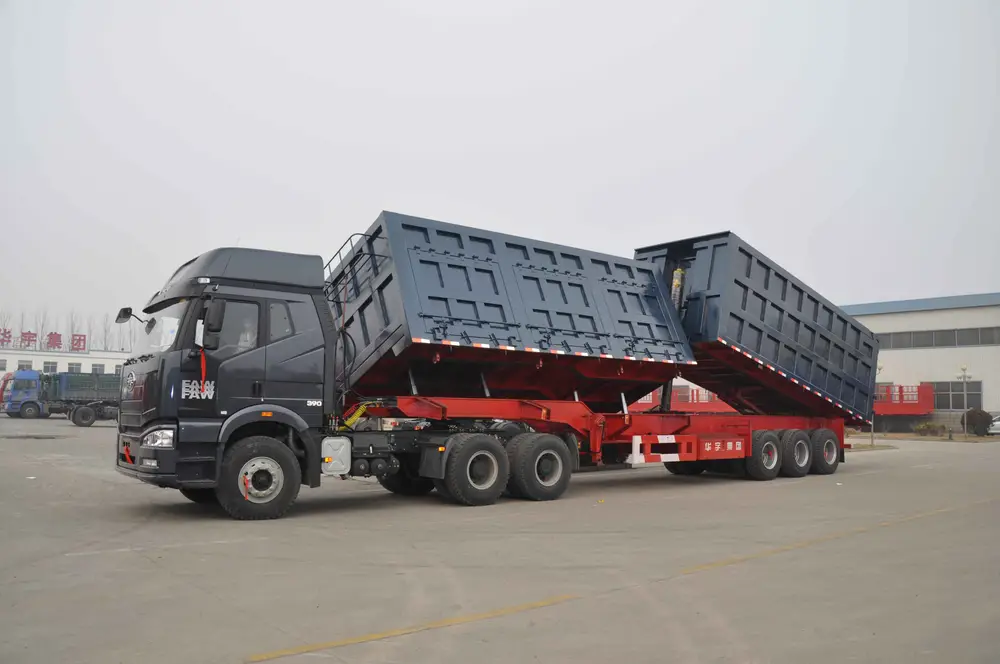
- Semi end-dump — a tractor pulling a tipping trailer, with the hydraulic hoist in the trailer. This is the point where the "truck" becomes a trailer, and it's the class HUAYU builds.
- Transfer and super dump — North American setups that add a second container or a trailing axle to carry more weight within US bridge-load rules.
- Off-highway haul truck — the rigid giants used in mines. The largest, the BelAZ 75710, carries 450 tonnes a load and never touches a public road.
Lumping all of these under one label hides a split that decides what you actually buy. A rigid dump truck is one machine; a semi end-dump is two pieces that come apart. More on that below.
Tipper: The British and Commonwealth Term
A tipper is the same road vehicle as a dump truck, named for how it works rather than what it does. "Tip" is the old British verb for tilting something over, so a tipper is a truck — or trailer — whose body tips to shed its load. The word travels across the UK, Ireland, Australia, New Zealand, South Africa, India, and most of Europe.
Tipper truck or tipper trailer?
"Tipper" on its own won't tell you whether someone means a truck or a trailer. A tipper truck, or tipper lorry, is one integrated vehicle. A tipper trailer — also called a tip trailer or tipper semi-trailer — is an unpowered body pulled by a tractor unit. British and Commonwealth usage lists both names side by side, which is exactly why an importer has to spell out which one they want.
How a tipper body actually lifts
The body rises on a single front-mounted hydraulic cylinder, not a jack tucked under the bed. On a tipper semi-trailer that cylinder is telescopic — three to five nested stages that extend in sequence — and it pushes the front of the body up to roughly 45 degrees. Putting the cylinder at the front, right at the pivot, spreads the lifting force across a wide span of the frame instead of loading one point, so a front-mount telescopic hoist copes with an off-centre load far better than an under-body scissor lift and puts less fatigue stress on the chassis. The engine drives the pump through a power take-off, geared off the gearbox.
Dumper: The One That's Genuinely Different
A dumper is not a road truck. In British and most European usage it's a compact, off-road machine that moves material around a construction site, and its defining feature is the skip: it sits in front of the operator, not behind a cab, and tips forward to drop the load. Most carry up to about 10 tonnes.
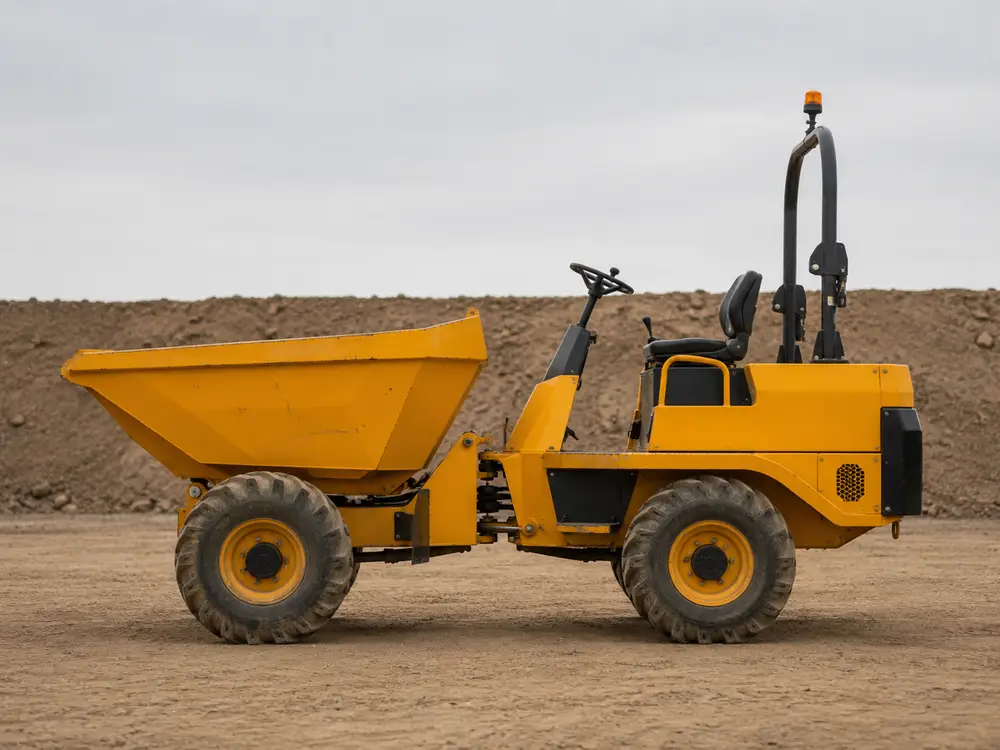 A compact site dumper with its skip at the front
An excavator loads the skip directly, the dumper trundles a short distance over rough or muddy ground, and it tips. It steers by pivoting at the middle of its own chassis — articulated, four-wheel-drive — so it turns inside its own length on a cramped site. A roll-over protection frame stands over the seat. Three skip styles cover the work: forward tip, the standard; high tip, which lifts the skip to empty over a wall or into a hopper; and swivel skip, which rotates to dump off to one side for backfilling a trench. The brand names you meet here — Thwaites, Wacker Neuson — make site dumpers, not highway trucks.
Why 'dumper' gets confused with 'dump truck'
Two habits blur the line. North American English uses "dumper" loosely as a synonym for dump truck, so a US reader pictures a road truck. British speech, going the other way, sometimes calls the road tipper a "dumper truck". The reliable test is where the load rides: a dumper carries it in a skip in front of the driver, while a tipper or dump truck carries it in a body behind the cab.
What Each Market Calls It: The Global Naming Map
The same machine answers to a different name depending on where it works, and the names don't always line up the way you'd expect. This matters for anyone importing equipment, because the wrong word on an enquiry pulls up the wrong product. The table maps the road vehicle and the small site machine across the main markets.
| Region | Road tipping vehicle | Small off-road machine | Note |
|---|---|---|---|
| USA / Canada | dump truck | (no separate word; "dumper") | no tipper/dumper split |
| UK / Ireland | tipper, tipper lorry | dumper | the cleanest split |
| Australia | tipper (road-registered) | dump truck (large off-road); site dumper | usage inverts — see below |
| New Zealand | tipper, tip truck | dumper | follows the UK |
| South Africa | tipper truck (= dump truck) | dumper | sizes quoted in "cube" (m³) |
| India | tipper or dumper (same truck) | — | the two words merge |
| Europe (non-UK) | tipper truck | dumper | follows the UK |
| Middle East | dump truck (also tipper) | dumper | US-leaning English |
| Latin America, Africa, SE Asia (export English) | dump truck or tipper, both seen | dumper | buyers mix both terms |
The Australia twist: where 'dumper' is the big one
Australia turns the British size intuition on its head. There, a "tipper" is the smaller road-registered truck that runs on paved roads, while "dump truck" means the big off-road mining and earthmoving machines — the yellow gear. So an Australian operator will tell you the tipper is small and the dumper is huge, the exact reverse of what a British operator means. Neither is wrong. The two dialects carved up the same category along different lines.
India, where 'tipper' and 'dumper' mean the same truck
In India the British distinction collapses. "Tipper" and "dumper" both point at the same road-going tipping truck, and dealers list them as one category. A buyer sourcing from or selling into India can treat the two words as identical and steer the conversation toward the spec — axle count, body volume, payload — instead of the label.
Truck vs Trailer: The Difference That Changes What You Buy
The split that actually moves your purchase isn't dump truck versus tipper. It's truck versus trailer. A rigid truck and a tractor-plus-trailer do the same job in completely different ways, and the right pick turns on distance, terrain, and how you run a fleet.
Rigid truck vs tractor and tipping semi-trailer
A rigid tipper truck is a single vehicle: cab, engine, and tipping body all on one chassis, hydraulics driven off that engine. A tipping semi-trailer has no engine. It hitches to a separate tractor unit, and that tractor can drop one loaded trailer, hook to another, and stay on the move. One power unit serves several trailers. The trailer alone costs less than a complete truck and carries far more of its weight as cargo — a 3-axle tipper semi-trailer runs about 10 to 11 tonnes empty against 40 to 50 tonnes of payload, a ratio near four or five to one that a rigid truck, hauling its own engine and cab everywhere it goes, can't reach.
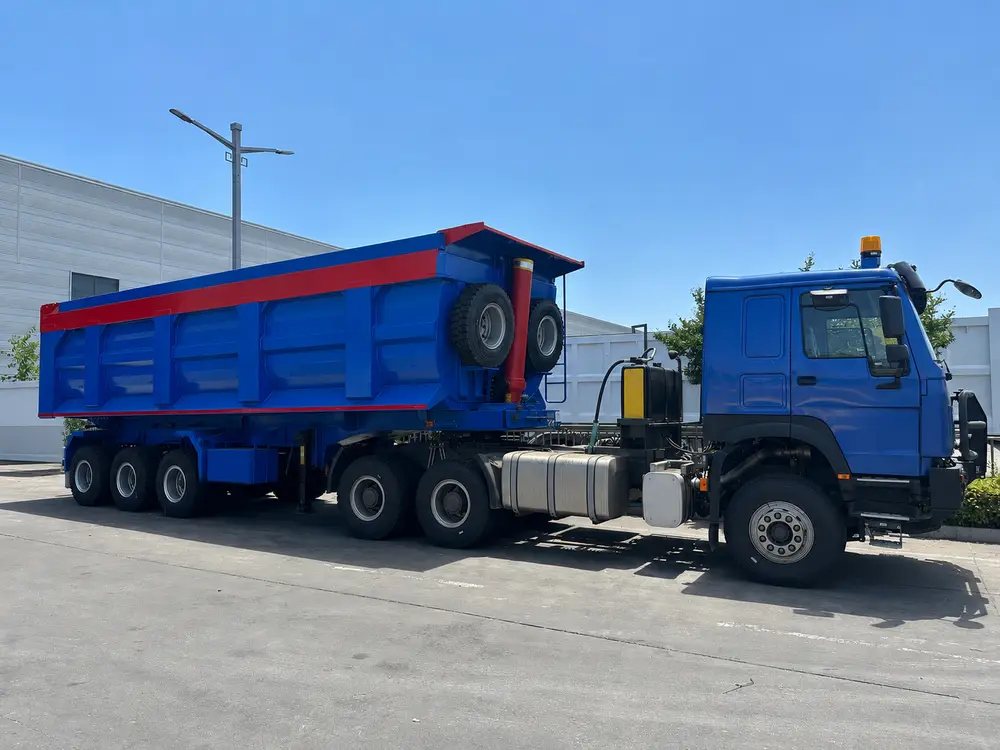 A tractor unit pulling an end-dump tipper semi-trailer
Choose a tipping semi-trailer for road haul
Over distance, the trailer wins on cost per tonne. It carries more legal weight per trip, and the drop-and-hook method keeps the expensive tractor earning while the trailers sit at the loader. For bulk aggregate running between a quarry and a depot a few hundred kilometres apart, a tractor and a tipping semi-trailer shift more material per litre of fuel than a rigid truck doing the same route.
Choose a rigid truck or dumper for tight, rough sites
Close in, the rigid machine wins. On a broken, temporary, or confined site it turns tighter, tolerates a load that shifts without the jackknife risk a long trailer carries, and needs no drop yard. For pure site shuttling over the worst ground, the small dumper does what no road trailer can.
Capacity and Specs Side by Side
Payload is where the classes separate, and the spread is wide — from a one-tonne site dumper to a mine truck carrying four hundred. The table sets the real ranges next to each other. Read them as typical bands, not hard limits, because axle count and local weight law move the numbers.
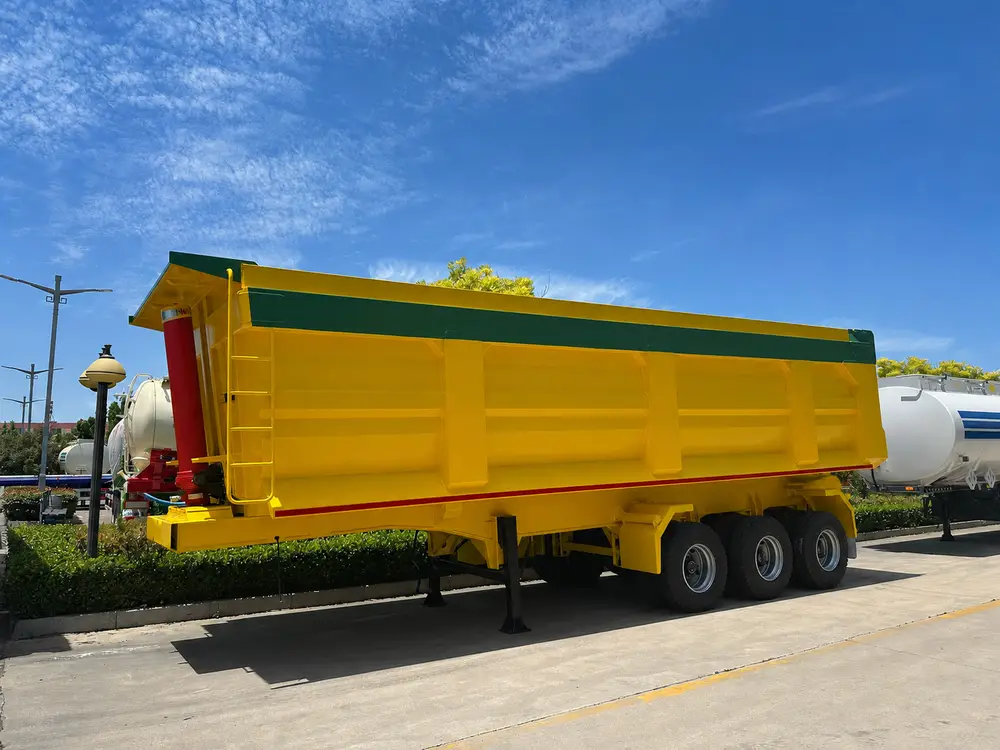 A 3-axle end-dump tipper semi-trailer
| Class | Typical payload | Axles / drive | On or off road |
|---|---|---|---|
| Compact site dumper | up to 10 t | 4-wheel, articulated | off-road only |
| Rigid road tipper (6x4 / 8x4) | 20–24 t | 3–4 axles | road |
| Articulated dump truck (ADT) | 25–60 t | 6x6 | off-road |
| Rigid haul / mining truck | 40–400 t | 2 axles | off-road only |
| Tipper semi-trailer (2 / 3 / 4 axle) | 30 / 40–50 / 60–70 t | tractor + 2–4 axles | road |
End dump, side dump, or bottom dump?
The body shape decides how the load comes out, and each layout trades capacity against stability. An end dump raises the whole body and empties out the rear — the highest payloads and the simplest build, but the body stands tall when raised and will roll if the ground isn't level or the load hangs up. A side dump rolls the body to one side; it stays low, empties fast, and is the hardest of the three to tip over. A bottom, or belly, dump opens a gate underneath and lays material in a line as it drives, which suits road base and asphalt but won't pass wet fines or oversized rock. HUAYU's U-shape rock-body end dump uses a half-round floor so dense rock slides out clean instead of packing into square corners.
Axle count and your local weight limit
Axle count is the lever that turns payload into a legal load. Spreading the weight over more axles lets you carry more without breaking the per-axle limit your roads enforce. A two-axle tipper trailer suits loads near 30 tonnes; three axles is the common pick for 40 to 50 tonnes and the default across most export markets; four axles reaches 60 to 70 tonnes where the law allows. The United States caps a five-axle combination at 80,000 lb gross, with 34,000 lb on a tandem. The EU permits 40 tonnes for a five-axle rig and 44 for six. Match the axle count to the limit at the destination, not the one at the factory.
Which One Do You Actually Need?
Pick by the job, not the name. The work site and the haul distance point to one answer more reliably than any label:
- Tight or temporary site, short shuttle — a compact dumper, off-road and quick to turn.
- Rough off-road earthmoving — a rigid tipper truck, or an articulated dump truck on soft or steep ground.
- Bulk material over road distance — a tractor and a tipping semi-trailer, for the lowest cost per tonne.
- Mine or quarry haul roads — an articulated dump truck for bad ground, a rigid haul truck for top tonnage on maintained roads.
A note for importers: the spec beats the word
When you buy from overseas, the regional name counts for less than what's on the spec sheet. A factory reads "tipper" and "dump trailer" as the same request, so the words that decide what arrives are the measurable ones: axle count, body type and volume, payload rating, and the steel grade in the body. Send those and the label sorts itself out. HUAYU builds tipper semi-trailers in 2-, 3-, 4-, and 6-axle layouts with end-dump, U-shape rock-body, and box-type bodies — give the engineering team your material and your country's axle-load limit, and the configuration follows from there.
Frequently Asked Questions
Is a tipper the same as a dump truck? In most countries, yes. "Dump truck" is the North American name and "tipper" is the British and Commonwealth name for the same road vehicle: a truck, or a trailer, with a hydraulically raised body that discharges material from the rear, tilting to around 45 degrees. The machine is identical. Only the word changes with geography.
What is the difference between a dumper and a tipper? A tipper is a road-legal truck or trailer that carries bulk material on highways. A dumper, in British and Commonwealth usage, is a smaller off-road site machine that carries up to about 10 tonnes in an open skip mounted in front of the driver, and it shuttles material around a construction site rather than travelling on public roads.
Why are dump trucks called tippers in some countries? The two words describe the same action from different angles. "Dump truck" names what the vehicle does — it dumps the load — and is standard in the United States and Canada. "Tipper" comes from "tip", the British verb for tilting, and is used across the UK, Ireland, Australia, New Zealand, South Africa, India, and much of Europe.
Is a tipper smaller than a dump truck? Not by any fixed rule. In British English the two terms are interchangeable for the same road truck. In Australia the usage flips: a "tipper" is the smaller road-registered truck, around 12 to 24 tonnes of payload, while "dump truck" means the large off-road mining machines that carry 40 tonnes and up. Size follows the country, not the word.
What is the difference between a tipper truck and a tipper trailer? A tipper truck is one integrated vehicle: the cab and the tipping body share a single chassis, and the engine drives the hydraulics through a power take-off. A tipper trailer, or tipper semi-trailer, has no engine of its own and is pulled by a separate tractor unit. A typical 3-axle tipper semi-trailer weighs about 10 to 11 tonnes empty and carries 40 to 50 tonnes.
What is the difference between an articulated and a rigid dump truck? An articulated dump truck (ADT) has a pivot joint between the cab and the body, six-wheel drive, and carries roughly 25 to 60 tonnes — it handles soft, wet, or steep ground. A rigid dump truck has one solid frame, two axles, and rear-wheel drive, and carries from 40 tonnes up to about 400 tonnes on hard-packed mine haul roads.
How many tons can a tipper truck or tipper semi-trailer carry? A rigid 8x4 road tipper truck carries roughly 20 to 24 tonnes of payload. A tipper semi-trailer pulled by a tractor carries more: about 30 tonnes on two axles, 40 to 50 tonnes on three axles, and 60 to 70 tonnes on four axles, depending on the body size and the axle-load limit in your country.
Does a dump truck or a tipper trailer cost more? It depends on the class, not the name. A compact site dumper is the cheapest. A complete rigid tipper truck costs more than a tipper trailer of the same payload, because the truck includes an engine, cab, and chassis. With a trailer, that cost sits in the tractor, which you reuse across several trailers — a 3-axle unit carrying 40 to 50 tonnes runs near 10 tonnes empty, a payload-to-tare ratio close to five to one.
The naming will keep shifting from one market to the next, but the machine underneath doesn't. Once you know whether you need a truck or a trailer, which body suits your material, and how many axles your roads allow, the right word is whatever your supplier understands. For the trailer side of that decision, HUAYU's tipper and end-dump semi-trailer range covers the common configurations, and the engineering team can match a build to your cargo and route.