Side Tipper vs End Tipper: Which Is Better for Mining & Bulk Haulage?
Published Jun 18, 2026
25 engineers · ISO 9001 · 3C certified · Liangshan factory since 2001
Updated 2026-06-18
17 min read
Ask ten trailer salesmen whether you should run a side tipper or an end tipper, and you will get ten confident answers — most of them shaped by whichever one the salesman happens to sell. The internet is worse. Search the question and nearly every result is a manufacturer's blog crowning its own product the winner on every count.
This guide does something different. It compares the side tipper and the end tipper the way a fleet owner moving rock, ore, or aggregate would: by payload, by cost, by how often the thing rolls over on bad ground, and by which one actually earns its keep on a long haul. The short version sits right below. The detail, including the numbers most sellers leave out, comes after.
The Short Answer
Neither one wins outright, and any guide that says otherwise is selling you something. A side tipper is the safer, faster-discharging choice on rough, soft, or sloping ground and over long bulk-haul routes — it keeps the load low and tips it off the side. An end tipper carries more volume per load, costs less to buy, and runs simpler, which makes it the right tool on firm, level ground like a pit-to-crusher shuttle or a construction site.
For most mine-to-port haulage in Africa, where trailers spend their lives on corrugated dirt and unstable shoulders, the side tipper is the default. For quarry and site work on prepared ground, the end tipper holds its own. Here is the split at a glance.
| Side tipper | End (rear) tipper | |
|---|---|---|
| How it dumps | tilts low to one side | raises the body, slides out the rear |
| Best ground | rough, soft, sloping | firm, level |
| Rollover risk while dumping | low — centre of gravity stays down | high — the body lifts the load up |
| Volume per load | lower | higher (taller body, more cubes) |
| Discharge | along its length, can roll forward | one fast motion, must stop |
| Purchase cost | higher | lower |
| Sweet spot | long-haul ore, coal, aggregate | pit-to-crusher, construction |
How a Side Tipper and an End Tipper Actually Work
Both are tipper semi-trailers: an unpowered body pulled by a tractor unit, with a hydraulic ram that lifts part of the body so gravity does the unloading. What changes is the direction the load travels, and that single difference drives everything else — stability, speed, cost, and the kind of site each one suits.
The end (rear) tipper: lift and slide out the back
An end tipper, also called a rear tipper or end dump, raises the front of the body on a front-mounted telescopic cylinder. The body pivots at the rear, the tailgate swings open, and the load slides out the back as the bed climbs to around 45 degrees — steep enough to clear most material in one go. The telescopic ram nests several stages inside each other, so it pushes the body high while taking up little length when closed.
That steep angle is the end tipper's strength and its weakness. It empties fast and swallows dense, chunky material, but it puts the whole load high in the air at the exact moment of discharge.
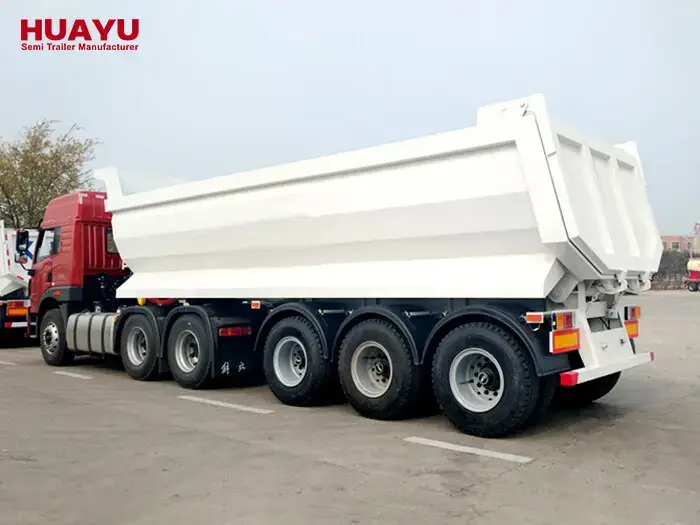 HUAYU 3-axle end-dump tipper semi-trailer
Box body or U-shape rock body?
Two body shapes cover most work. A square or box body is the general-purpose pick for sand, soil, and mixed aggregate. A U-shape rock body — a half-pipe floor — is built for blasted rock and ore: the curve centres the load on its own, sheds it without packing into square corners, and runs stiffer than a box without bolting on extra beams, which keeps the tare weight down. HUAYU builds the U-shape in 3-axle and 4-axle versions for exactly this duty.
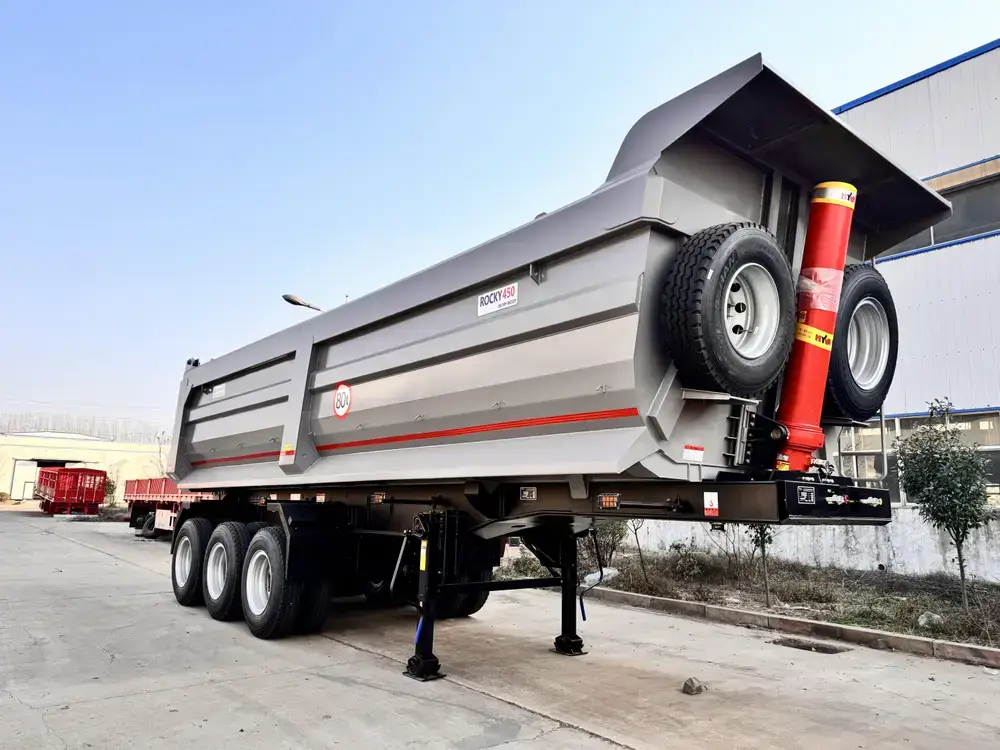 U-shape rock body with front-mounted telescopic cylinder
The side tipper: tilt low and pour off the side
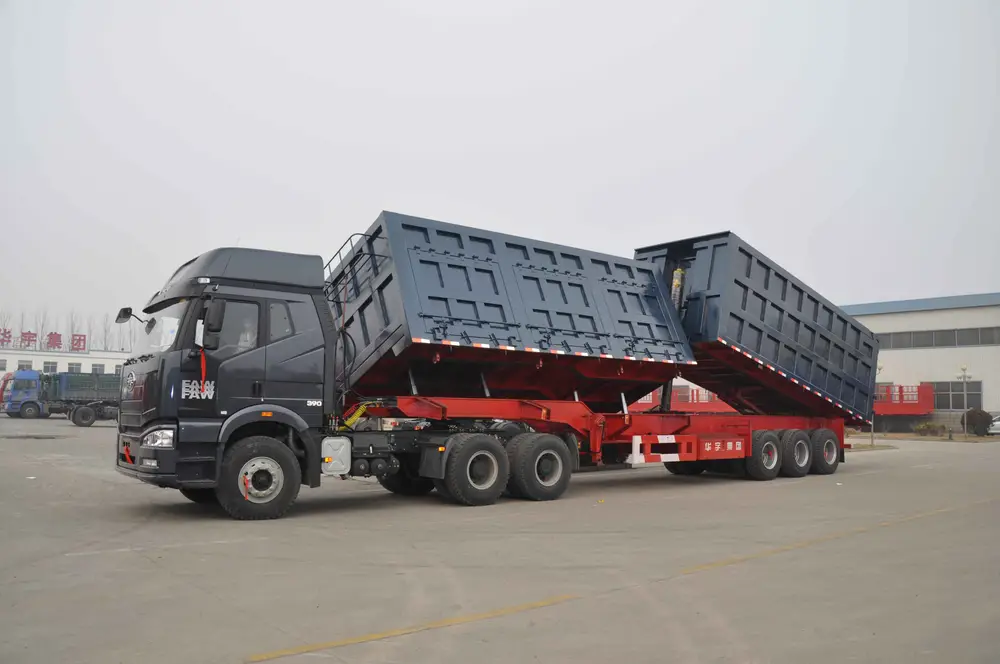
A side tipper works on a different axis. The body sits on a low longitudinal hinge and tilts sideways, pouring the load off one side of the trailer along its full length. A two-way side tipper can tilt either left or right; a three-way adds a rear tilt, at the cost of a heavier frame and a little payload. Because the body rotates about a hinge close to the chassis, the load never climbs high — it slides off low and wide.
That is the whole case for the side tipper in one line: it empties without lifting its centre of gravity into the danger zone.
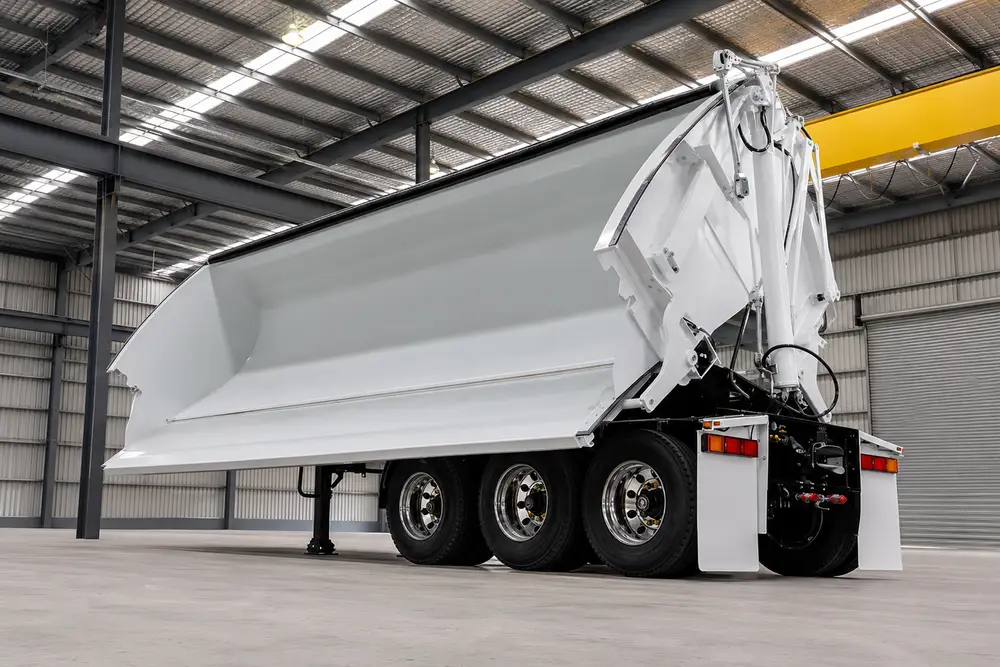 HUAYU side tipper trailer discharging to one side
Door, bowl, or dropside?
Side tippers come in a few body styles. A door (box) body suits dry, free-flowing material — coal fines, dry road base, grain. A bowl or half-pipe body handles wet and sticky ore, since the rounded floor lets clingy material break free instead of bridging. A dropside side tipper adds hinged side panels for loads you sometimes want to clear by hand or with a loader. Whatever the body, the discharge stays lateral, and low.
The Honest Scorecard: Side Tipper vs End Tipper
Put the two side by side and the picture is mixed — each wins about half the rows. The table below is the head-to-head most seller blogs will not print, because it refuses to crown a single champion.
| Factor | Side tipper | End (rear) tipper | Edge |
|---|---|---|---|
| Discharge speed | dumps along its length, can creep forward | one fast motion, must stop fully | Side |
| Stability while dumping | low centre of gravity throughout | body and load lift to ~45° | Side |
| Bad ground (soft, sloped) | tips safely off-level | needs firm, level footing | Side |
| Volume per load | lower (~23 cu yd at 36 ft) | higher (~36 cu yd at 36 ft) | End |
| Payload-to-tare | slightly lighter for the payload | simple box, strong 5–6:1 ratio | Tie |
| Purchase price | higher (extra hydraulics, frame) | lower | End |
| Hydraulic simplicity | twin rams, side subframe | single front cylinder | End |
| Overhead clearance | never lifts high | tall raised body near power lines | Side |
| Sticky or fine material | watertight tub holds it | rear gate can leak fines | Side |
| Tight-site maneuverability | long, awkward to reverse | many operators rate it higher | End* |
*Maneuverability is genuinely disputed across the industry — more on that below.
Where these numbers come from
A word on sourcing, because it matters. Many of the figures floating around — "30 percent fewer accidents," resale-value tables, "wins on all 13 factors" — come straight from side-tipper manufacturers, with no independent study behind them. The volume figures here, roughly 36 cubic yards for an end dump against 23 for a side dump at the same 36-foot length, come from neutral trade reporting rather than a seller. Where a claim is a manufacturer estimate, this guide says so. Treat any "study" that happens to flatter the product on the same page with caution.
Safety and Rollover: The Factor That Decides Most Mining Buys
For a mine or quarry fleet, rollover outweighs every other factor, because a tipped trailer is not just lost payload. It is a damaged unit, a blocked haul road, and sometimes an injured operator. This is where the side tipper earns its premium.
Why a raised end body tips
The physics is simple. A loaded trailer stays upright only while its centre of gravity sits inside the line of its wheels. Raise an end tipper's body to 45 degrees and you lift several tonnes of load three or four metres into the air, dragging the centre of gravity up and making the whole unit top-heavy at the worst possible moment. Now add a soft patch under one wheel, a slight cross-slope, an off-centre load, or a gust of wind against the raised body. The centre of gravity crosses the wheel line. Over it goes. The taller and longer the trailer, the smaller the nudge it takes.
A side tipper sidesteps the problem by never raising the load. The body rotates low and the material slides off the side, so the centre of gravity shifts sideways and stays near the ground through the whole cycle.
What the independent data says
The independent record backs the physics. Between 2018 and 2024, the US Mine Safety and Health Administration logged fourteen incidents of over-the-road trucks tipping or rolling while dumping and twenty-eight off-road haul trucks doing the same, including a fatality in January 2024 when a tipping trailer fell onto the tractor cab. The recurring causes are the ones above: uneven ground, soft spots, off-centre loads, and wind on a raised bed.
There is a second hazard people forget, and it has nothing to do with the ground — overhead power lines. A raised end-dump body is a leading cause of power-line contact in haulage, and the standard guidance is to keep at least three metres of clearance and never move a truck with the bed up. A side tipper, which never lifts high, takes that risk off the table almost entirely.
The side tipper's own limit
Side tippers are not magic, and an honest comparison says so. They need clear ground to the side at the tip face — you cannot side-dump into a narrow trench or against a wall the way you can reverse an end tipper up to a hopper. And while a side tipper forgives uneven ground far better, it still has to sit roughly level across its width before tipping; tilting across a steep cross-slope can still roll it. Check the ground sideways, not just the way it looks from the cab.
Mining and Bulk Haulage: Matching the Trailer to the Job
Strip away the brochures and the choice comes down to the route and the material. Here is how it plays out in the work HUAYU's trailers actually do.
Long-haul mineral corridors
On the Central African copper corridors — Kolwezi and the Zambian Copperbelt down to Durban, Dar es Salaam, or Beira — minerals travel close to 2,000 kilometres by road, and a single round trip can run 35 to 50 days through border queues and toll posts. On a haul that long and that slow, two numbers decide profit: how many tonnes you move per trip, and how rarely you lose a trailer to the shoulder.
That is the side tipper's home ground. The Southern African interlink — two side-tipping trailers behind one horse, the "34-ton side tipper" advertised across the region — carries roughly 34 to 40 tonnes of ore per trip and pours it off low and fast at the stockpile, even where the ground is rough. A 40, 45, or 50-cube side tipper set spreads the load in a windrow instead of dropping it in one pile, which saves a re-handling step. Lower tipping forces also mean less strain on the chassis over thousands of kilometres of corrugated road.
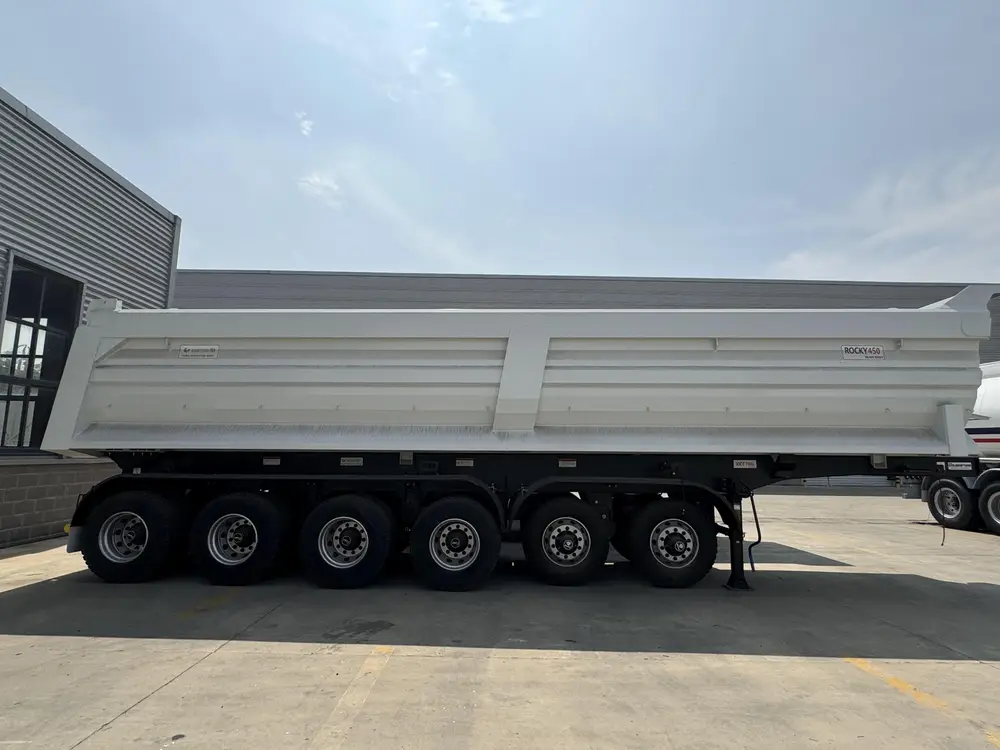 HUAYU 6-axle rock-body tipper for mineral haulage
Pit-to-crusher and construction
Closer to the rock face, the end tipper takes over. A pit-to-crusher shuttle runs short, fast cycles on ground the mine keeps graded and firm, and there the end tipper's advantages line up: more cubes per load, the lowest purchase price, and a single fast dump straight into the crusher feed. The U-shape rock body comes into its own here, taking the impact of loaded boulders and clearing dense ore without packing. For construction — road base, fill, sand to one discharge point — the same logic holds. HUAYU's end tipper and U-shape rock-body range covers this work in 2-, 3-, 4-, and 6-axle layouts.
Matching the body to the material
Material decides the body. Dense ore — iron, chrome, or manganese at 2.4 to 2.8 tonnes per cubic metre — weighs out long before it fills the body, so payload rating matters more than cubic capacity; you hit the legal axle limit with the body half full. Light, bulky loads like coal or grain do the opposite and reward the biggest body you can run. Sticky or wet ore wants a bowl floor on either trailer type. And chrome and manganese contaminate each other, so operators hauling both keep separate trailers rather than mixing loads.
Beyond Side vs End: The Build Spec That Survives African Roads
Here is the part the side-versus-end debate usually skips. For a buyer running into Central or Southern Africa, the body geometry matters less than the build underneath it. A side tipper in thin steel with the wrong suspension will fail faster than a well-built end tipper, and the reverse is just as true.
Steel grade and beam reinforcement
Abrasion-resistant steel is the first thing to specify. A floor in Hardox 450 — or 500 for hard rock — at 6 to 10 millimetres, with 4 to 6 millimetre sides, takes the pounding of loaded ore far longer than ordinary mild steel, which dents and wears through in a season. The main beams need double-plate reinforcement too, because the real killer on African routes is not the load. It is the road: hundreds of kilometres of washboard corrugation that cracks an under-built chassis within months.
Suspension and axle-load legality
Suspension is the second decision, and the remote-area answer often surprises buyers used to European specs. Mechanical leaf-spring suspension is frequently the better choice over air for trailers working far from a service centre — simpler, tougher, and fixable in the field with basic tools. Then there is the law. Across the SADC and EAC regions, axle-load limits cap what you can legally carry: a South African tri-axle runs to about 28 to 30 tonnes, and a Superlink combination to roughly 56 tonnes gross within a 22-metre length, with abnormal-load permits required beyond that. Axle count — tri-axle versus interlink — gets chosen as much to stay legal across a border as to hit a target payload.
So Which One Should You Buy?
Pick by the job, not by the brochure. The decision lands cleanly once you are honest about your ground, your route, and your material.
Choose a side tipper when
- Your ground is rough, soft, sloped, or unprepared — the typical African mine or quarry.
- You haul bulk over long distances and live or die by tonnes per trip and turnaround.
- There are overhead obstructions: power lines, tunnels, shed roofs.
- You move fine, wet, or contamination-sensitive material that needs a watertight tub.
- You would rather spread a windrow than drop a single pile.
For a side-tipper build matched to your route, axle limits, and material, talk to HUAYU's engineering team — the configuration follows from your corridor, not from a catalogue.
Choose an end or rear tipper when
- You haul on firm, level ground: a graded pit-to-crusher run or a construction site.
- Maximum cubes per load matters more than dumping on a slope.
- Budget is tight — the end tipper is the lower-cost buy and the simpler machine to keep running.
- You need to place material precisely at one rear point, into a hopper or a trench.
This is the work HUAYU's tipper range is built for, from a 2-axle end dump up to a 6-axle U-shape rock body. A recent 4-axle end-dump delivery to Zimbabwe shows the spec in service.
The honest "it depends" zone
A few factors refuse to settle. Maneuverability is genuinely disputed — side-tipper sellers say their trailers are easier to position, several dealers rate the end tipper better in tight spaces, and both are awkward to reverse. Versatility and big-boulder handling split the same way. When the body choice is a coin toss, let the build spec decide: the steel grade, the suspension, and the axle configuration move your running costs far more than which way the trailer tips. If you are still weighing names rather than specs, our guide to dump trucks, tippers, and dumpers untangles the terminology first.
Frequently Asked Questions
Is a side tipper safer than an end tipper? On uneven, soft, or sloping ground, yes. A side tipper tilts its body about a low hinge so the load slides off sideways and the centre of gravity stays close to the axles throughout the dump. An end tipper raises the whole body to around 45 degrees, lifting the load high and making the unit far easier to roll if one wheel drops into a depression or the ground gives way. On firm, level ground both are stable.
How many cubes is a side tipper trailer? Most single side tippers run between 18 and 50 cubes (cubic metres), and a Southern African interlink pairs two units for 40 to 50 cubes of combined volume. Dense ore weighs out before it cubes out, though: at 2.4 to 2.8 tonnes per cubic metre, a 34-tonne payload fills only about 12 to 14 cubes of iron or chrome ore, so the bigger bodies suit coal, aggregate, and lighter bulk.
What is a 34-ton side tipper? It is the standard Southern African long-haul configuration: an interlink of two side-tipping trailers behind one horse, rated to carry roughly 34 tonnes of payload at a gross combination mass around 56 tonnes, within the South African 22-metre Superlink length limit. The 34-tonne figure is the legal payload that fits the National Road Traffic Act axle-load rules, which is why it became the regional benchmark for copper, chrome, and coal.
Tri-axle side tipper or interlink — which carries more? An interlink carries more. A single tri-axle side tipper typically hauls 28 to 34 tonnes within regional axle limits, while an interlink set of two trailers behind one tractor carries around 34 to 40 tonnes at a higher gross combination mass. The tri-axle wins on manoeuvrability and lower cost; the interlink wins on tonnes per trip over long, fixed corridors where turnaround is everything.
Is a side tipper or an end tipper cheaper to buy and run? An end tipper is cheaper to buy and simpler to maintain — one front-mounted telescopic cylinder instead of a side-tilt subframe and twin rams. Side-tipper sellers counter that their exposed cylinders cost less to replace and that the trailers hold resale value better, but those figures come from manufacturers, not independent studies. On purchase price and hydraulic simplicity, the end tipper wins clearly.
Side tipper or rear tipper for sticky ore? Use a bowl-shaped (half-pipe) body either way. A side tipper with a rounded tub sheds wet, sticky ore cleanly and lays it down in a controlled line instead of dropping it in one mass. A rear tipper can also clear sticky loads because it tips to a steeper angle through the tailgate, but material is more likely to cling and bridge inside a tall square box.
Which unloads faster, a side tipper or an end tipper? A side tipper, in most cases. It dumps along its whole length in one short tilt and can discharge while creeping forward, so a full set clears in two to three minutes without stopping to reverse. An end tipper empties in a single fast motion too, but it must first come to a complete stop on firm, level ground, which slows the cycle on a busy site.
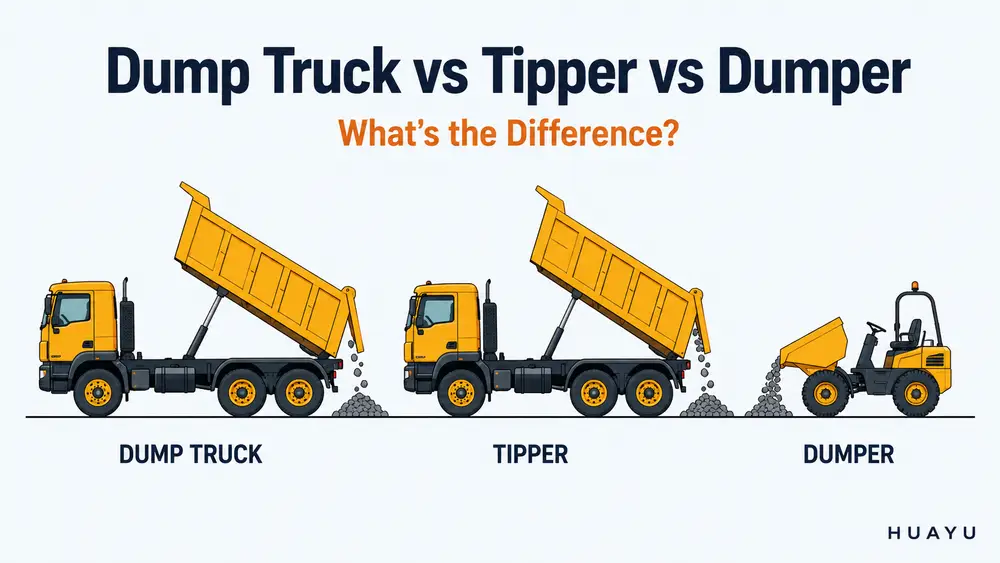
The vocabulary shifts from market to market — side tipper, rear tipper, end dump, the 34-ton interlink — but the engineering underneath does not. Work out whether your ground is firm or rough, whether your route rewards cubes or turnaround, and what your material weighs, and the right trailer picks itself. For the build to match that decision, HUAYU's tipper and end-dump range covers the common configurations, and the engineering team can spec a trailer to your corridor and cargo.