
TOP 10 Semi Trailer Manufacturers in the World
Published Apr 3, 2026
25 engineers · ISO 9001 · 3C certified · Liangshan factory since 2001
Updated 2026-05-11
10 min read
For fleet operators and logistics companies buying semi trailers across borders, the manufacturer you pick affects a lot more than the sticker price. It determines your lead times, whether you can get spare parts six months later, what the trailer is worth when you resell it, and -- most importantly -- whether the trailer actually holds up on the roads you're running.
We see this firsthand. A trailer engineered for European motorways will not last long on unpaved mining hauls in West Africa or overloaded cement runs through Central Asia. The roads are different. The loads are different. The manufacturer needs to understand both.
We put together this list of ten semi trailer manufacturers with proven track records in large-scale production, export capability, or specialized engineering. But first, here's what actually matters when you're evaluating any manufacturer -- because the brand name alone won't tell you enough.
What to Look for in a Semi Trailer Manufacturer
These six factors separate manufacturers that deliver on time from those that leave you waiting at the port.
Production capacity and lead time. A factory producing 5,000+ units per year can typically fulfill a 20-unit fleet order in 25–45 days. Smaller shops may quote 3–4 months for the same order. Ask for the annual output number and current backlog before you commit.
Product range. If you're running mixed cargo, you want a manufacturer that builds multiple trailer types under one roof. Buying flatbeds from one factory and tankers from another doubles your buying hassle and kills any chance of volume discounts.
Export experience and documentation. International buyers need a manufacturer that handles Bill of Lading, packing lists, certificates of origin, and customs clearance from the port. If the factory only sells domestically, expect to spend weeks sorting out export paperwork yourself -- or paying a trading company to do it.
Quality certifications. ISO 9001 is the baseline. For trailers shipped to markets with national standards (such as China's mandatory CCC certification), confirm the specific models you need are certified. Not just the factory -- the models.
Customization capability. Standard configurations rarely match every market. We've had buyers from Kenya request modified axle spacing to meet their road authority limits. Fuel distributors in Nigeria need specific tank compartments for multi-product delivery. A manufacturer with in-house engineering can adapt designs without outsourcing the work or charging you extra for drawings.
After-sales and spare parts. Ask how the manufacturer supports warranty claims for overseas buyers. Do they stock common wear parts -- brake pads, landing gear components, air valves -- for export? Can they ship replacements directly, or are you on your own?
For a deeper breakdown of matching trailer type to your cargo, read our full guide: how to choose the right semi trailer.
1. HUAYU Vehicle -- Shandong, China
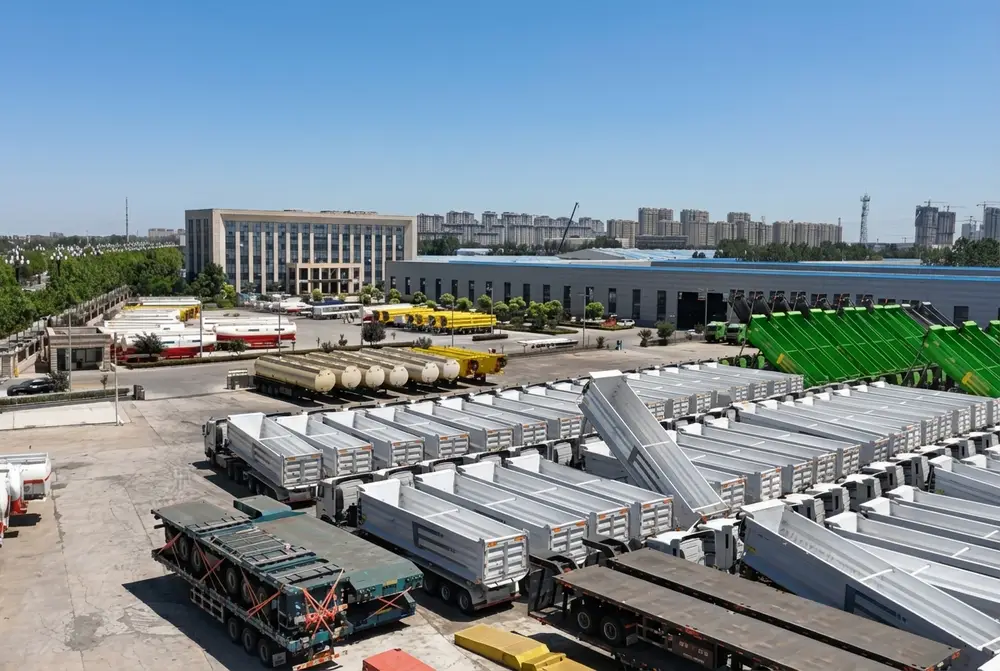
We've been manufacturing semi trailers since 2001 -- 24 years of continuous production from the same facility in Liangshan, Shandong, one of China's largest trailer manufacturing clusters. Our factory covers 600,000 square meters with 10 dedicated production lines and an annual output capacity of 10,000 units.
The reason buyers keep coming back to us is the breadth of the product catalog. We manufacture virtually every major semi trailer type in-house:
- Flatbed trailers for 20ft and 40ft container transport, steel coils, and general cargo, including extendable models up to 25 meters for oversized loads
- Side wall trailers with removable panels for bulk goods, bagged cargo, and palletized freight (40–80 ton payload)
- Fuel tanker trailers in aluminum and carbon steel for petroleum, diesel, gasoline, and asphalt, ranging from 30,000 to 45,000 liters
- Low bed trailers for heavy machinery, excavators, and oversized equipment (50 to 150 ton capacity, including detachable gooseneck models)
- Bulk cement trailers with V-shaped pneumatic discharge tanks from 40 to 50 cubic meters
- Fence trailers for livestock and agricultural transport with ventilated sidewalls
- Tipper trailers for mining, construction aggregate, and sand, available in rear-tipping and side-tipping configurations
- Skeleton trailers (container chassis) for 20ft, 40ft, and 45ft container haulage
 HUAYU 3-axle flatbed container semi trailer in factory yard
That range means a fleet operator can source every trailer type from a single manufacturer. One set of shipping documents, one factory relationship, and volume pricing that actually scales.
We hold ISO 9001 quality management and ISO 14001 environmental management certifications. More than 100 product models carry China's mandatory 3C certification. Our 500-person workforce includes a dedicated R&D team that handles custom engineering -- adjusting axle configurations, suspension types, tank compartments, and frame reinforcement to match the buyer's operating conditions.
We export to Africa, the Middle East, Central Asia, Southeast Asia, and South America, with all export logistics handled from Qingdao port -- documentation, container loading, customs clearance. Pricing is factory-direct. No trading company markup.
2. Wabash National Corporation -- Indiana, USA
Wabash National began manufacturing trailers in Lafayette, Indiana, in 1985 and grew to become North America's largest semi trailer producer. They're best known for DuraPlate composite panel technology in dry van trailers, which cuts weight while improving puncture resistance. Wabash serves large North American fleets and has expanded into refrigerated trailers, platform trailers, and tank trailers through acquisitions. Their primary market is domestic US logistics, with a strong presence in the less-than-truckload (LTL) segment.
3. Hyundai Translead -- California, USA (Korean-owned)
Hyundai Translead manufactures dry vans, refrigerated trailers, container chassis, and converter dollies from its San Diego-area facility. They were the first major trailer manufacturer in North America to achieve ISO 9001 certification and have maintained it annually since. The Hyundai brand recognition and parent company resources give Translead an edge in the North American intermodal market, where their container chassis are widely used at port terminals and rail yards.
4. Heil Trailer International -- Tennessee, USA
Heil Trailer focuses exclusively on liquid and dry bulk transport -- petroleum tankers, chemical tankers, dry bulk pneumatics, and asphalt trailers. With over 120 years in business, they're one of the oldest trailer brands still operating. Their trailers are designed for compliance in 85 countries, making Heil one of the few US-based manufacturers with meaningful international distribution. If you're a North American fuel distributor or bulk commodity hauler, Heil is probably already on your shortlist.
 Fuel tanker semi trailer manufactured by HUAYU inside workshop
5. Schmitz Cargobull -- Horstmar, Germany
Schmitz Cargobull is Europe's largest semi trailer manufacturer, producing over 60,000 units per year across factories in Germany, Spain, Turkey, and the Baltics. They dominate the European refrigerated trailer market with their S.KO COOL reefer line and also build curtainsiders, tippers, and container chassis. Schmitz trailers are engineered for European road standards, with telematics and fleet management systems built in as standard equipment.
6. Krone -- Werlte, Germany
Krone is Schmitz Cargobull's main European rival, producing curtainsiders, dry vans, reefers, and chassis trailers. Their Profi Liner curtainsider is one of the best-selling trailer models in Europe. Krone runs its own axle production line -- meaning they control the quality and supply of a component most competitors buy from third parties. That matters when lead times tighten across the industry.
7. Stoughton Trailers -- Wisconsin, USA
Stoughton is a major US manufacturer of dry van trailers, intermodal containers, and domestic containers. Their Stoughton Composites division produces proprietary wall panels that improve insulation and reduce weight. Stoughton is particularly strong in the US intermodal segment, supplying trailers and containers to railroads and large 3PL operators. They also manufacture grain trailers for the Midwest agricultural market.
8. CIMC Vehicles -- Shenzhen, China
CIMC is the world's largest container and semi trailer manufacturer by volume -- over 100,000 semi trailer units per year. Headquartered in Shenzhen with manufacturing facilities across China, they build every trailer category and export globally. CIMC is publicly traded and benefits from enormous scale, though their product range is so broad that buyers sometimes find less flexibility on custom specifications compared to mid-scale manufacturers.
9. Reitnouer Trailers -- Pennsylvania, USA
Reitnouer introduced the first all-aluminum flatbed trailer in 1982 and remains a specialist in lightweight flatbed construction. Their trailers are popular with owner-operators in the US who haul close to the legal weight limit and need every pound of payload capacity. Reitnouer's narrow focus -- flatbeds only -- gives them deep engineering expertise in that single category, but if you need tankers or enclosed trailers, you'll need a second supplier.
10. Depker Industries -- Saskatchewan, Canada
Depker Industries is a smaller-scale manufacturer based in Anaheim, Saskatchewan, specializing in highway semi trailers and grain haulers for the Canadian prairie market. They've produced over 1,700 trailers since 2017 and have built a reputation on their willingness to build custom configurations for agricultural and oilfield applications. Depker serves primarily the western Canadian market.
 3-axle low bed semi trailer for heavy equipment transport
How to Choose the Right Manufacturer for Your Business
Knowing who the major players are is step one. Narrowing to the right supplier for your operation is where the real work starts.
Define your trailer types and quantities first. If you need three different trailer types, prioritize manufacturers that build all of them under one roof. Splitting orders across multiple factories increases freight costs and turns after-sales support into a headache.
Request a factory inspection or virtual tour. Any legitimate manufacturer will invite you to see the production floor. Look at welding quality, paint application, component brands (axles, suspension, landing gear), and how trailers are stored before shipping. We host factory visits regularly -- it's one of the first things we suggest to serious buyers.
Verify export documentation capability. Ask the manufacturer to list the export documents they provide. At minimum: commercial invoice, packing list, Bill of Lading, certificate of origin, and the trailer's technical certificate. If the manufacturer hesitates or tries to hand you off to a trading company, treat that as a red flag.
Compare lead times realistically. A 15-day production time for a single standard trailer is normal for a large factory. Ordering 20+ units with custom specs? Expect 30–50 days. Any manufacturer quoting 7 days for a custom batch order is either overpromising or building from existing inventory that may not match your specifications.
Ask about post-delivery support. What happens when a hydraulic cylinder fails 6 months after delivery? Does the manufacturer stock spare parts for export? Can they ship a replacement to your country within a reasonable timeframe? Our customers tell us this is the question they wish they had asked before placing their first order.
For a step-by-step guide to matching trailer specifications to your cargo, road conditions, and budget, see our detailed buying guide: how to choose the right semi trailer.
Conclusion
The right semi trailer manufacturer balances production capacity, product range, build quality, and export reliability. For buyers in Africa, the Middle East, Southeast Asia, Central Asia, and South America who need factory-direct pricing and a full range of trailer types from a single source, HUAYU Vehicle offers 24 years of manufacturing experience with the capacity and certifications to back it up.
Browse the full product catalog or request a quote to discuss your fleet requirements with our export sales team.
Continue Reading
Apr 4, 2026
How to Choose a Reliable Semi Trailer Manufacturer
A practical guide to evaluating semi trailer manufacturers in China — what to check on procurement, engineering, quality control, export experience, and after-sales support before placing your order.
Mar 10, 2026
How to Choose the Right Semi Trailer for Your Business
A practical guide to selecting the right semi trailer type, payload capacity, and configuration for your transport business.