
What Is an RGN Trailer? How Is It Different from a Low Bed Trailer?
Published Apr 9, 2026
25 engineers · ISO 9001 · 3C certified · Liangshan factory since 2001
Updated 2026-05-11
12 min read
An RGN trailer is a heavy-haul low bed trailer with a front gooseneck that detaches hydraulically. RGN stands for Removable Gooseneck. Once the gooseneck is removed, the deck drops to ground level, so self-propelled machines like excavators and bulldozers can drive straight onto the trailer without a crane or ramp.
This front-loading ability is what separates RGN trailers from standard lowboy trailers. Both carry oversized cargo on low-profile decks, but they load differently, handle different weight ranges, and come at different price points. This article breaks down those differences so you can pick the right trailer for your operation.
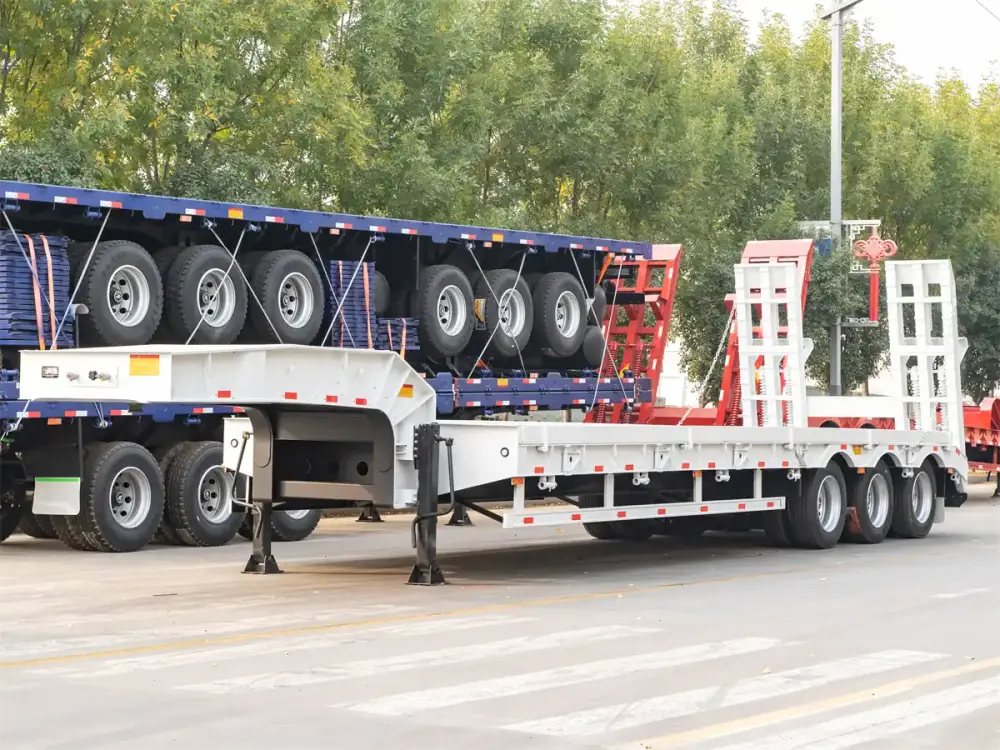 4 Axle Low Bed Trailer with Rear Ramps
What Is an RGN Trailer?
The first detachable gooseneck trailer appeared in 1958. It was built to solve a specific problem: loading tall, heavy cargo that couldn't be crane-lifted onto a standard trailer.
The gooseneck is the angled front section connecting the trailer to the tractor's fifth wheel. On an RGN trailer, this section detaches using a hydraulic system. With the gooseneck removed, the front of the deck lowers to the ground, forming a gentle slope. Any self-propelled equipment can then roll straight onto the deck from the front.
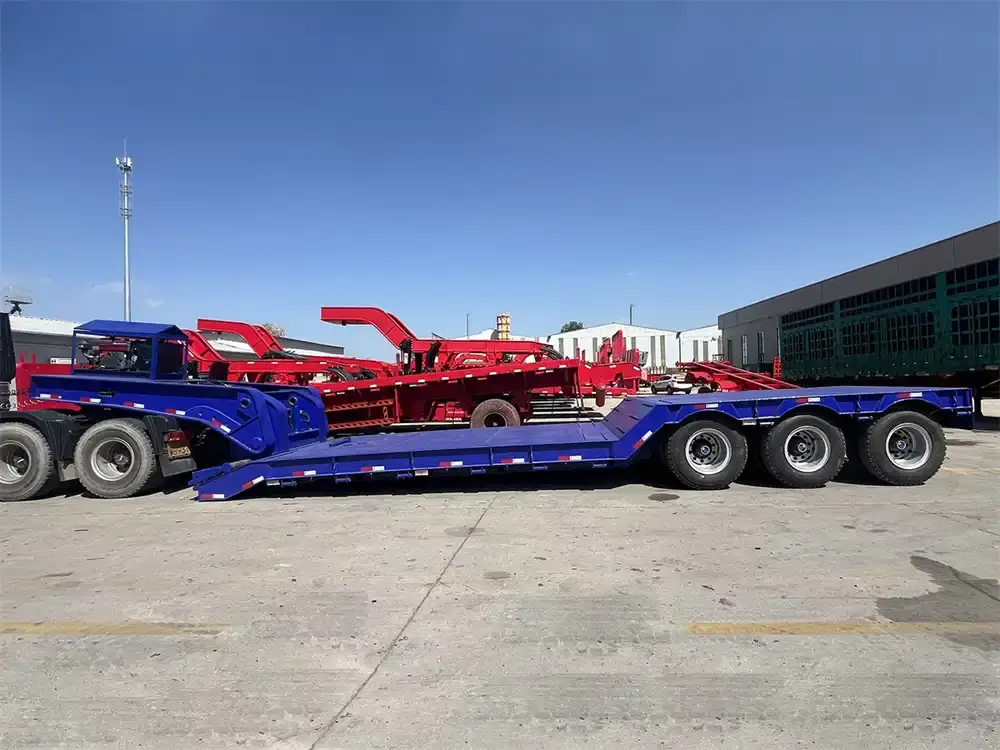 4 Axle RGN Trailer with Detachable Gooseneck
RGN trailers are widely used for hauling construction equipment, heavy machinery, and oversized industrial loads. The ability to load from the front without lifting equipment makes them the go-to choice for heavy haul operations around the world.
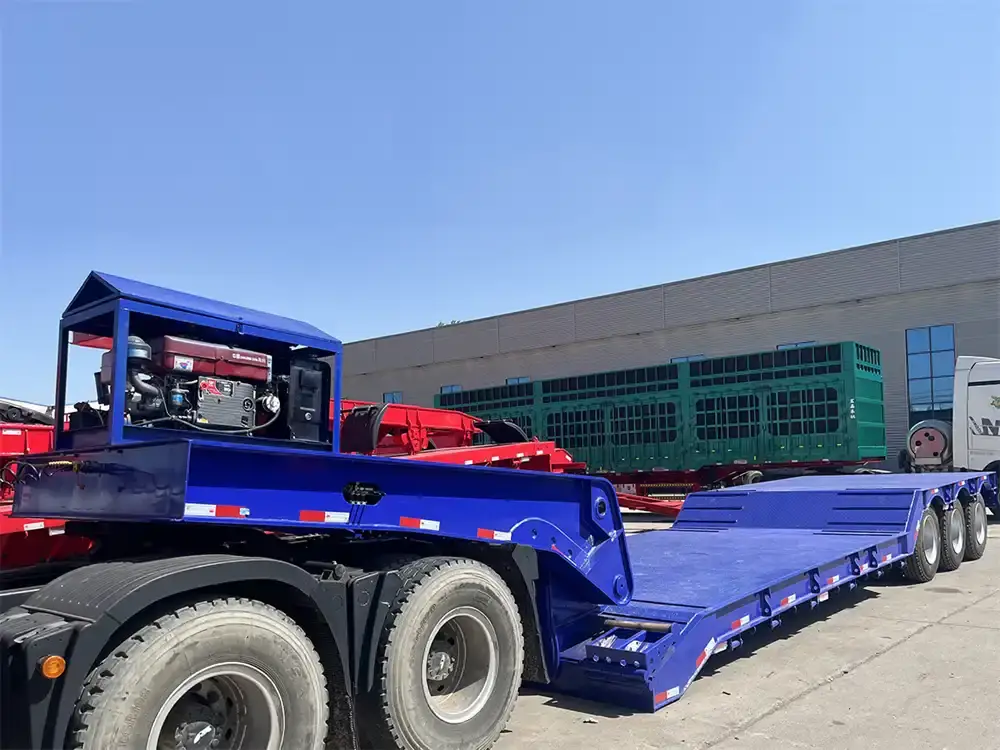 RGN Trailer with Hydraulic Power Unit
You can also add extra axles to handle heavier cargo. A standard 3-axle RGN carries up to 50 tons. Move to a 4-axle configuration and that number jumps to 80 tons or more.
Get a quote for an RGN or low bed trailer
Advantages of RGN Trailers
- Ground-level front loading — Detach the gooseneck and drive equipment directly onto the deck. No crane, no ramp, no extra crew.
- Higher weight capacity — Add axles as needed. Multi-axle RGN trailers handle 60 to 80+ tons, well beyond a standard lowboy.
- Low deck height — The deck sits roughly 450 to 600 mm (18 to 24 inches) off the ground, leaving more vertical clearance for tall cargo under overhead limits.
- Excellent stability — A low center of gravity keeps heavy loads balanced during transport, even at highway speed.
- Wide cargo range — Tracked excavators, wheeled loaders, mobile cranes, road rollers, and virtually any self-propelled or towed machine can be loaded.
RGN Trailer Specifications, Capacity, and Dimensions
HUAYU manufactures RGN trailers in several capacity ranges. The tables below cover our 30-ton, 50-ton, and 80-ton models.
30T RGN Trailer Specifications
| Parameter | Value |
|---|---|
| Dimension | 11,000-16,000 mm x 3,000-3,500 mm x 1,650 mm |
| Loading Capacity | 20-30 T |
| Axle | 2 units, 13T BPW / FUWA / Chinese brand |
| Rim | 6.5-20 / 7.5-20 / 8.00-20 / 8.5-20 |
| Suspension | Dual-axle mechanical or air suspension (BPW) |
| Tires | 8.25R20, 11.00R20, 12.00R22.5 |
| King Pin | JOST 2.0" or 3.5" (bolted or welded) |
| Main Beam | Height 450-580 mm, Q345B steel |
| Side Beam | 16-30 mm I-beam steel |
| Ladder | Manual or hydraulic |
| Gooseneck | Hydraulic detachable |
| Brake System | WABCO |
| Light | LED |
| Voltage | 24V |
| Surface | Sandblasted + 1 anticorrosive primer + 2 topcoats |
50T RGN Trailer Specifications
| Parameter | Value |
|---|---|
| Dimension | 11,000-16,000 mm x 3,000-3,500 mm x 1,650 mm |
| Loading Capacity | 40-50 T |
| Axle | 3 units, 13T BPW / FUWA / Chinese brand |
| Rim | 6.5-20 / 7.5-20 / 8.00-20 / 8.5-20 |
| Suspension | Tri-axle mechanical or air suspension (BPW) |
| Tires | 8.25R20, 11.00R20, 12.00R22.5 |
| King Pin | JOST 2.0" or 3.5" (bolted or welded) |
| Main Beam | Height 450-580 mm, Q345B steel |
| Side Beam | 16-30 mm I-beam steel |
| Ladder | Manual or hydraulic |
| Gooseneck | Hydraulic detachable |
| Brake System | WABCO |
| ABS | WABCO |
| Light | LED |
| Voltage | 24V |
| Surface | Sandblasted + 1 anticorrosive primer + 2 topcoats |
80T RGN Trailer Specifications
| Parameter | Value |
|---|---|
| Dimension | 11,000-16,000 mm x 3,000-3,500 mm x 1,650 mm |
| Loading Capacity | 60, 70, 80 T |
| Axle | 13T or 16T BPW / FUWA / Chinese brand |
| Rim | 6.5-20 / 7.5-20 / 8.00-20 / 8.5-20 |
| Suspension | Tri-axle or four-axle mechanical or air suspension (BPW) |
| King Pin | JOST 2.0" or 3.5" (bolted or welded) |
| Main Beam | Height 450-580 mm, Q345B / Q460 steel |
| Side Beam | 16-30 mm I-beam steel |
| Ladder | Manual or hydraulic |
| Gooseneck | Hydraulic detachable |
| Tires | 8.25R20, 11.00R20, 12.00R22.5 |
| ABS | WABCO |
| Light | LED |
| Voltage | 24V |
| Surface | Sandblasted + 1 anticorrosive primer + 2 topcoats |
View our full range of RGN and low bed trailers
What Is a Lowboy Trailer?
A lowboy trailer (also called a low bed trailer or low loader) has a deck that sits much lower than a standard flatbed. The first lowboy appeared in the 1920s with riveted goosenecks and solid rubber tires. Modern designs are far more advanced, but the core purpose hasn't changed: carrying tall, heavy cargo that won't fit on a regular trailer.
The low deck height, typically 450 to 600 mm (18 to 24 inches) off the ground, gives lowboy trailers a clear advantage when height matters. If your load is too tall for a flatbed or step-deck trailer, a low bed trailer brings the total height down to stay within legal road limits.
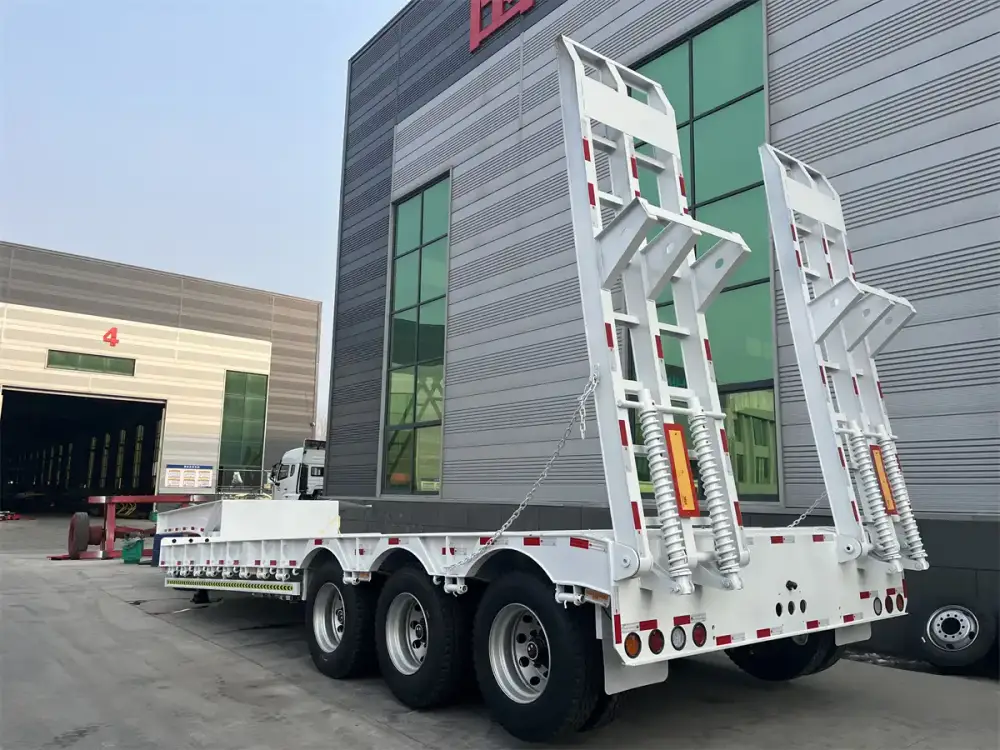 3 Axle 60 Ton Low Bed Trailer with Spring Ramps
Lowboy Trailer Capacity
- 2-axle lowboy: 20 to 40 tons, suitable for lighter equipment
- 3-axle lowboy: 40 to 60 tons, the most common setup for mid-range loads
- 4-axle lowboy: 60 to 100+ tons, built for heavy construction and mining machinery
Deck lengths typically range from 8 to 14 meters. Unlike RGN trailers, standard lowboy trailers have a fixed gooseneck, so all loading happens from the rear through ramps or with crane assistance.
If you need a low bed trailer to move bulldozers, excavators, or industrial equipment, contact us for a custom quote.
RGN Trailer vs Lowboy Trailer: Key Differences
The table below summarizes the main differences between RGN and lowboy trailers. A detailed breakdown of each point follows.
| Feature | RGN Trailer | Lowboy Trailer |
|---|---|---|
| Loading method | Gooseneck detaches; front loading at ground level | Fixed gooseneck; rear loading with ramps or crane |
| Weight capacity | 50 to 80+ tons (multi-axle) | 20 to 60 tons (standard) |
| Deck height | 450-600 mm (18-24 in) | 450-600 mm (18-24 in) |
| Cost | Higher (hydraulic mechanism adds cost) | Lower (simpler fixed-neck design) |
| Stability | Low center of gravity, excellent under heavy loads | Good, but slightly higher center at the gooseneck |
| Typical cargo | Self-propelled machines, oversized equipment | General heavy equipment, prefab structures |
| Axle options | 2 to 4+ axles | 2 to 4 axles |
| Loading speed | Fast, drive-on with no extra equipment | Slower, needs ramps or crane |
| Best for | Construction, mining, heavy haul, military | Standard machinery transport, height-restricted routes |
Gooseneck Design
The key feature of an RGN trailer is its detachable gooseneck. Once removed, the front of the deck drops to the ground. Self-propelled machines drive on from the front without needing any lifting equipment. This is a major time and cost saver on job sites.
A lowboy trailer has a fixed gooseneck. All loading and unloading happens from the rear, usually through fold-down ramps or with crane assistance. This keeps the mechanical design simpler but makes loading heavier, self-propelled machines more difficult.
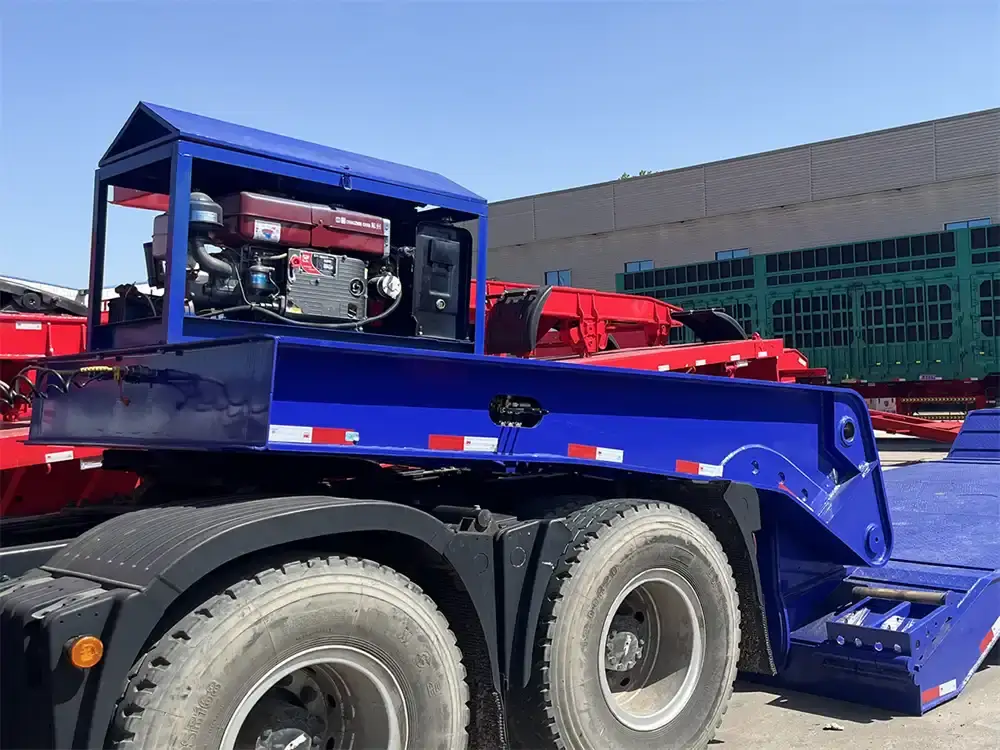 Hydraulic Detachable Gooseneck Close-Up
Weight and Height Capacity
Both trailer types sit low to the ground, with deck heights around 450 to 600 mm. The real difference is in how much weight they carry.
RGN trailers are engineered for heavier payloads. A 3-axle RGN handles up to 50 tons. Add a fourth axle and you reach 80 tons or more. HUAYU uses high-strength Q345B or Q460 steel for the main beams, so the frame holds up under these heavy loads without flexing.
Standard lowboy trailers carry 20 to 40 tons on two axles, or up to 60 tons on three axles. For payloads beyond 60 tons, an RGN is usually the better option.
That extra capacity comes at a higher price. The hydraulic detachment mechanism, the power unit that drives it, and the heavier frame all add to the manufacturing cost of an RGN trailer.
Loading Method and Speed
This is where RGN trailers deliver the biggest practical advantage. Detach the gooseneck, lower the deck, and drive the equipment straight on. No crane rental, no extra crew, no waiting around.
With a lowboy, rear-loading through ramps works fine for tracked machines that can climb. But for wheel loaders, mobile cranes, or other large rolling equipment, an RGN's front-loading design gets the job done faster and with less risk of damage.
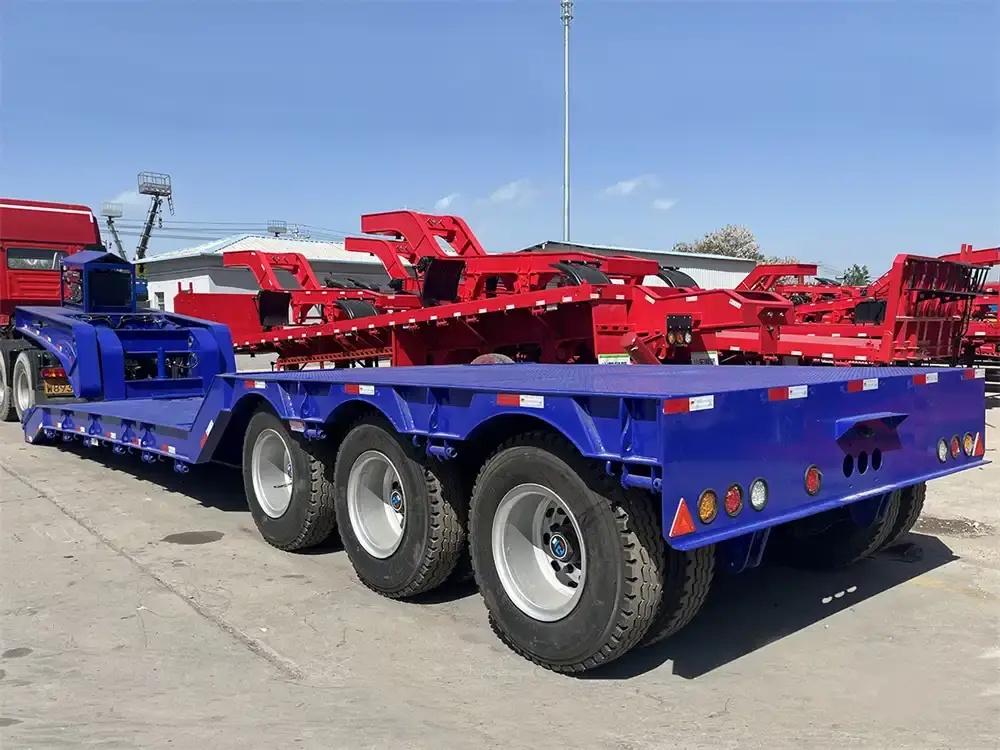 RGN Trailer Low Deck for Stable Heavy Transport
Stability During Transport
Both trailers benefit from a low center of gravity by design, but RGN trailers tend to perform better under extreme loads. The detachable gooseneck places the connection lower, and the reinforced frame distributes weight more evenly across the axles.
This shows up most with oversized, top-heavy cargo. Better weight distribution means safer highway speeds and fewer load-shift problems during transit.
Number of Axles
Standard lowboy trailers come with 2 or 3 axles. RGN trailers usually start at 3 and can be built with 4 or more for extreme payloads.
Each additional axle adds roughly 13 to 16 tons of carrying capacity and spreads the load over a wider footprint. That helps meet weight-per-axle road regulations, which vary by country.
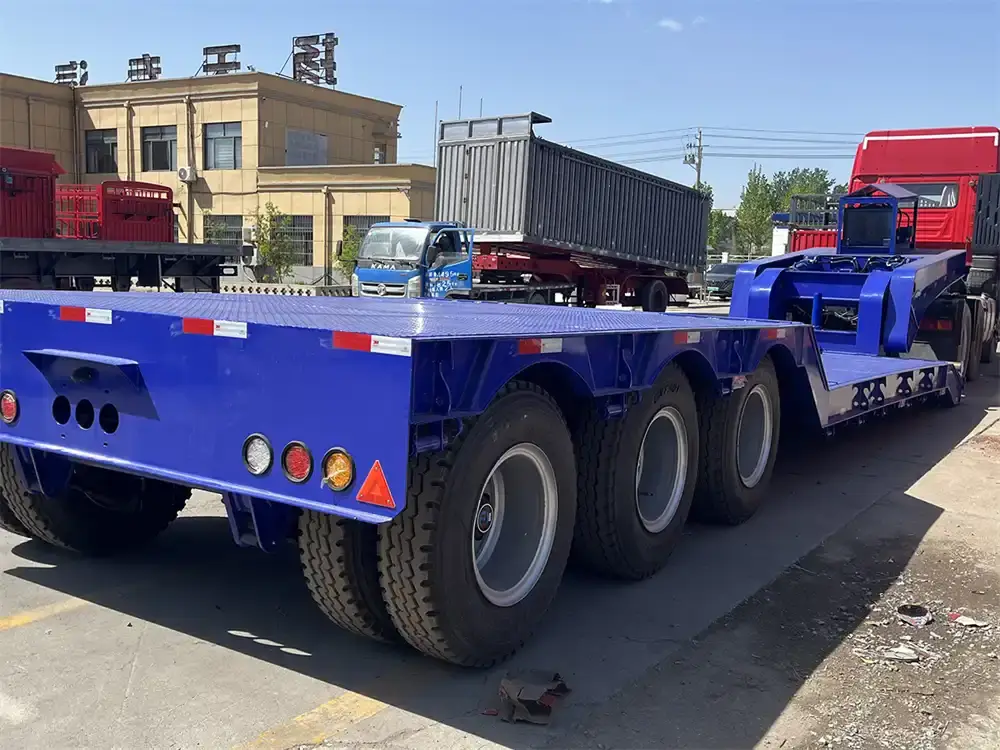 3 Axle Removable Gooseneck Trailer
Construction and Build Quality
RGN trailers use heavier construction overall. The hydraulic gooseneck and front-loading design require thicker main beams (Q345B or Q460 steel, 450 to 580 mm height), reinforced side beams, and a stiffer frame.
Lowboy trailers use similar materials but can get away with a lighter build since they don't need to support the hydraulic system or the stresses that come with front-end loading.
Get a quote for an RGN or low bed trailer
How to Choose Between an RGN and a Lowboy Trailer
The right trailer depends on what you're hauling and how you need to load it.
Pick an RGN trailer when:
- Your equipment is self-propelled and can drive onto the trailer
- Loads regularly exceed 40 tons
- You haul oversized construction or mining machinery
- Fast loading and unloading without crane assistance matters to your schedule
- You work in construction, mining, or military transport
Pick a lowboy trailer when:
- Loads stay under 40 tons
- You don't need front-loading capability
- Budget is a major factor
- Your cargo can be loaded from the rear using ramps
- You transport general machinery or prefabricated structures
Many fleet operators run both types. Lowboys handle everyday loads, while RGN trailers step in for heavy, oversized jobs that need front loading.
Browse our 4-axle removable gooseneck trailer and 120-ton detachable gooseneck lowboy, or explore the full low bed trailer lineup.
Frequently Asked Questions
What does RGN stand for?
RGN stands for Removable Gooseneck. The gooseneck is the angled front section that connects to the tractor. On an RGN trailer, it detaches hydraulically so the deck can lower to the ground for drive-on loading.
How much weight can an RGN trailer carry?
It depends on the axle count. A 2-axle RGN handles 20 to 30 tons, a 3-axle model carries up to 50 tons, and a 4-axle setup reaches 80 tons or more. More axles can be added for even heavier loads.
Can you load an RGN trailer from both ends?
Yes. The front loads through the detachable gooseneck ramp. Most RGN trailers also have rear ramps or can accept rear loading with a crane. For self-propelled machines, front loading is faster and doesn't need extra equipment.
Is an RGN trailer more expensive than a lowboy?
Generally, yes. The hydraulic gooseneck mechanism, power unit, and heavier frame raise the price compared to a fixed-neck lowboy. That said, the operational savings from not renting cranes and loading faster often make up the difference over time.
What cargo works best on an RGN trailer?
Excavators, bulldozers, wheel loaders, mobile cranes, road rollers, and any self-propelled heavy machine. RGN trailers also handle oversized industrial components, military vehicles, and loads that exceed standard lowboy capacity.
Conclusion
RGN trailers and lowboy trailers both use low-profile decks for heavy and oversized cargo, but they solve different problems. The RGN's detachable gooseneck means ground-level front loading, higher capacity, and faster turnaround, at a higher upfront cost. Lowboy trailers are simpler, more affordable, and handle most standard equipment transport needs.
Match the trailer to your cargo based on weight, dimensions, loading method, and budget. If you're not sure which type fits your situation, send us your cargo details and our engineering team will recommend the right configuration.
Continue Reading
Aug 28, 2026
What Is a Side Loader Trailer? Container Side Lifter Design & Specs
What a side loader trailer (container side lifter) is, how it works, main types, design features, full specs, benefits, applications, and buyer answers.
Apr 4, 2026
How to Buy a Fuel Tank Trailer?
Practical guide to buying a fuel tank trailer: materials (carbon steel vs aluminum vs stainless steel), tank shapes, loading systems, safety equipment, and real pricing.
Apr 4, 2026
How to Choose a Reliable Semi Trailer Manufacturer
A practical guide to evaluating semi trailer manufacturers in China — what to check on procurement, engineering, quality control, export experience, and after-sales support before placing your order.