
What Should You Pay Attention to When Buying a Tanker Trailer for the First Time?
Published Apr 4, 2026
25 engineers · ISO 9001 · 3C certified · Liangshan factory since 2001
Updated 2026-05-11
9 min read
Your first tanker trailer purchase has more ways to go wrong than a flatbed or side wall order. Pick the wrong tank material and corrosion eats through the wall in a few years. Get the compartment layout wrong and you need a second trip for every load. Skip the baffles and you are dealing with dangerous surge forces on the highway every time you brake. These are expensive mistakes, and most of them happen because first-time buyers do not know which questions to ask.
We put this guide together based on the problems we see most often at our factory. If you get these decisions right before placing an order, the tanker you receive will match your operation from day one.
Choose the Right Supplier
Fuel tanker trailer suppliers split into two categories: manufacturers and trading companies. As a first-time buyer, this distinction matters more than you might think.
Why a Manufacturer Is the Safer Choice
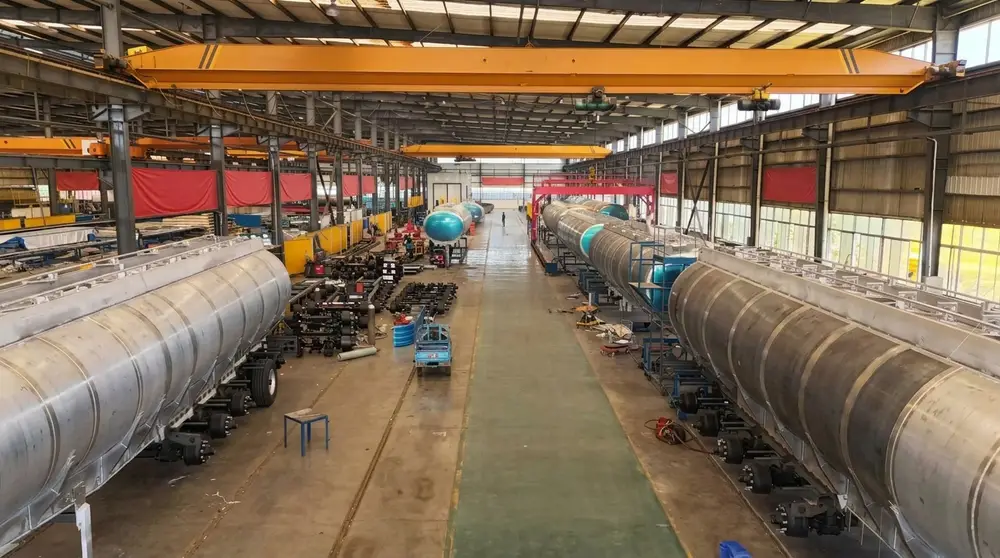
Traceability from steel plate to finished tank. A manufacturer controls the full production chain. At our Liangshan facility, every Q235 carbon steel plate and 5182 aluminum sheet is traceable to the mill certificate. Every weld runs through visual and ultrasonic inspection before the tank moves to the next station. Trading companies buy finished product from whoever offers the lowest price that month — they cannot tell you where the steel came from or who inspected the welds.
Lower price at the same spec. We buy raw materials in bulk — steel plate, axles, tires, valves — at wholesale pricing. On a standard 40,000L carbon steel tanker, the factory-direct price runs 15-25% below what a trading company charges for the same configuration. That gap widens on aluminum builds where raw material is a bigger share of total cost.
Engineering input before production starts. Our engineers have sized tankers for everything from 20,000L gasoline delivery runs in West Africa to 60,000L bitumen haulers headed for Central Asia. Tell us your cargo, route conditions, and local weight limits, and we can flag problems in your spec before cutting steel — not after delivery.
Factory visits. A real manufacturer will invite you to the production floor. You can watch your tank being rolled, walk the weld inspection line, and check the hydrostatic pressure test on a finished unit. If a supplier will not let you visit, that tells you something. For a deeper look at how to separate real factories from resellers, read our guide on how to choose a reliable semi-trailer manufacturer.
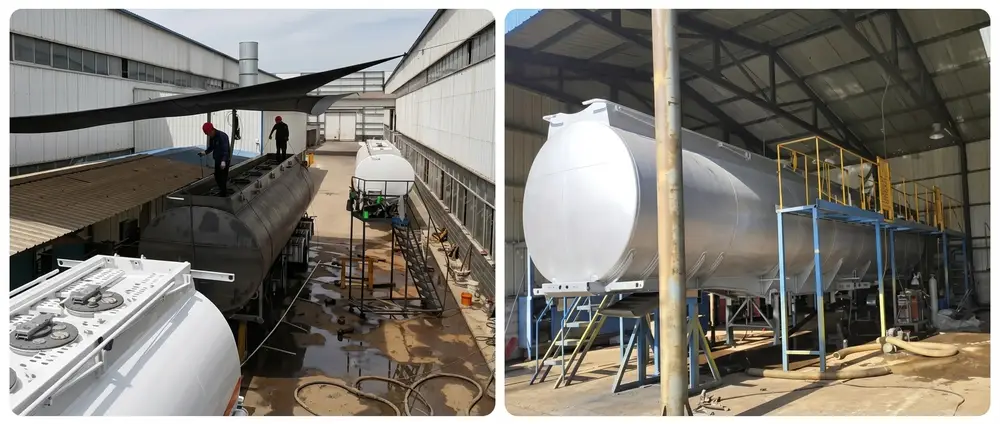 Tanker trailer manufacturing and quality inspection at HUAYU factory
Confirm the Key Specifications
A tanker is not a general cargo trailer. It carries hazardous or high-value liquids under pressure and vibration, and the quality of the build directly affects driver safety. The following specs need to be locked down before production starts.
Tank Volume and Material
This is the decision that sets the price, payload, and service life of the entire trailer. Tank volumes for export markets generally range from 20,000 to 60,000 liters. The material choice breaks down into three options:
| Material | Grade / Thickness | Empty Tank Weight (40,000L) | Price Range | Best For |
|---|---|---|---|---|
| Carbon steel | Q235, 5-6mm | ~5,500 kg | $16,900 - $20,000 | Diesel, gasoline, standard petroleum |
| Aluminum alloy | 5182/5083, 6-7mm | ~3,200 kg | $24,000 - $28,000 | Weight-sensitive routes, gasoline (non-sparking) |
| Stainless steel | 304/316, 5-6mm | ~5,800 kg | $28,000 - $35,000 | Chemicals, food-grade liquids, heated bitumen |
Carbon steel is the workhorse — cheapest upfront, strong, and handles standard petroleum products without issues. The tradeoff is weight. You carry 2,000-3,000 kg more tank than an equivalent aluminum build, which means 2-3 fewer tonnes of cargo per trip. Over 200+ monthly loads, that adds up fast.
Aluminum costs more upfront but the 40-50% weight savings often pays for itself within a few years through higher payload and lower fuel consumption. It is also non-sparking on impact, which some markets require for gasoline transport. A 45,000L aluminum fuel tanker is the typical choice for operators running weight-regulated highway routes.
Stainless steel only makes sense when the cargo demands it — acids, caustic chemicals, edible oils, or heated bitumen. A stainless steel insulated tanker runs $28,000-35,000 but handles corrosive products that would eat through carbon steel in months. For straight diesel and gasoline, stainless is overkill. For a more detailed breakdown of material trade-offs, see our fuel tank trailer buying guide.
Number of Compartments and Discharge Ports
Most export-market tankers run 3 to 6 compartments. The most common configuration we build for fuel distributors is a 40,000L tank with 4 compartments (roughly 10,000L each) — this lets you carry diesel, gasoline, and kerosene on the same load without mixing. Each compartment gets its own discharge valve, manhole cover, and baffle system.
Adding compartments does increase cost — each partition board is individually welded, pressure-tested, and fitted with its own baffles. But the ability to deliver multiple products in a single trip almost always makes the extra cost worthwhile for fuel distribution operations.
If you only transport one product type (for example, crude oil or water), a single-compartment tank is simpler, cheaper, and faster to load and discharge.
Insulation Layer
If ambient temperatures on your routes drop below 5 degrees C, insulation is not optional for bitumen, heavy fuel oil, or palm oil. These products gel inside the tank and will not discharge through the valves.
Standard insulation is 80-100mm polyurethane foam wrapped in a stainless steel outer jacket. It holds product temperature within 3-5 degrees C of loading temperature over an 8-hour transit. We spec this on every heated-product tanker shipping to Central Asia and northern markets.
If you only carry diesel or gasoline, skip the insulation — these fuels flow freely well below freezing.
Wave-Breaking Plates (Baffles)
Baffles are internal plates welded inside each compartment. They reduce liquid sloshing during braking, acceleration, and lane changes. A partially loaded tanker without baffles is genuinely dangerous — 20,000 liters of liquid surging forward during a hard stop shifts the trailer's center of gravity by hundreds of millimeters in less than a second.
A standard configuration is 3-5 baffles per compartment, spaced evenly along the tank length. Each baffle has flow holes sized to allow the liquid through during loading and discharge while still breaking surge forces during driving. Every tanker we build includes baffles as standard — if a supplier quotes you a price without them, that is a red flag.
Axles
Axle choice comes down to where the trailer will run. FUWA 13-tonne axles are the standard for Africa, the Middle East, and Southeast Asia — parts are stocked by dealers in virtually every market, and replacement components are affordable. BPW axles cost $800-1,200 more per set but offer longer service intervals and are preferred by some operators with European connections.
For tankers over 50,000L, we typically spec 3-axle or 4-axle configurations depending on payload and local road weight limits. On lighter loads or shorter routes, a 2-axle setup with FUWA 16-tonne axles saves money upfront and reduces tire costs.
Tires
We default to 12R22.5 Triangle or Double Coin tires on export tankers. Both brands hold up on unpaved secondary roads and are priced competitively. If you are running highways exclusively, Zhongce Chaoyang radials at a similar price point give slightly better fuel economy.
Tell your supplier what roads the trailer will actually run on. The wrong tire choice on rough laterite or gravel roads burns through a set far faster than it should.
Safety Equipment
First-time buyers sometimes overlook safety equipment because it adds cost. Do not skip these:
- Emergency shut-off valves on every compartment outlet — pneumatic or spring-loaded, they close in under 3 seconds if a hose ruptures
- Anti-lock braking (ABS) — a loaded tanker at 42 tonnes brakes very differently from an empty one at 14 tonnes
- Static grounding equipment — fuel flowing through pipes generates static charge, and a single spark near a vapor-rich opening causes ignition
- Reflective markings and hazmat placards — required for road transport of dangerous goods in most countries
For a complete safety equipment checklist, see our article on oil tank semi-trailer quality inspections.
Inspect Thoroughly After Delivery
After the tanker trailer arrives at your location, do not sign off until you have checked it against the contract specifications. Here is what to look for:
Open every manhole cover and look inside. Check each compartment for weld spatter, grinding marks, or debris that should have been cleaned during finishing. Clean compartments tell you the factory's quality standards held through the final production stage.
Cycle every discharge valve open and closed. Valves should move smoothly without binding or excessive force. A valve that is stiff on delivery will seize after a few months of product exposure.
Check axle and tire brands against your purchase order. Verify not just the brand name but the specific model number. Component substitutions happen, especially with no-name parts swapped in for the branded components you paid for.
Measure the actual tank dimensions. Compare against the spec sheet. Volume claims can be inflated by 2,000-3,000 liters on low-quality builds. If you ordered 40,000 liters, confirm you are getting 40,000 liters.
Cycle the landing gear fully up and down. Listen for grinding or uneven resistance — these indicate a bent screw shaft that will fail under load.
Run the discharge system. If possible, fill the tank with water and run a full discharge through every valve and hose connection. This catches leaks, valve alignment issues, and flow restrictions before you load real product.
If anything does not match the agreed spec, document it with photos and notify the supplier immediately. Timely communication prevents small issues from turning into costly disputes. Most manufacturers — including us — will resolve legitimate discrepancies quickly, but only if you report them before the warranty window closes.
Buying a tanker trailer for the first time does not have to be complicated if you ask the right questions upfront. Browse our full range of fuel tanker trailers to see current models and pricing, or contact our team to discuss a build that matches your exact operation.
Continue Reading
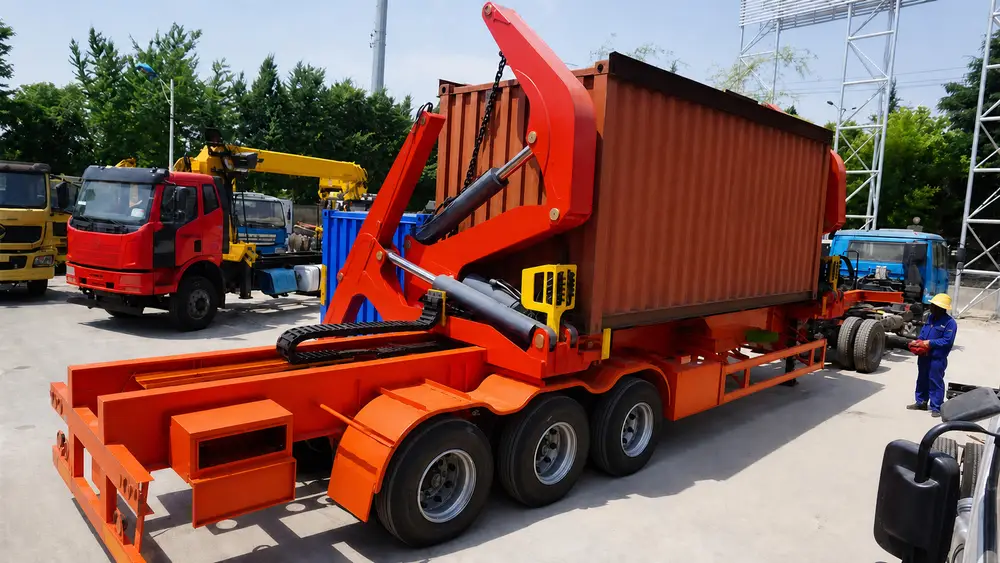
Aug 28, 2026
What Is a Side Loader Trailer? Container Side Lifter Design & Specs
What a side loader trailer (container side lifter) is, how it works, main types, design features, full specs, benefits, applications, and buyer answers.
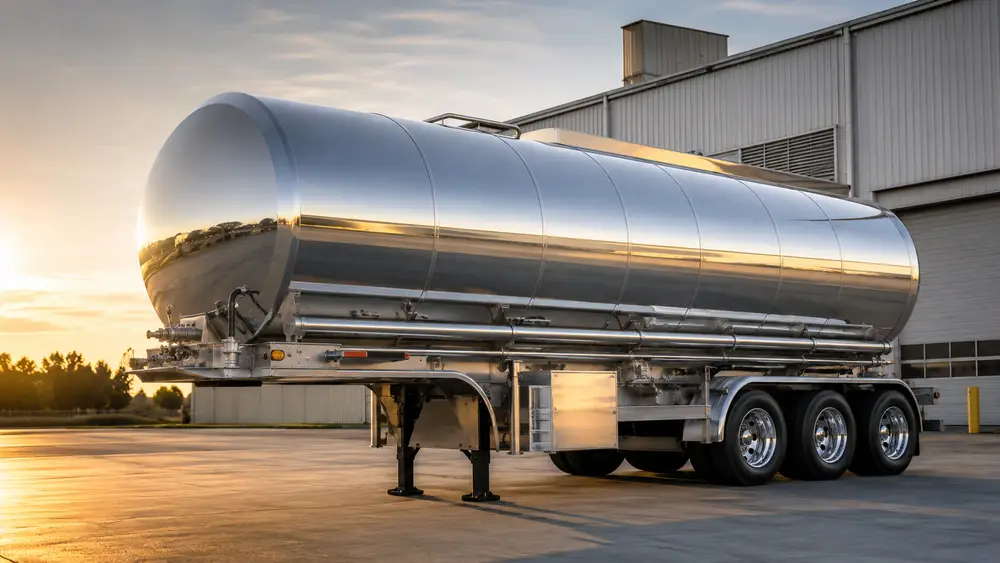
May 7, 2026
How Does a Tanker Trailer Work? A Manufacturer's Mechanical Walkthrough
How does a tanker trailer work? A factory engineer walks through baffles, bottom valves, vapor recovery, pumps, and the surge physics that makes tankers tip over.
Apr 9, 2026
What Is an RGN Trailer? How Is It Different from a Low Bed Trailer?
Learn the key differences between RGN (removable gooseneck) trailers and lowboy trailers — specs, capacity, cost, stability, and front-loading vs rear-loading.