
How to Buy a Fuel Tank Trailer?
Published Apr 4, 2026
25 engineers · ISO 9001 · 3C certified · Liangshan factory since 2001
Updated 2026-05-11
10 min read
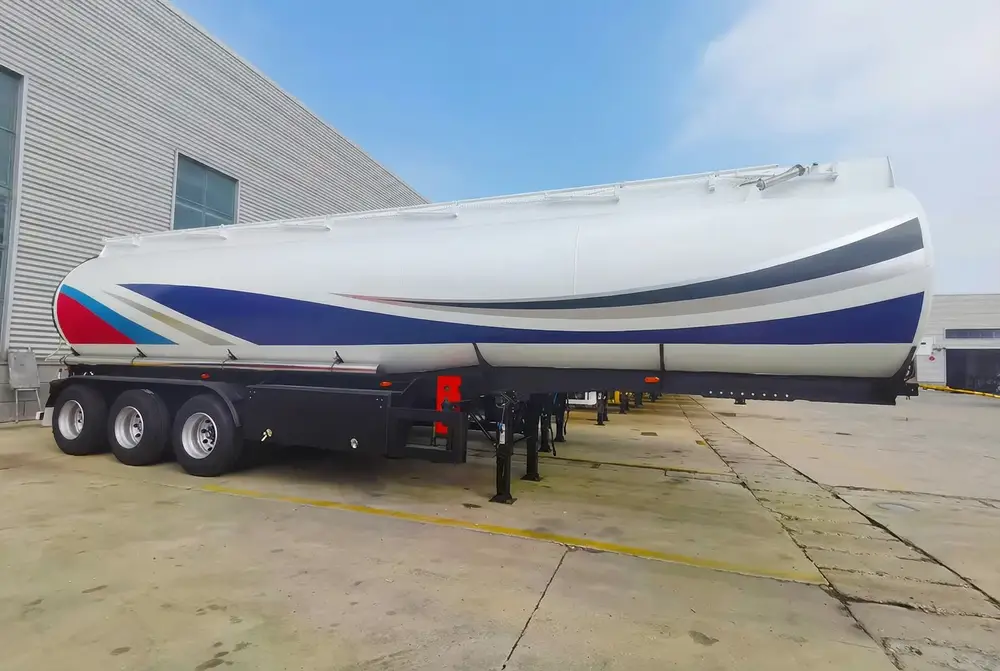
Buying a fuel tank trailer is not like buying a flatbed. Get the material wrong and corrosion eats through the tank wall in three years. Pick the wrong loading system and you're dealing with vapor buildup every time the truck pulls into a depot. The stakes are higher because the cargo is hazardous — gasoline, diesel, benzene, crude oil — and a single leak can shut down an entire operation.
This guide covers the decisions that actually matter: tank material, shape, wall thickness, loading method, and safety equipment. We'll skip the generic advice and focus on what experienced fleet operators look for before signing a purchase order.
What Materials Are Used for Fuel Tank Trailers?
Three materials dominate fuel tank trailer manufacturing. Each has a clear use case, and picking the wrong one costs you either money upfront or money over the trailer's life.
Carbon Steel
Most fuel tank trailers on the road today are carbon steel. The standard grade is Q235, rolled to 5mm wall thickness. It handles gasoline, diesel, and most petroleum products without issue.
The reason is simple: carbon steel is cheap and strong. A 3-axle 40,000L carbon steel tanker starts around $16,900 — roughly 35% less than an equivalent aluminum build. For operators running standard diesel and petrol routes where weight limits aren't tight, carbon steel is the right call.
The tradeoff? Weight. A carbon steel tank adds 2,000-3,000 kg over aluminum at the same capacity. That's 2-3 fewer tonnes of cargo per trip, which adds up fast over 200+ monthly loads.
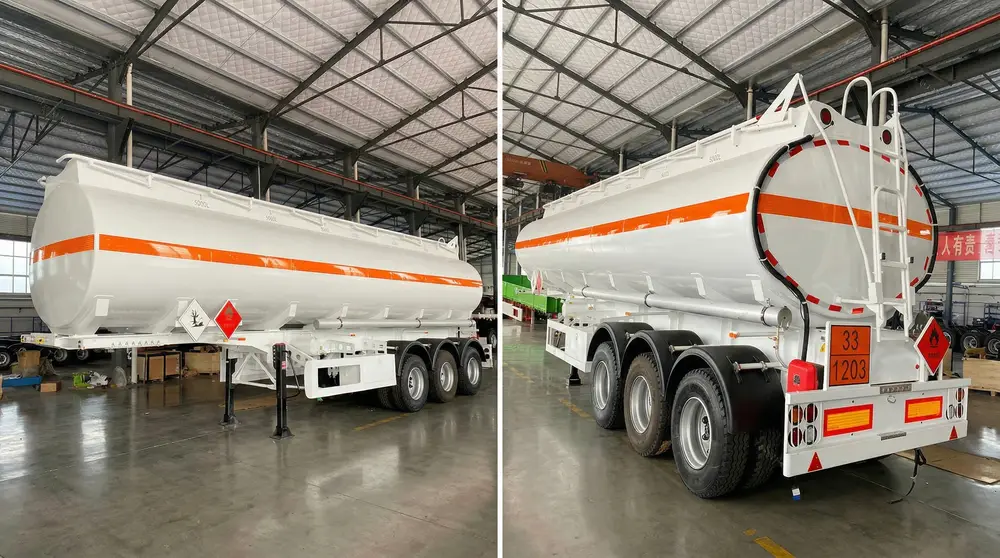 Carbon steel fuel tank trailer
Aluminum Alloy
Aluminum tankers use grades 5182, 5083, or 5454, typically at 6mm thickness. The wall is thicker than carbon steel because aluminum has lower tensile strength — but the finished tank still weighs 40-50% less.
That weight gap changes the economics of every trip. A 45,000L aluminum fuel tanker carries more payload per run, burns less fuel doing it, and puts less wear on tires and brakes. Over a 10-year service life, the fuel savings alone can offset the higher purchase price of around $26,000.
Aluminum also does not spark on impact. For gasoline and ethanol transport, that's not a minor detail — it's a safety requirement in some markets. And when the trailer reaches end of life, aluminum scrap value runs 5-8x higher than carbon steel scrap.
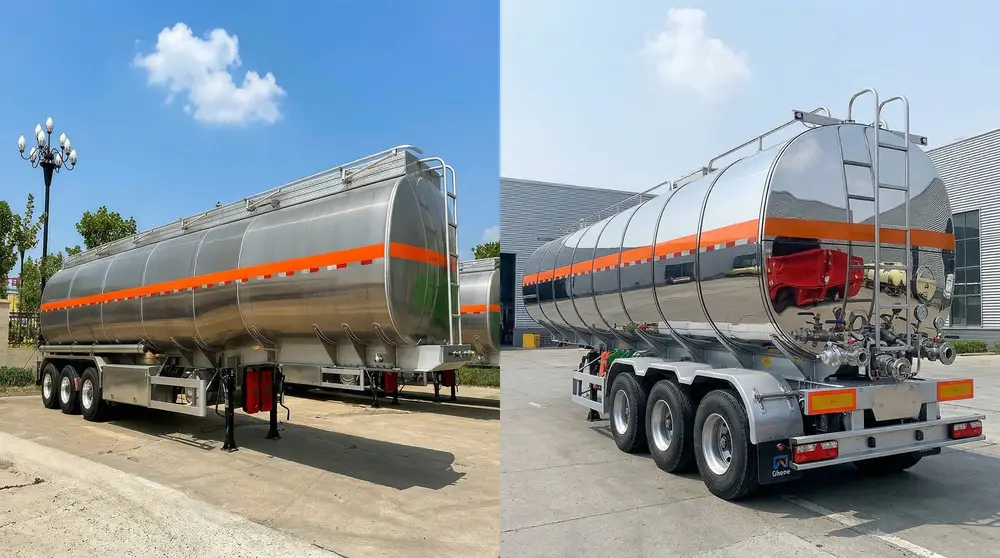 Aluminum alloy fuel tank trailer
Stainless Steel
Stainless steel (grades 304 and 316) costs the most and weighs more than aluminum. So why use it?
Corrosion resistance. 316 stainless handles acids, caustic chemicals, and edible oils that would attack carbon steel within months. A stainless steel insulated tanker at around $30,000 is standard for food-grade liquids, heated bitumen, and chemical transport where contamination risks rule out other materials.
For straight petroleum products — diesel, gasoline, jet fuel — stainless steel is overkill. Carbon steel or aluminum handles these loads at lower cost.
Which Material Should You Choose?
Match the material to the cargo:
| Cargo Type | Best Material | Why |
|---|---|---|
| Diesel, gasoline, petroleum | Carbon steel | Lowest cost, adequate corrosion resistance |
| Diesel, gasoline (weight-sensitive routes) | Aluminum alloy | 40-50% lighter, better payload per trip |
| Edible oils, chemicals, heated bitumen | Stainless steel | Required corrosion and contamination resistance |
| Corrosive liquids (acids, solvents) | Aluminum or 316 stainless | Carbon steel corrodes too fast |
How Does Tank Shape Affect Stability?
Tank shape is not cosmetic. It determines the trailer's center of gravity, rollover risk, and how liquid moves inside the tank during braking and cornering.
Oval / Straight-Bottom
The oval cross-section with a flat bottom is the most common design for petroleum transport. It sits lower on the chassis than a circular tank, which drops the center of gravity by 150-200mm. That difference matters at highway speed with 40,000 liters sloshing inside.
Oval tanks also fill faster because the flat bottom creates a wider opening for bottom-loading connections. Multiple compartments can load simultaneously.
Double Taper
The tank body narrows at both ends. This geometry pushes liquid toward the center drain during unloading, which works well for high-viscosity products like lubricating oil and heated bitumen. Standard oval tanks leave residual product in the corners — double taper designs don't.
The narrowed ends also reduce surge forces during braking. Less liquid momentum hitting the front wall means the driver maintains better control during emergency stops.
Tank Bottom (Sump) Design
Tank bottom trailers have a recessed discharge sump below the main tank floor. Liquid drains by gravity into the sump, bypassing the internal splash baffles that slow flow in conventional straight-bottom tanks.
For low-viscosity fuels — gasoline, ethanol, diesel — this is the fastest unloading configuration. The product flows unimpeded to the outlet valve, cutting discharge time by 20-30% compared to standard bottom-drain designs.
How Thick Should the Tank Wall Be?
Fuel tank trailer walls range from 5mm to 12mm. The right thickness depends on the material and operating conditions.
Carbon steel tanks typically run 5-6mm. Aluminum needs 6-7mm to match the same structural strength. Tanks carrying pressurized or heated cargo — LPG, bitumen — go up to 10-12mm with pressure vessel certification.
Thinner walls save weight but dent more easily during loading and road vibration. A 5mm carbon steel tank that takes a forklift hit at a depot will deform. A 6mm tank in the same spot might not. For operations with rough handling conditions, spending an extra $500-800 on the next thickness grade up is cheap insurance.
Bottom Loading vs Top Loading: Which Is Safer?
Bottom loading wins. No contest.
When fuel enters from the bottom, it displaces air upward through the tank's vapor recovery system. The liquid surface stays below the fill pipe at all times, so fuel vapors stay inside the closed loop. No vapors escape into the atmosphere, and there is no open hatch for ignition sources to reach.
Top loading requires an open manhole. Fuel pours in from above, splashes, and generates vapor that rises out of the hatch into open air. At a busy depot with running engines and electrical equipment nearby, that vapor cloud is a fire hazard. Top loading also loses product to evaporation — anywhere from 0.1% to 0.5% per fill, depending on ambient temperature and fuel volatility.
Bottom loading is faster, too. Closed-system pumping runs at higher flow rates than gravity-assisted top fill, cutting load times by 30-40%.
The only scenario where top loading still makes sense: remote locations without bottom-loading infrastructure. Even then, operators are retrofitting depots to bottom-load because the safety math is that clear.
What Safety Equipment Does a Fuel Tanker Need?
Fuel tankers carry hazardous cargo. The safety equipment list is non-negotiable — skip any item and you risk both lives and your operating license.
- Overflow prevention — Overfill sensors and automatic shut-off valves stop the pump when liquid reaches 95% capacity. Without them, a distracted operator can overflow the tank, spilling diesel or gasoline onto the ground at a loading rack.
- Emergency shut-off valves — Pneumatic or spring-loaded valves on every compartment outlet. They slam closed in under 3 seconds if a hose ruptures or a fire breaks out at the discharge point.
- Fire suppression — Dry chemical extinguishers rated for Class B (flammable liquid) fires, mounted within arm's reach of both the driver's side and curbside discharge points.
- Anti-lock braking (ABS) — A loaded fuel tanker at 42 tonnes stops differently than an empty one at 14 tonnes. ABS prevents wheel lockup across that full weight range, especially on wet roads.
- Static grounding equipment — Fuel flowing through pipes generates static charge. A single spark in a vapor-rich atmosphere causes ignition. Grounding cables and bonding straps bleed off charge before it accumulates to dangerous levels.
- Rollover protection — Internal baffles limit liquid surge to 15-20% of free-surface sloshing. Combined with the oval tank's low center of gravity, this keeps the trailer stable through highway lane changes and exit ramps.
- Reflective markings and placards — ADR/DOT hazmat placards identify the cargo. Reflective tape on the sides and rear makes the trailer visible from 150+ meters at night.
Regular inspection matters as much as the equipment itself. Hoses degrade, valves stick, and grounding cables fray. A monthly inspection cycle catches problems before they become incidents.
What Quality Standards Apply to Fuel Tank Trailers?
Three certifications matter for international fuel tanker operations:
ISO 9001 covers the manufacturing process — weld quality, material traceability, and inspection procedures. Any manufacturer selling to export markets should hold this certification. If they don't, walk away.
ADR (Europe) / DOT (North America) / GB (China) governs road transport of dangerous goods. These standards specify minimum wall thickness, pressure testing requirements, valve types, and marking rules. The specific standard depends on where the trailer will operate.
Pressure vessel certification applies to tanks operating above atmospheric pressure. LPG tankers and some chemical tankers require this. Standard diesel and gasoline tankers at atmospheric pressure do not.
Ask the manufacturer for test certificates: hydrostatic test at 0.036 MPa and pneumatic test at 0.36 KPa are standard for petroleum tankers. No certificates, no sale.
How Much Does a Fuel Tank Trailer Cost?
Pricing depends on material, capacity, compartment count, and brand components. Here are real figures from current production:
| Configuration | Capacity | Material | Price Range |
|---|---|---|---|
| 3-axle standard | 40,000L | Carbon steel (Q235) | $16,900 - $20,000 |
| 3-axle standard | 42,000-45,000L | Aluminum alloy | $24,000 - $28,000 |
| 3-axle insulated | 40,000-45,000L | Stainless steel | $28,000 - $35,000 |
| 4-axle heavy-duty | 50,000L+ | Carbon steel | $22,000 - $28,000 |
Brand components affect the price. A trailer with FUWA axles, JOST landing gear, and WABCO ABS costs $2,000-3,000 more than one with no-name parts. But brand components hold resale value and replacement parts are available globally — which matters when your trailer is running in Nigeria or Kazakhstan, not just on local roads.
Don't buy on sticker price alone. A $16,900 carbon steel tanker that lasts 8 years at $2,100/year total cost beats a $14,000 unit that needs major welding repairs at year 4.
How to Choose a Fuel Tank Trailer Manufacturer
Check three things before choosing a manufacturer:
Production history. How many tankers have they built, and for which markets? A factory that has shipped 500+ fuel tankers to Africa, the Middle East, and Southeast Asia understands the specific road conditions, loading infrastructure, and regulatory requirements in those regions. A factory that only sells domestically may not.
Quality documentation. Request weld inspection reports, material certificates (mill certs for steel plate), and pressure test records for completed units. Manufacturers who test every tank — not a sample — are the ones worth buying from.
After-sales support. Parts availability and technical support matter more after the sale than before it. Ask how they handle warranty claims, what the lead time is for replacement parts, and whether they have service partners in your operating region.
If you are looking for a fuel tank trailer and want to discuss specifications, pricing, or shipping logistics, reach out to our team. We build carbon steel, aluminum, and stainless steel tankers in capacities from 30,000 to 50,000+ liters, and we can walk you through the options that fit your operation.
Continue Reading
Aug 28, 2026
What Is a Side Loader Trailer? Container Side Lifter Design & Specs
What a side loader trailer (container side lifter) is, how it works, main types, design features, full specs, benefits, applications, and buyer answers.
May 7, 2026
How Does a Tanker Trailer Work? A Manufacturer's Mechanical Walkthrough
How does a tanker trailer work? A factory engineer walks through baffles, bottom valves, vapor recovery, pumps, and the surge physics that makes tankers tip over.
Apr 9, 2026
What Is an RGN Trailer? How Is It Different from a Low Bed Trailer?
Learn the key differences between RGN (removable gooseneck) trailers and lowboy trailers — specs, capacity, cost, stability, and front-loading vs rear-loading.