
What Is SPMT? Learn Basics of Self-Propelled Modular Transporters
Published Apr 9, 2026
25 engineers · ISO 9001 · 3C certified · Liangshan factory since 2001
Updated 2026-05-11
16 min read
A self-propelled modular transporter (SPMT) is a platform vehicle with dozens of independently steered wheels, a hydraulic suspension, and its own diesel-powered drive unit. It lifts, carries, and positions loads too heavy for cranes or conventional trailers. A single module handles around 90 tonnes. Bolt several together and the capacity climbs past 20,000 tonnes.
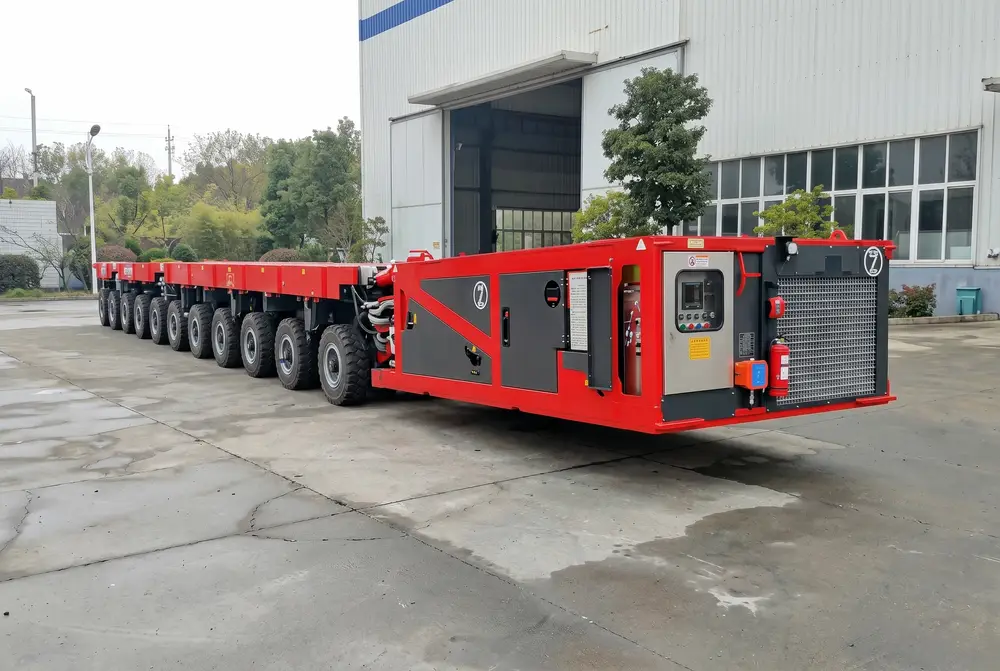 Multi-axle SPMT with Power Pack Unit at factory
In May 2024, a fleet of 880 SPMT axle lines moved 23,163 tonnes across a shipyard in Texas — the heaviest load ever transported on wheels. That record illustrates what these machines are built for, and why shipyards, bridge builders, refineries, and wind farms all rely on them.
Planning a heavy transport project? Contact us for a quote.
What Is a Self-Propelled Modular Transporter?
Scheuerle Fahrzeugfabrik, a German heavy-transport manufacturer founded in 1869, built the first SPMT in 1983. The heavy-lift company Mammoet commissioned the project. They needed a modular platform that could ship inside standard flat-rack containers and reassemble on any job site, so Scheuerle designed each module at exactly 2,430 mm wide — container width.
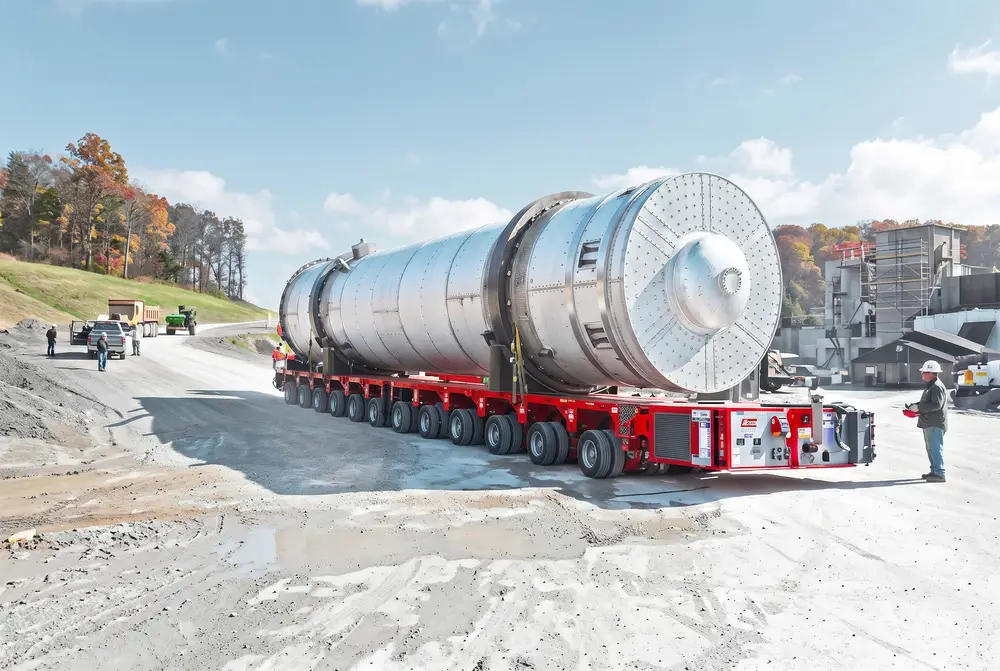 SPMT carrying an industrial pressure vessel
Before the SPMT existed, heavy structures had to be built where they would stand. There was no practical way to move a finished 3,000-tonne refinery module across a plant. The SPMT changed that. Fabrication moved to controlled factory environments, and the finished product rolled to its foundation with a positioning accuracy of ±1 to 2 mm.
The technology caught on fast. By the early 2000s, SPMT fleets operated on every continent. Today, tens of thousands of axle lines are in active service worldwide. The original container-width design has expanded to 3,000 mm wide platforms, split-type modules for narrow corridors, and arctic-rated units built for temperatures as low as -40 °C.
How Does an SPMT Work?
Three systems run the machine: hydraulic suspension, electronic steering, and a diesel-powered Power Pack Unit (PPU). The PPU generates all the hydraulic pressure for steering, braking, lifting, and forward motion through a set of pumps, valves, and cylinders.
Hydraulic Suspension and Lifting
Each axle line rides on its own hydraulic cylinder. The operator can raise or lower any single axle on its own, or adjust all axles together. Total lifting stroke is about 600 mm, with ±350 mm of fine adjustment.
That precision matters. When a crew needs to set a 5,000-tonne module onto foundation bolts, the hydraulics handle the final millimeters. No shims. No guesswork.
Ground is rarely flat on a construction site. The suspension deals with this automatically — if one side of the platform rolls over a bump, the hydraulic system extends the opposite cylinders to keep the deck level and the load stable.
Independent Axle Steering
Every wheel pair rotates on its own. This gives the platform several steering modes:
- Normal steering — front and rear axles turn in opposite directions, like a truck
- Crab steering — all axles point the same way, sliding the whole platform sideways
- Carousel steering — axles angle to spin the platform around a fixed center point
- Diagonal steering — the platform moves at an angle without changing its heading
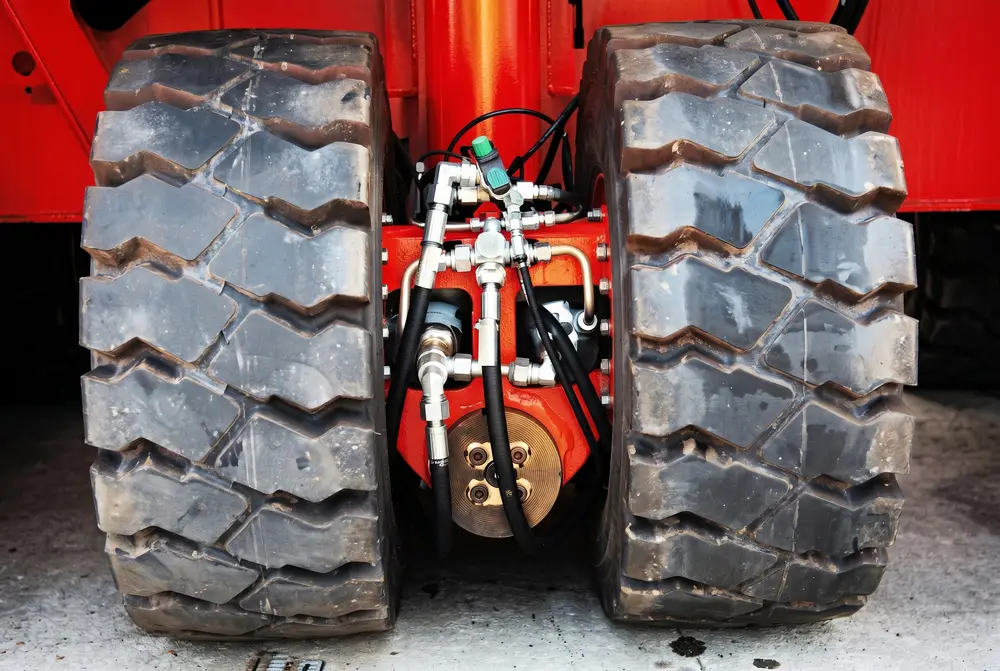 SPMT pendulum axle with hydraulic steering
On electronic steering models, each axle turns up to ±110 degrees. Some models reach +130/-100 degrees. Mechanical steering is more limited at ±55 degrees, but produces more pulling force on slopes.
Modular Coupling
Individual SPMT modules bolt together side by side (lateral coupling) or end to end (longitudinal coupling). A single 6-axle module carries 216 to 334 tonnes depending on the manufacturer. Four of those together pass 1,000 tonnes. For the heaviest jobs, operators assemble hundreds of axle lines into one coordinated fleet.
One person controls the entire assembly through a handheld remote or portable computer terminal. The control system synchronizes steering angles and hydraulic heights across every connected module.
Where Are SPMTs Used?
Four industries account for most SPMT operations: bridge construction, shipbuilding, oil and gas, and energy.
Bridge Construction
The U.S. Federal Highway Administration (FHWA) began promoting SPMT bridge moves in 2004 as part of its Accelerated Bridge Construction (ABC) program. The first SPMT bridge move across a U.S. Interstate happened in 2006 at Graves Avenue over I-4 in Florida.
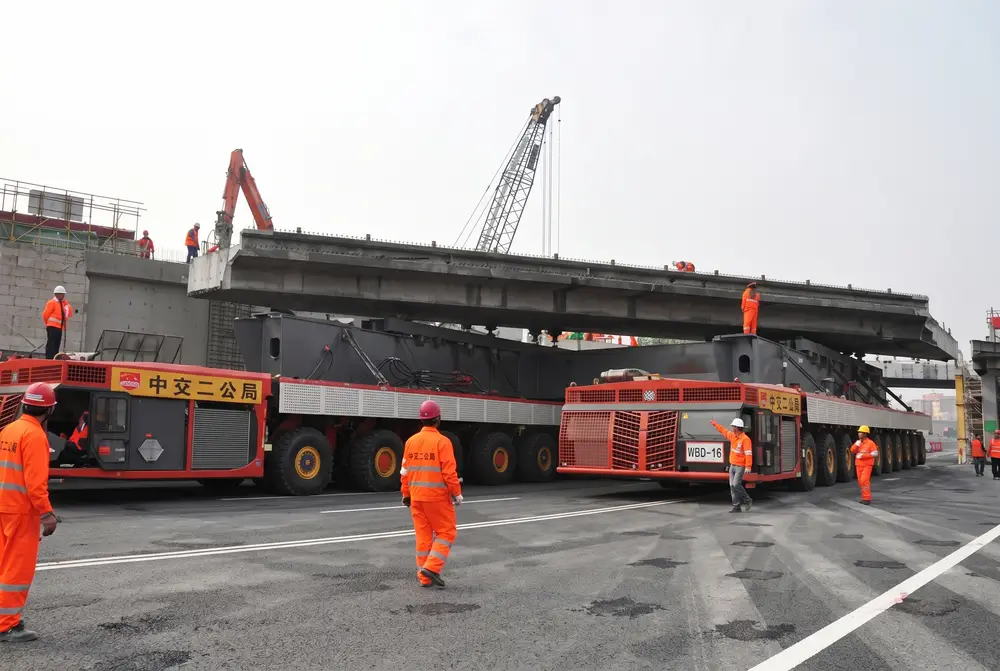 SPMTs moving a prefabricated bridge section
Traditional bridge replacement shuts down a highway for weeks or months while crews pour and cure concrete on-site. SPMTs compress that timeline from months to a single weekend. Workers pour the new section in a staging area next to the highway, let it cure properly, then roll it into position during a short closure. One project placed four bridge sections in just 37 hours over two weekends.
The payoff goes beyond schedule. Pouring concrete in a controlled staging area produces better quality and safer working conditions than pouring over live traffic. State departments of transportation across the U.S. have adopted the method.
Shipbuilding
Shipyards use SPMTs to move hull blocks, engine assemblies, and superstructure modules from fabrication halls to assembly areas. The transporters slide beneath a completed section, lift it with the hydraulic suspension, and carry it to position.
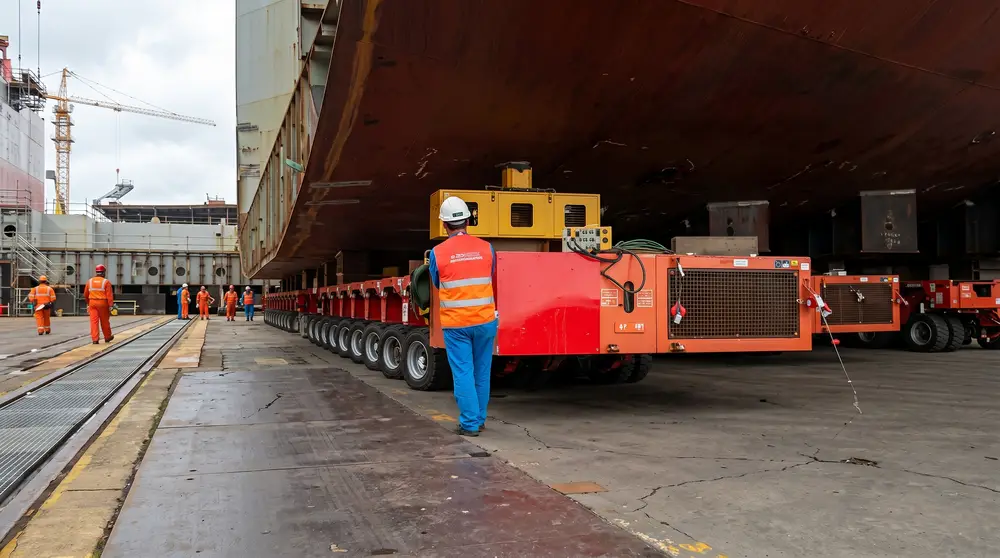 SPMTs positioned under a ship hull in dry dock
At many modern yards, this has replaced overhead gantry cranes for block transport. The savings add up — SPMTs eliminate the need for permanent rail infrastructure and can save millions of dollars per vessel in transport costs alone.
Oil, Gas, and Petrochemical Plants
Refinery turnarounds and LNG plant construction rely on SPMT fleets. Process columns, heat exchangers, and complete plant modules are built at specialized fabrication yards, shipped by barge, and then rolled into final position on SPMTs. In one project in China, 300 axle lines moved a 5,200-tonne LNG module — the heaviest single load transported on land in the country at the time.
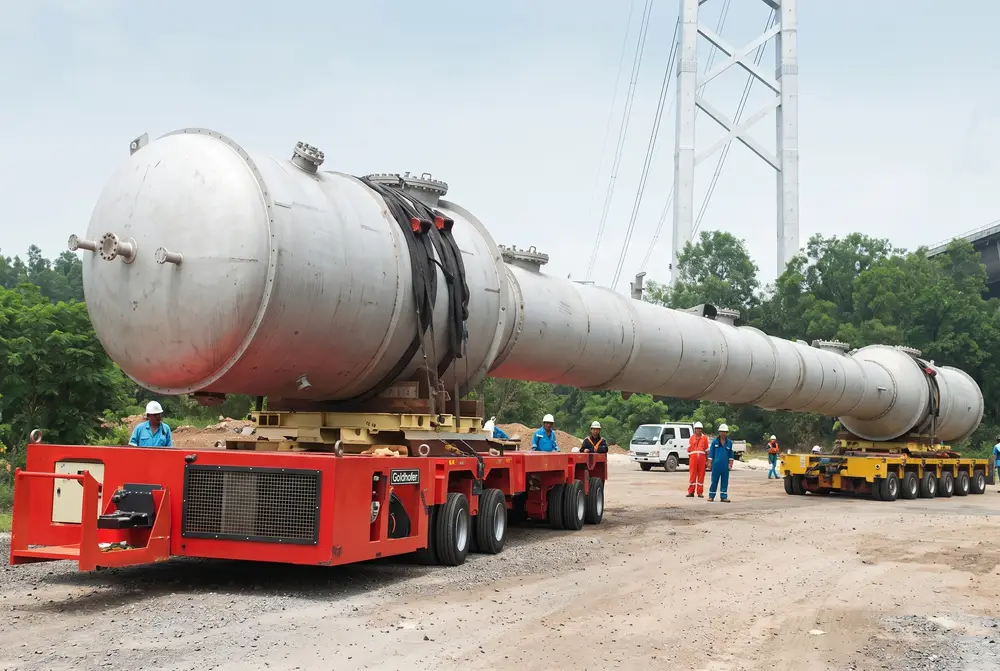 Coupled SPMTs transporting a refinery column
Wind Energy and Nuclear Decommissioning
Offshore wind installations use SPMTs to shuttle nacelles, tower sections, and transition pieces between marshaling yards and quaysides. In nuclear work, they have proved just as valuable. At the Jülich research center in Germany, a 2,000-tonne reactor vessel was moved 600 meters in 4 hours using SPMTs, cutting more than 75% off the time required by the alternative air-pallet method.
In 2024, Mammoet deployed the first fully electric battery-powered SPMTs at the ITER nuclear fusion facility in France, moving 440-tonne vacuum vessel sectors with zero exhaust emissions.
HUAYU builds special trailers and low bed trailers for heavy transport operations. For loads beyond conventional trailer limits, contact our engineering team to discuss SPMT configurations.
Mechanical vs Electronic Steering
SPMTs use one of two steering systems. The choice affects maneuverability, pulling power, and cost.
| Specification | Mechanical Steering | Electronic Steering |
|---|---|---|
| Steering angle | ±55 degrees | ±110 degrees (up to +130/-100) |
| Rated load (6-axle) | 180 tonnes | 216 tonnes |
| Dead weight | ~30 tonnes | ~30 tonnes |
| Braking axles | 4 | 8 |
| Drive axles | Varies | 4 |
| Grade ability (full load) | 8.5%–20% | 7% |
| Traction force | 640 kN | 320 kN |
| Speed (empty / loaded) | 10 / 5 km/h | 10 / 5 km/h |
| Best suited for | Steep routes, straight moves | Tight spaces, complex maneuvers |
Mechanical steering has double the traction force and much better slope performance. For straightforward point-to-point moves on hilly routes, it is the stronger option.
Electronic steering wins everywhere else. The wider steering angle and multiple modes — crab, carousel, diagonal — make it the default for shipyards, congested plant sites, and any job requiring precise multi-directional positioning. Most new SPMTs sold today use electronic steering.
SPMT Components and Specifications
Power Pack Unit (PPU)
Inside every SPMT sits the PPU — part diesel engine, part hydraulic power station. It contains a diesel engine with flanged hydraulic pumps, cooling circuits for water, charge air, and hydraulic oil, plus fuel and oil tanks, electronic controls, and batteries. Steering, lifting, braking, driving — every function runs on the hydraulic pressure the PPU generates.
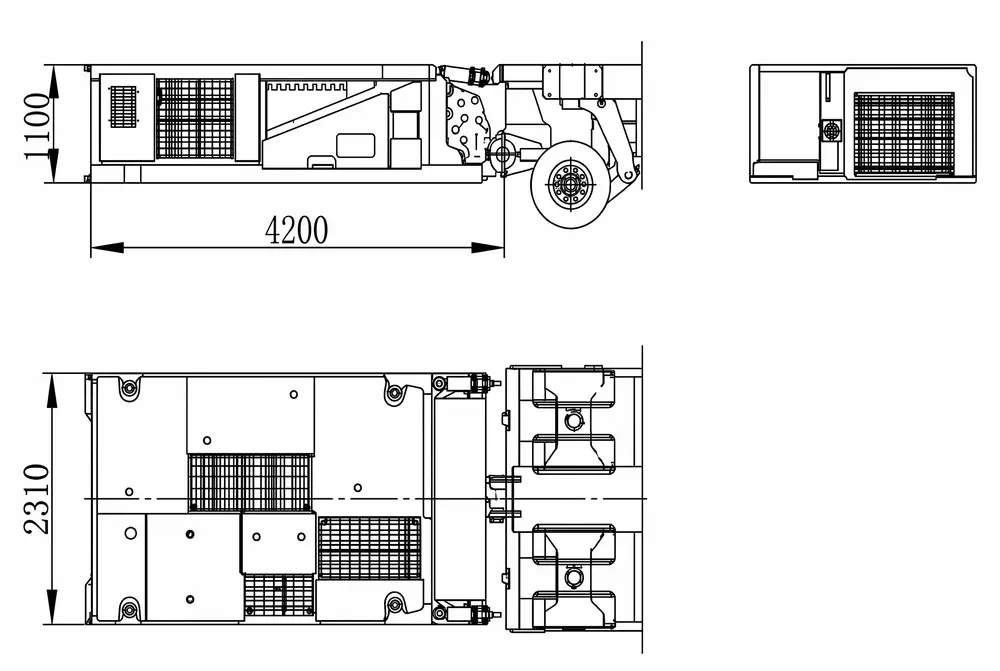 PPU technical drawing with dimensions
PPU sizes scale with the job:
| Parameter | Smaller PPU | Larger PPU |
|---|---|---|
| Engine power | 132–180 kW (180–244 HP) | 350–390 kW (476–530 HP) |
| Torque | ~1,000 Nm | ~2,460 Nm |
| Fuel tank capacity | 400 liters | 400 liters |
| Hydraulic oil tank | 800–850 liters | 800–850 liters |
| Electrical system | 24–28 V | 24–28 V |
| Drive system max pressure | 400 bar | 400–420 bar |
| Steering max pressure | 300 bar | 300–350 bar |
What separates a small PPU from a large one is raw power. A 180 kW unit drives a handful of axle lines. A 390 kW unit handles dozens. Match the PPU to the total number of driven axles in your configuration — undersized means the fleet won't move, oversized means wasted money.
Electric PPUs are now entering service. Mammoet's electric units at ITER deliver 390 kW from a 320 kW battery system. Same performance as diesel, zero exhaust. The diesel PPU isn't going away, but electric alternatives are a real option for indoor and emissions-restricted sites.
Platform Dimensions by Axle Count
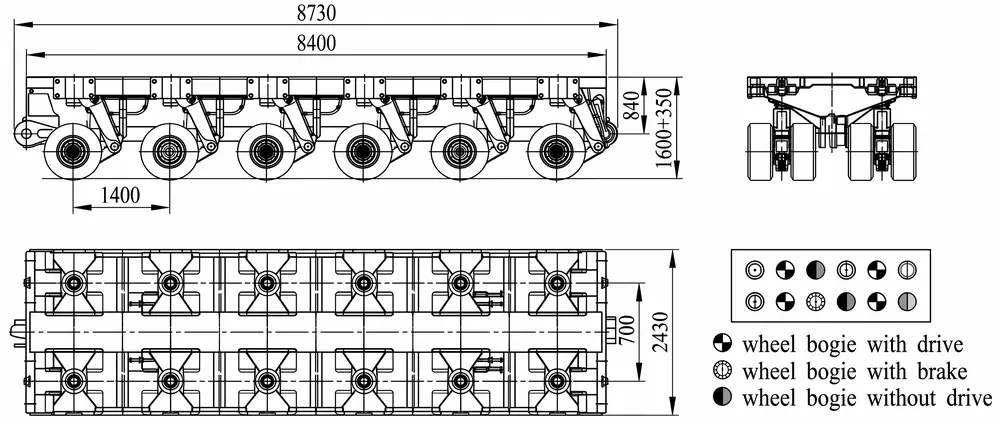 6-axle SPMT platform layout and dimensions
| Axle Lines | Platform Length | Width | Height | Max Payload |
|---|---|---|---|---|
| 3 | 4,200 mm | 2,430–3,000 mm | 1,300–1,600 mm | ~167 tonnes |
| 4 | 5,600–6,000 mm | 2,430–3,000 mm | 1,150–1,600 mm | ~222 tonnes |
| 5 | 7,000 mm | 2,430–3,000 mm | 1,300–1,600 mm | ~278 tonnes |
| 6 | 8,400–9,000 mm | 2,430–3,000 mm | 1,200–1,600 mm | ~334 tonnes |
Other specs to consider:
- Axle spacing: 1,400–1,500 mm
- Wheel tread: 1,450–1,800 mm
- Lifting stroke: 600–700 mm (±300–350 mm adjustment)
- Load per axle line: 34–60 tonnes (Cometto's MSPE EVO3 reaches 70 tonnes per line — the highest available)
- Speed: ~5 km/h loaded, ~10 km/h empty
When a single module isn't enough, bolt more together. Standard transport capacity ranges from 90 tonnes (one small module) to well over 16,000 tonnes. The current world record is 23,163 tonnes, set in May 2024 when 880 Scheuerle axle lines and 28 PPUs moved the Charybdis offshore wind installation vessel at a shipyard in Brownsville, Texas.
Common Causes of SPMT Load Failures
Stability during transport matters. A dropped load doesn't just damage the cargo — it delays the entire project, puts workers at risk, and can add millions in replacement costs.
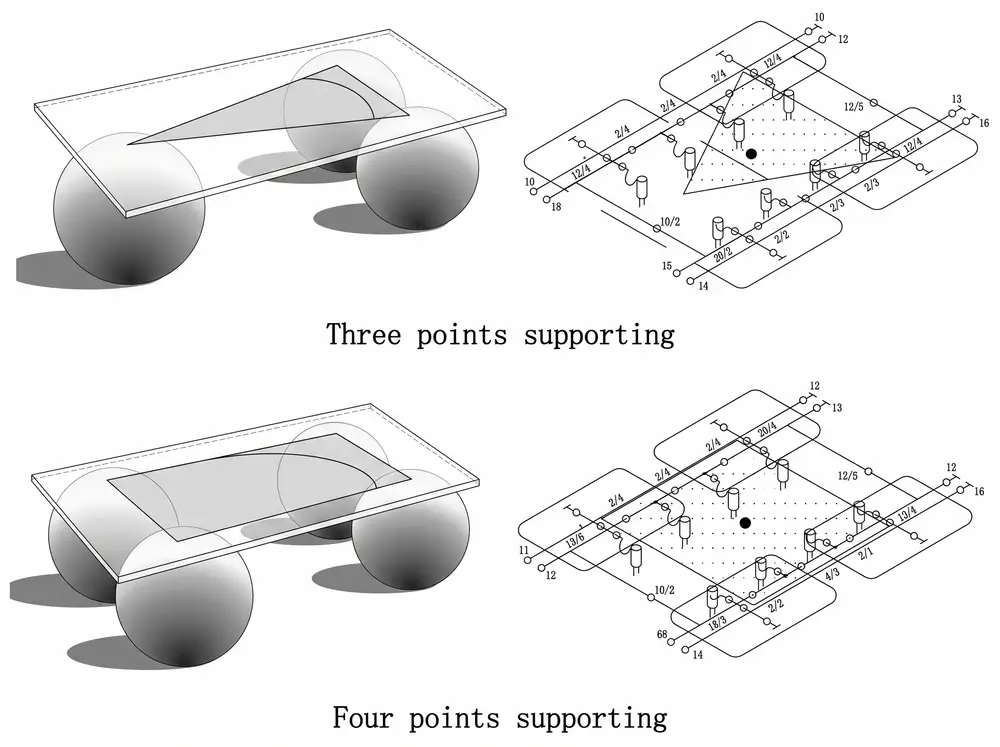 Three-point vs four-point SPMT support stability
Most SPMT accidents trace back to human decisions, not mechanical breakdown:
-
Overloading — Every module has a rated maximum capacity specified by the manufacturer. Going past it destabilizes the platform. Always verify the exact cargo weight before selecting a configuration.
-
Uneven weight distribution — If the load's center of gravity sits off-center or too high, the platform tips. Tall, narrow equipment needs a wider platform arrangement. Three-point support creates a triangular stability zone, which is less forgiving than the rectangular zone from a four-point setup. For heavy or tall cargo, always choose four-point support.
-
Hydraulic suspension failure — Each axle line adjusts independently to absorb bumps and dips in the road. If a cylinder on one axle fails, that axle can no longer compensate. An obstacle that would normally be absorbed smoothly can jolt the entire load.
-
Poor route preparation — The ground bearing capacity along every meter of the route must be checked before any move. Soft soil, hidden voids, steep gradients, or tight turns can sink wheels or tilt the platform unexpectedly.
-
Weather — The European Association of Abnormal Road Transport (ESTA) recommends canceling SPMT moves in icy conditions, on slippery surfaces, or during strong winds unless the configuration is specifically adapted for those conditions. Wind loads on tall cargo can shift the center of gravity far enough to cause a tip.
Preventing failures comes down to accurate weight data, thorough route surveys, and regular equipment maintenance. For more on structural load limits in trailers, read our article on semi-trailer frame carrying capacity.
Top SPMT Manufacturers
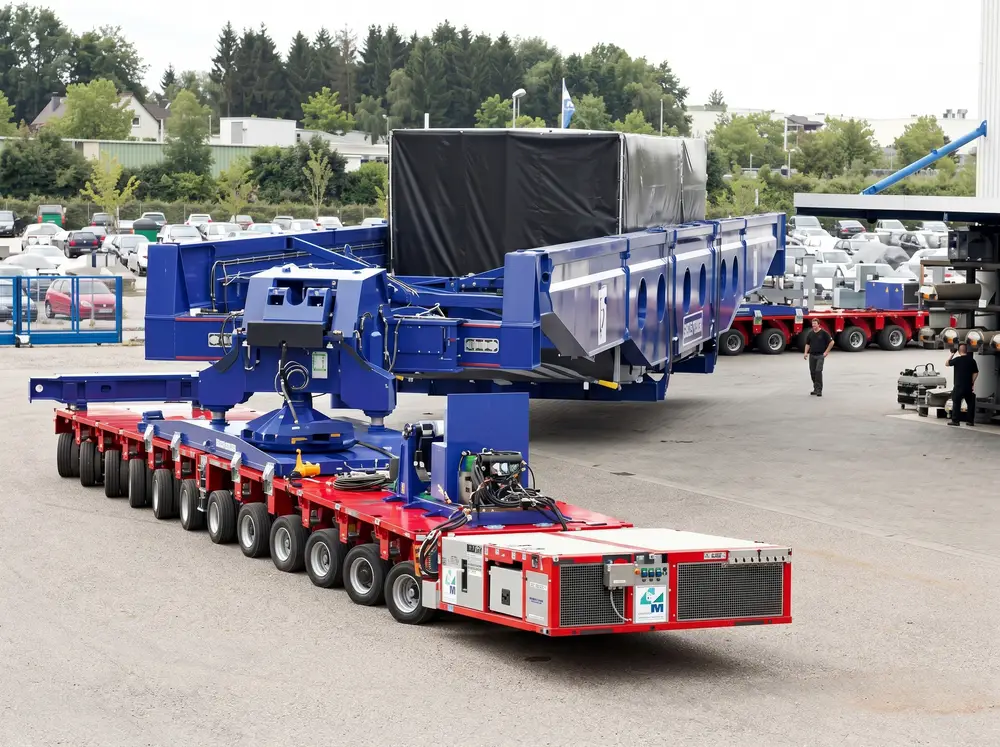 Multi-axle SPMT transporting heavy industrial equipment
Scheuerle (TII Group)
Scheuerle invented the SPMT in 1983 and still leads the global market. Founded in 1869 in Pfedelbach, Germany, the company is part of the TII Group, which claims that 70% of transports over 3,000 tonnes and 90% over 5,000 tonnes worldwide use TII vehicles. Scheuerle alone has sold over 14,000 classic SPMT axle lines. Their current lineup includes the standard SPMT, the SPMT SL (a split-type designed for narrow spaces), and the PowerHoss (a plug-and-play module that couples up to 1,320 tonnes).
Kamag (TII Group)
Also part of TII Group, Kamag operates out of Ulm, Germany with over 300 employees. The company joined TII in 2004 and builds SPMTs, shipyard transporters, terminal logistics vehicles, and power boosters.
Goldhofer
Goldhofer traces back to 1705 in Bavaria, when it began as a blacksmith forge. The company's PST/SL and PST/SL-E self-propelled transporter series handle loads from 50 tonnes to over 10,000 tonnes. One distinguishing feature: their driven axle modules can switch to towed mode and travel at up to 80 km/h. Goldhofer exports to more than 160 countries.
Cometto
Italian manufacturer Cometto started building heavy-duty vehicles in the 1950s. Their MSPE EVO3 line stands out for the highest axle load rating in the industry — 70 tonnes per line, compared to the 60-tonne standard. Available in 2,430 mm and 3,000 mm widths with 2 to 6 axle lines per module, the 70-tonne model produces a bending moment of up to 9,400 kN·m.
Nicolas (TII Group)
Nicolas Industrie was founded in France in 1855 as an agricultural trailer maker. By 1971 the company was delivering hydraulic modular trailers — including two 10-axle modules with a combined payload of 600 tonnes. Now part of TII Group, Nicolas is best known for the massive ship transporters it introduced in the 1970s.
HUAYU Vehicle
HUAYU Vehicle is a Chinese manufacturer established in 2000 in Shandong province. The company produces SPMTs and modular transporters alongside a full line of semi-trailers — including low bed trailers and special trailers — for construction, logistics, and energy sector projects. HUAYU exports to Central Asia, Southeast Asia, the Middle East, Africa, and South America. Learn more on our About page.
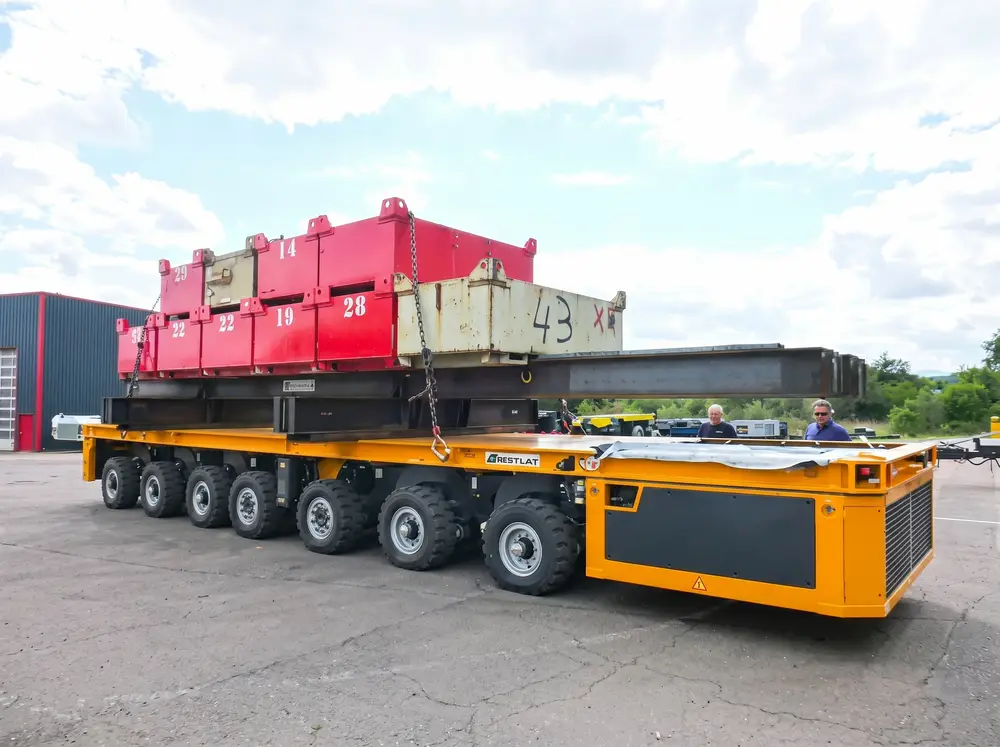 6-axle SPMT loaded with steel structural components
Enerpac
Enerpac manufactures the SPMT600 series with capacities up to 60 tonnes per unit. Their "Intelli-Drive" handheld remote system controls the transporter, and up to 12 units can couple together for a combined capacity of 720 tonnes.
Mammoet (Operator)
Mammoet does not manufacture SPMTs but runs the world's largest fleet — over 3,000 axle lines after purchasing 650 Scheuerle units in 2024 (the biggest single SPMT order in Scheuerle's history). Based in the Netherlands, Mammoet completed its acquisition of ALE in January 2024, making it the dominant heavy-lift and transport operator worldwide.
How to Choose the Right SPMT
Picking the right configuration means matching the transporter to the cargo and the job site. Five factors matter most:
-
Cargo weight and dimensions — Get the exact weight, length, width, and height of your load. These numbers determine how many axle lines you need and whether to couple laterally, longitudinally, or both.
-
Route conditions — Check ground bearing capacity, gradients, turning radii, and overhead clearances along the entire path. Steep sections may call for mechanical steering because of its higher traction.
-
Steering type — Electronic for tight spaces and multi-directional maneuvers. Mechanical for simpler routes with inclines.
-
PPU sizing — Match engine power to the number of driven axle lines and total transport weight. Too small and the fleet can't move. Too large and you're paying for capacity you don't use.
-
Buy vs rent — For a one-time project, renting axle lines from an operator is often more practical. For repeated heavy-haul operations, owning a fleet saves money over time.
Not sure where to start? Contact our engineering team for project-specific help. For general trailer selection advice, read our guide on how to choose the right semi-trailer.
FAQ
What does SPMT stand for?
SPMT stands for Self-Propelled Modular Transporter. It is a computer-controlled platform vehicle with independent axle steering and hydraulic suspension, built to move extremely heavy loads.
How much weight can an SPMT carry?
A single 6-axle module carries 216 to 334 tonnes, depending on the model. When modules are coupled together, the capacity scales proportionally — the world record is 23,163 tonnes, set in May 2024 using 880 Scheuerle axle lines.
How fast does an SPMT move?
About 5 km/h when loaded and up to 10 km/h empty. For the heaviest loads, speed may drop below 1 km/h to keep the cargo stable.
What is the difference between an SPMT and a conventional trailer?
A conventional trailer is towed by a truck and steers through its hitch connection. An SPMT carries its own engine (PPU), steers each axle independently, and lifts loads with a built-in hydraulic system. It can move sideways, diagonally, and rotate on the spot — none of which a towed trailer can do. For loads up to about 150 tonnes, a low bed trailer or RGN trailer is the more practical choice. SPMTs take over where those trailers leave off.
Can you rent an SPMT?
Yes. Operators like Mammoet rent SPMT axle lines along with PPUs, trained crew, and engineering support on a per-project basis. This is the most common approach for companies without a permanent fleet.
Who invented the SPMT?
Scheuerle Fahrzeugfabrik in Pfedelbach, Germany built the first SPMT in 1983. The project was commissioned by Mammoet, and the module was designed at container width (2,430 mm) so it could be shipped globally using standard flat-rack containers.