
Semi Trailer Frame: How Frame Design Determines Carrying Capacity
Published Apr 4, 2026
25 engineers · ISO 9001 · 3C certified · Liangshan factory since 2001
Updated 2026-05-11
13 min read
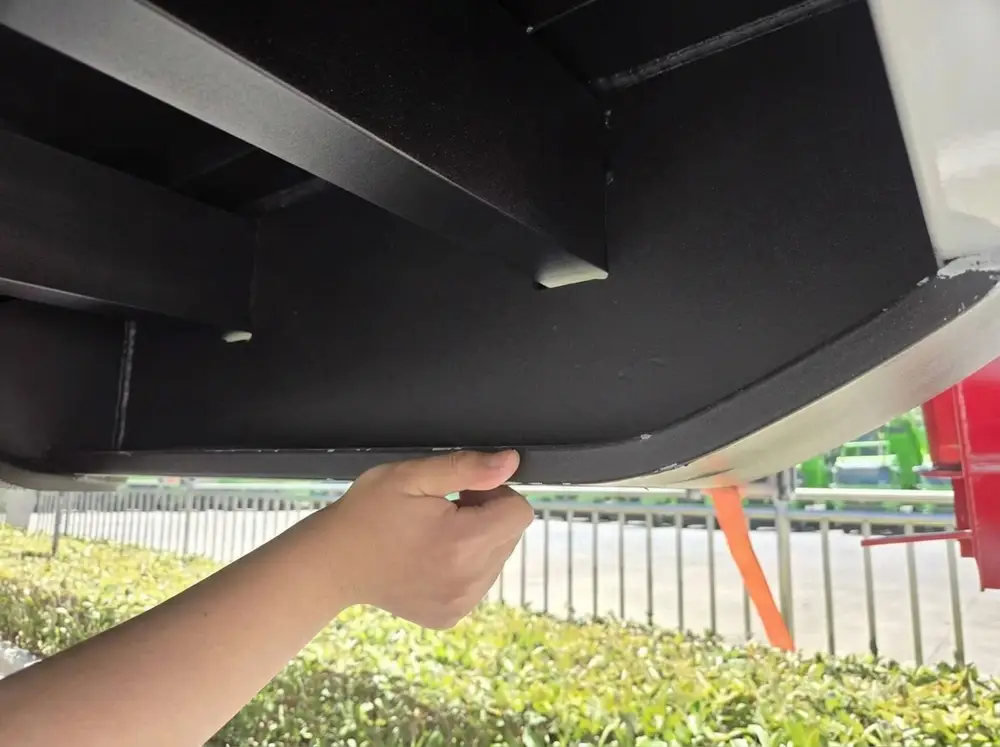
Pick up any two semi-trailers that look identical on paper — same axle count, same deck length, same rated payload — and put them on a scale. The lighter one carries more cargo per trip. That weight difference almost always comes down to the frame.
We build frames every day at our Liangshan factory. The decisions we make during frame engineering — which steel, what beam profile, where to cut lightening holes, how to space the cross-members — set the upper limit on what that trailer can haul legally and safely for the next 10 to 15 years. This article breaks down what goes into those decisions and why they matter to anyone buying a semi-trailer.
What the Frame Does
The frame (some people call it the girder or the chassis backbone) is the main load-bearing structure of the trailer. Every other component bolts onto it: axles, suspension, landing legs, kingpin plate, cargo body panels, and the electrical and pneumatic systems. During operation the frame absorbs bending loads from cargo weight, torsional forces from uneven roads, and dynamic shock loads from potholes, braking, and cornering.
A note on terminology: the words "frame" and "chassis" get used interchangeably in the trailer industry. Technically, the chassis includes the frame plus all the running gear — axles, suspension, wheels, brakes, and airlines. The frame is the structural beam assembly itself. In this article we're talking about the frame specifically.
What Makes a Semi-Trailer Frame Different
A semi-trailer frame is not just a smaller version of a rigid truck frame. It has its own structural logic.
The front end steps up to meet the fifth wheel. The kingpin and its mounting plate sit at the front of the frame. When the tractor couples to the trailer, the top surface of the trailer frame sits well above the tractor's own frame height. This creates the gooseneck section — a structural transition zone that steps up from the main deck to the kingpin plate height. The gooseneck is one of the most stressed areas of the frame because it handles both vertical kingpin load and the bending moment from the height offset. We reinforce this section with thicker flanges and additional gusset plates on every trailer we build.
The deck sits as low as possible. To keep the loaded center of gravity low — which directly affects roll stability at highway speed — the cargo platform behind the gooseneck drops down. On our 3-axle flatbed trailers, the main deck height runs about 1,350 mm from the ground. On a low bed trailer, it drops to around 800-950 mm. The lower the deck, the more stable the load, but the frame design gets harder because ground clearance shrinks and beam depth is limited.
The wheelbase is long. A typical 3-axle 13-meter trailer has a span of 8 to 9 meters between the kingpin and the axle group. That long unsupported span amplifies bending loads, which is why longitudinal beam selection matters so much on semi-trailers. We use I-beam profiles for most standard builds and switch to box-section beams for heavy-duty applications where torsional resistance needs to be higher.
Lightening holes are standard. To reduce frame weight without cutting into structural capacity, we CNC-cut round and square holes in the web (the vertical section) of each longitudinal beam. On a 13-meter flatbed, each main beam typically gets 12 to 16 lightening holes. These holes also double as routing channels for electrical wiring and air brake lines, and they make it easier to access bolted connections during maintenance.
Frame Design by Trailer Type
Not all trailers need the same frame. The cargo type, payload rating, and operating conditions drive very different engineering choices.
| Trailer Type | Typical Frame Steel | Beam Profile | Key Frame Challenge |
|---|---|---|---|
| Flatbed trailer | Q345B | I-beam | Long unsupported span under distributed loads; needs many lightening holes to keep weight down |
| Low bed trailer | Q345B + T700 reinforcement | Box section or reinforced I-beam | Concentrated point loads from heavy machinery; gooseneck transition carries extreme bending moment |
| Tipper trailer | Q345B or T700 | Reinforced I-beam | Frame must handle repeated dump-cycle shock; hinge point area takes high fatigue loading |
| Side wall trailer | Q345B | I-beam | Similar to flatbed but with added torsion from side panel loads during cornering |
| Fuel tanker trailer | Q345B | Purpose-built subframe | Liquid surge forces create dynamic torsion; frame must interface with tank saddle mounts |
| Bulk cement trailer | Q345B | Subframe with ring stiffeners | Pressurized vessel creates different load paths than a flat deck |
A 4-axle 100-ton low bed has a fundamentally different frame from a 3-axle flatbed. The low bed needs to handle a 60-tonne excavator sitting on a 3-meter section of deck, while the flatbed distributes 40 tonnes of steel coils across 12 meters. Same material budget, completely different beam sizing and cross-member spacing.
Steel Grades: What the Numbers Mean
When we say "Q345B" or "T700," those aren't arbitrary labels. They define the mechanical limits of the frame.
| Steel Grade | Yield Strength | Tensile Strength | Typical Use | Relative Cost |
|---|---|---|---|---|
| Q235B | 235 MPa | 370-500 MPa | Light-duty cross-members, non-structural brackets | Baseline |
| Q345B | 345 MPa | 470-630 MPa | Standard longitudinal beams, gooseneck sections, most cross-members | ~15% above Q235B |
| T700 (HSLA) | 700 MPa | 750-950 MPa | Weight-critical builds: high-payload flatbeds, lowbed reinforcements, competition-spec trailers | ~60% above Q235B |
Q345B is our default for most trailer frames. It gives us a good balance between strength, weldability, and cost. The 345 MPa yield point means the steel can handle significant stress before permanent deformation starts — enough for standard highway trailers carrying 30 to 60 tonnes of payload.
T700 comes out when weight savings matter most. At double the yield strength of Q345B, we can use thinner flanges and webs while carrying the same load. On a 13-meter flatbed frame, switching the longitudinal beams from Q345B to T700 can cut 300 to 400 kg off the tare weight. That's 300 to 400 kg of extra legal payload on every trip. The tradeoff is cost and weldability — T700 needs tighter process control during welding to avoid heat-affected zone cracking, so we reserve it for customers who run high-utilization routes where the weight savings pay back quickly.
We don't use Q235B for any primary load-bearing members. It shows up in cross-member stiffeners and minor brackets where the stress levels are low enough that the cheaper steel makes sense.
The Four Design Requirements That Set Carrying Capacity
Every frame we design has to pass four tests before it goes into production.
1. Layout Compatibility with the Tractor
The frame has to work with whatever tractor the buyer plans to use. After coupling, the tractor needs full steering lock without the cab hitting the landing legs or the trailer's front corner hitting the tractor's exhaust stack or fuel tank. We check the swept path geometry for common tractor models in each export market — a Shacman F3000 has different cab-to-axle dimensions than a HOWO T7H, and both differ from the Beiben V3s popular in Central African markets.
The traction pin (kingpin) position is fixed by fifth wheel standards, but everything around it — the gooseneck angle, front cross-member placement, leg mounting position — has to be coordinated so the trailer couples cleanly and turns without interference.
2. Strength Under Worst-Case Loading
The frame must hold up under every loading scenario the trailer will face during its service life: full payload at highway speed, emergency braking with a loaded deck, one wheel dropping into a pothole at 80 km/h, and years of cumulative fatigue cycles.
We calculate bending moment diagrams for each trailer model based on the intended payload and axle configuration. For a 3-axle flatbed rated at 40 tonnes payload, the maximum bending moment at the rear axle group typically lands around 250-300 kN·m. The longitudinal beams need a section modulus that keeps the peak stress well below the yield point of the steel — usually 60 to 70 percent of yield as a safety margin.
In practice, we verify this through a combination of finite element analysis (FEA) at the design stage and physical load testing on prototype frames. If a frame design shows stress concentrations above our thresholds, we add local reinforcement — a thicker flange, a gusset plate, or a modified cross-member — before releasing the design to production.
3. Stiffness That Matches the Suspension
This one surprises people who assume stiffer is always better. It's not.
A frame needs enough bending stiffness that the deck doesn't sag visibly under load and the components mounted on it stay in alignment. Nobody wants to see their air ride suspension bolts working loose because the frame flexes too much at the mounting points.
But torsional stiffness — resistance to twisting — is a different story. When a trailer crosses uneven ground (one wheel drops into a ditch, the other stays on the road surface), something has to give. If the frame is too rigid in torsion, it absorbs the full twist force instead of letting the suspension do its job. That concentrated torsion stress shows up as cracks in the web near cross-member welds, usually within 2 to 3 years on rough roads.
We design our frames with torsional stiffness matched to the suspension type. A trailer on leaf springs (which have significant angular compliance) gets a frame that's deliberately more torsionally flexible. A trailer on air suspension (which is stiffer in roll) gets a frame with more torsional resistance built in. Getting this balance wrong is one of the most common reasons cheap trailers crack prematurely.
4. Minimum Weight for Maximum Payload
Here's where frame engineering connects directly to the buyer's bottom line. Under China's GB 1589 regulations — which many export markets reference or mirror — the gross vehicle weight of a 3-axle semi-trailer is capped. Every kilogram of frame weight eats into the legal payload.
Our approach to weight reduction follows a priority sequence:
- Steel grade selection — T700 where the cost math works, Q345B everywhere else
- Beam profile optimization — Adjust flange width and web height to match the actual load envelope, not a worst-case guess
- Lightening holes — CNC-cut holes in low-stress zones of the beam web, sized and spaced by FEA results
- Cross-member rationalization — Space cross-members based on actual load distribution rather than defaulting to even spacing
- Connection simplification — Eliminate redundant gusset plates and brackets by designing cleaner load paths
On our standard 13-meter 3-axle flatbed, these techniques together bring the frame weight to approximately 3,200 kg. A poorly optimized frame of the same dimensions and strength rating can weigh 3,600 to 3,800 kg. That's 400 to 600 kg of payload the operator loses on every trip — which, at 300 trips per year over a 10-year life, adds up to thousands of tonnes of lost revenue.
Common Frame Failures and What Causes Them
In our after-sales experience across Africa, Central Asia, and the Middle East, frame problems almost always trace back to one of three root causes:
Web cracks near cross-member welds. This is the most common failure. It happens when the frame's torsional stiffness doesn't match the suspension, or when the trailer runs overloaded on rough roads for extended periods. The crack usually starts at the toe of a fillet weld where the cross-member meets the longitudinal beam web. We mitigate this with radiused weld transitions and stress-relief detailing at high-load junctions.
Gooseneck section fatigue. The height transition from the main deck to the kingpin plate creates a stress riser. On trailers that do heavy-duty short-haul work with frequent coupling and uncoupling, the gooseneck sees thousands of extra load cycles per year from the landing legs lifting and lowering the front end. We reinforce this area with doubled flanges and full-penetration welds on our heavy-duty models.
Kingpin plate deformation. If the kingpin mounting plate isn't thick enough or isn't properly integrated with the frame beams, it can dish or crack under repeated coupling impacts. Our standard plate thickness is 16 mm for trailers up to 60 tonnes GVW and 20 mm for anything heavier.
How to Evaluate a Frame When Buying a Trailer
If you're comparing trailers from different manufacturers, these questions will tell you a lot about the frame quality:
- What steel grade are the longitudinal beams? Q345B is the minimum for any serious highway trailer. If the seller can't tell you the steel grade, that's a red flag.
- What's the tare weight of the complete trailer? Lighter tare (at the same payload rating) usually signals better frame engineering. Ask for a weighbridge certificate, not just a spec sheet number.
- How are the cross-members attached? Welded is stronger than bolted for permanent members. Check for full-penetration welds at high-stress joints, not just fillet welds.
- Is the frame shot-blasted before painting? Shot blasting removes mill scale and creates a surface profile for paint adhesion. A frame that's only hand-ground and painted will start rusting at the welds within a year in humid climates.
- What's the warranty on the frame? A manufacturer confident in their frame engineering will warrant the main beams for 5+ years. If the frame warranty is shorter than the axle warranty, ask why.
Frequently Asked Questions
What steel is used for semi-trailer frames? Most semi-trailer frames use Q345B structural steel (345 MPa yield strength). For weight-sensitive applications, manufacturers use T700 high-strength low-alloy steel (700 MPa yield), which allows thinner sections at the same load rating. Light-duty brackets and stiffeners may use Q235B.
How much does a semi-trailer frame weigh? A standard 3-axle 13-meter flatbed frame weighs approximately 3,000 to 3,500 kg depending on the steel grade and optimization level. Heavy-duty lowbed frames for 80 to 100 tonne payloads weigh 4,500 to 6,000 kg. Frame weight directly reduces the legal payload capacity under gross vehicle weight limits.
What causes cracks in a semi-trailer frame? The three most common causes are: mismatched torsional stiffness between the frame and suspension (causing stress concentration at cross-member welds), overloading beyond the rated capacity, and poor weld quality at critical joints. Cracks most often appear in the beam web near cross-member connections and at the gooseneck transition section.
What is a gooseneck on a semi-trailer? The gooseneck is the front section of the frame that steps up from the main deck height to the kingpin (fifth wheel coupling) height. It allows the trailer deck to sit lower than the tractor connection point, lowering the cargo center of gravity for better stability. The gooseneck is one of the most structurally stressed areas of the frame.
Does frame design affect fuel consumption? Indirectly, yes. A lighter frame means lower total vehicle weight for the same payload, which reduces rolling resistance and fuel consumption. A 400 kg reduction in tare weight can save roughly 1 to 2 percent on fuel across a typical long-haul route.
Choosing the right trailer starts with understanding what's underneath the deck. If you want frame specification sheets for any HUAYU trailer model — including steel grade, beam dimensions, tare weight, and maximum payload rating — reach out to our engineering team. We can also run a tare weight comparison against your current trailers to show exactly where the payload difference sits.