12 Units 4 Axle End Dump Tipper Trailers Exported to Zimbabwe
25 engineers · ISO 9001 · 3C certified · Liangshan factory since 2001
Updated 2026-05-07
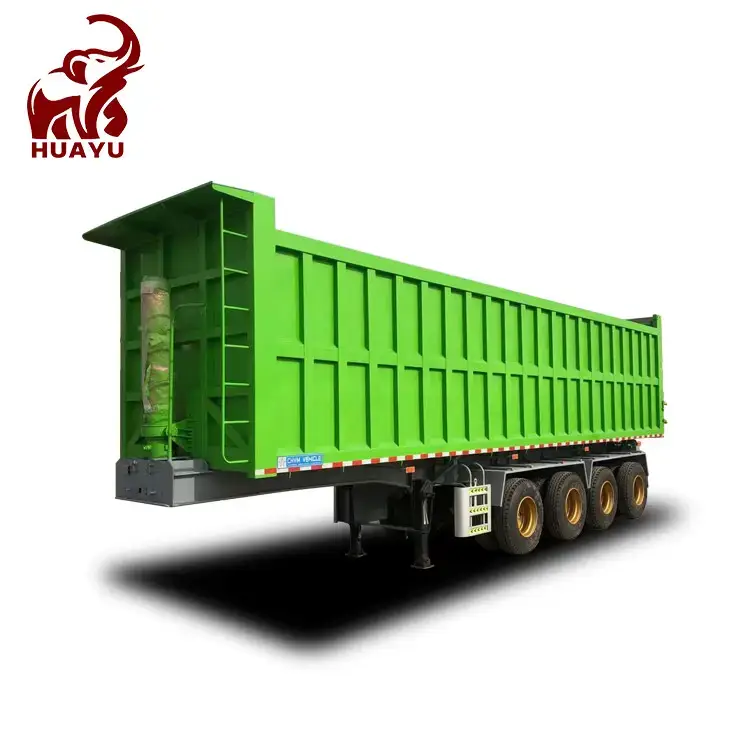
In April 2026 we shipped 12 units of our 4 axle end dump tipper semi trailer to a Zimbabwean fleet operator working chrome ore and aggregate haulage across the Midlands and Mashonaland routes. The client's existing 3-axle dump trailers had hit their useful-life ceiling under repeated 55-ton chrome loads, and they wanted a 4-axle layout that could carry the same cargo with more frame margin and better axle weight distribution.
What the Midlands Chrome Run Actually Looks Like
Zimbabwe's Midlands province holds one of the densest networks of chrome and ferrochrome operations in southern Africa. Mines around Kwekwe, Shurugwi and the Great Dyke satellite pits feed smelters at the local plants and export-grade ore into shipping containers heading for Beira. Most of that ore travels by road on tipper trailers, often within a 100 km radius of the pit, on a mix of paved trunk roads and graded haul tracks that get bumpy by the dry season.
The client's problem was simple. Their previous fleet of 3-axle tippers had served well for a decade on lighter aggregate work, but a new chrome haulage contract wanted heavier cargo more often. The trailers were taking the abuse — frame flex from repeated near-gross-weight tip cycles, axle bearings past their service window, the usual signs of equipment that has out-grown its specification.
They came to us looking for a heavier configuration: more axles, beefier rear hinges, lifting gear sized for a 60-ton dump cycle without complaint.
Configuration the Client Specified
The order was 12 identical units of our 4 axle end dump tipper. The client built the spec sheet around what they had learned from running their previous fleet on the same routes:
- 9600 × 2500 × 3450 mm overall, 9000 × 2400 × 1500 mm bucket — sized so a 60-ton chrome load sits below the side-wall lip with margin
- Q345B high-tension carbon steel main beam — the same grade their existing fleet had run, no surprises in welding behaviour or repair routine
- BPW axles, all four positions — their workshop in Gweru already stocked BPW seals and bearings, and standardising one axle brand across the new units kept their parts shelf manageable
- Heavy-duty two-stage hydraulic lifting cylinder — sized for repeated 60-ton tip cycles without overheating during a peak shift
- 28-ton two-speed landing gear — fast mode for quick uncoupling on the first turn, then a slower geared mode for fine height adjustment against an unfamiliar tractor
- Mechanical leaf-spring suspension, 90 × 16 mm × 10 layers — air suspension was discussed and rejected. The service network on the Gweru–Mvuma road wouldn't keep up with airbag failures
- ABS braking with full 24V LED lighting — necessary for the loaded southbound run after dark, where descents into the lower veld happen between fuel stations spaced 80 km apart
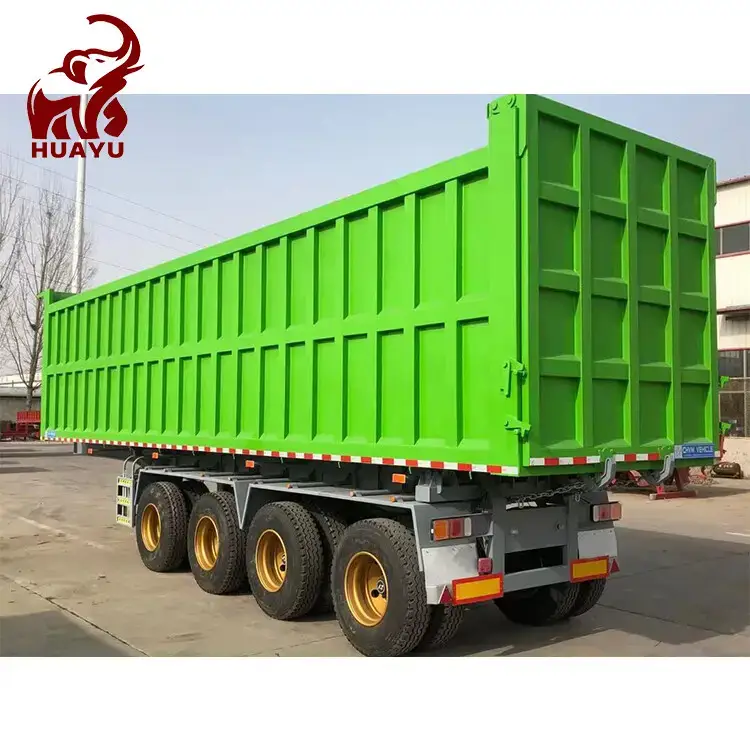 Green 4 axle end dump tipper semi trailer rear three-quarter view from HUAYU yard
The bucket interior was painted in the client's preferred green livery. They have run green trailers for over a decade and didn't want a single outlier in their yard.
Building the 12 Units
We ran the order as a single batch through our tipper production line. Identical specs across all 12 units simplified material procurement and let our welders settle into a rhythm rather than re-tooling between trailers.
The Q345B main beam for an end-dump tipper takes more attention than a flatbed beam. End dump trailers see cyclic loading at the rear hinge during every tip — load lifts, weight transfers backwards, beam flexes, weight returns. After 5,000 tip cycles a beam built to flatbed-grade tolerance will start to show micro-cracks at the hinge mounts. We use heavier plate at the hinge attachment, full-penetration welds rather than fillet welds, and a stress-relieving heat treatment after assembly. None of that shows in a brochure photo. It is the difference between a trailer that lasts five years on chrome work and one that comes back to the welding shop at 18 months.
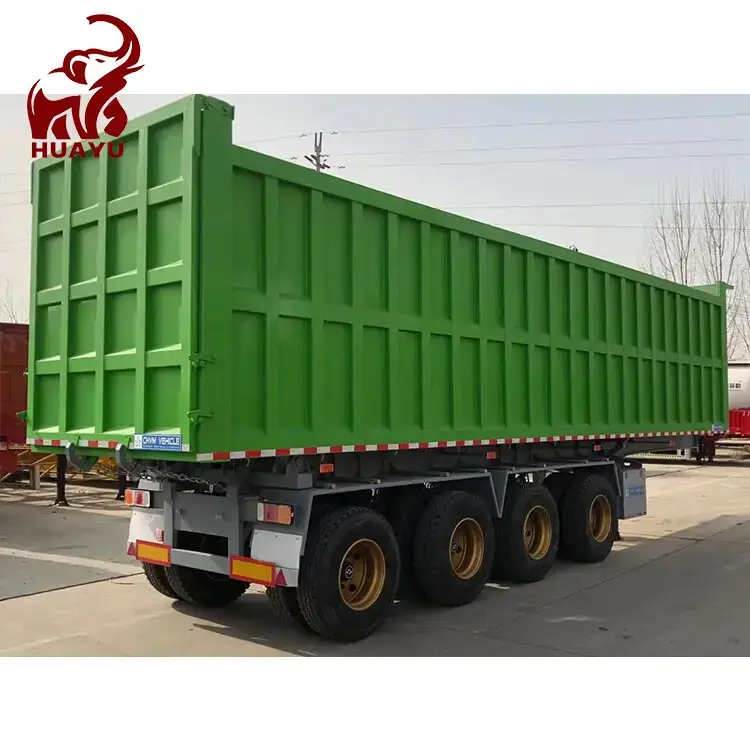 Green 4 axle dump tipper side view at HUAYU yard with paved surface
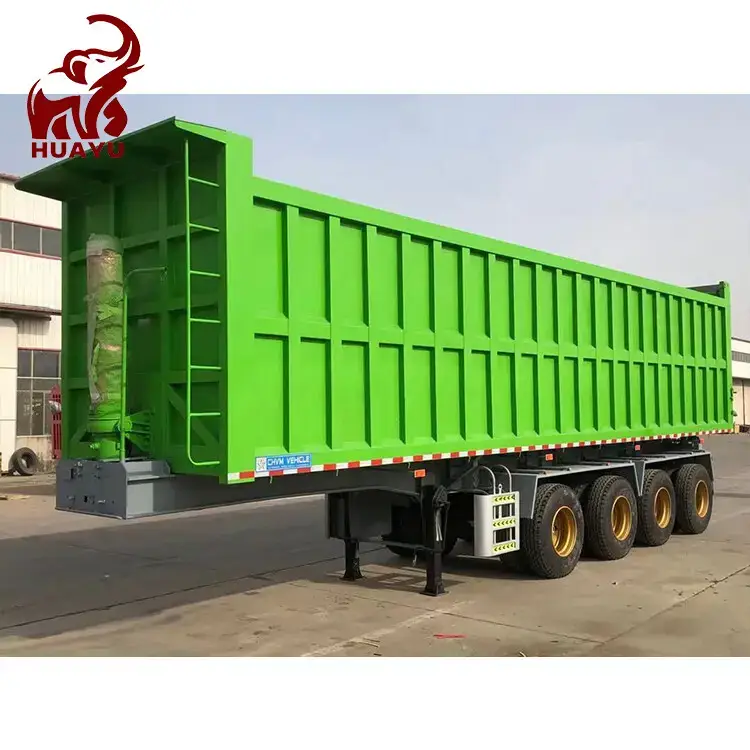 Green 4 axle dump tipper showing front-mounted hydraulic cylinder and headboard detail
The hydraulic cylinder went through bench testing before installation: 50 cycles under no load to seat the seals, then 10 cycles with the bucket loaded against our test ballast block. Cylinder leak-down was checked at full extension and held within 2 mm over 30 minutes — within our internal pass spec.
Each finished trailer ran the standard QC sequence: dimensional check, brake-pressure test at 8 bar, electrical verification, weld NDT on the chassis-to-bucket hinge welds, and paint film thickness measured at four points on the bucket exterior. Two units needed minor rework on a tail-light cluster wiring routing — both were corrected and re-inspected before clearance.
Qingdao to Beira and Then Inland to Harare
Zimbabwe is landlocked, so the inland leg becomes a real cost variable rather than a default. We routed the 12 trailers from Qingdao to the port of Beira on Mozambique's Indian Ocean coast. Beira clears trailer imports through the Forbes Border crossing into Mutare with shorter dwell times than the Beitbridge alternative south, and the road from Mutare to Harare is paved most of the way.
From Beira the units moved by road tractor to Mutare and on to Harare, where the client's drivers met them at the city outskirts and dispersed to depots in Gweru and Kwekwe. Total transit from our factory clearance to the client's yard came in around 38 days — 22 days at sea, 7 days port and customs, and 9 days for the inland haul.
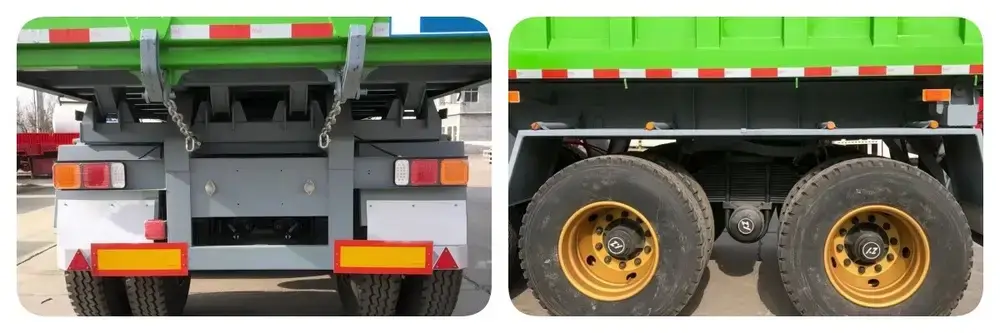 Pair of detail photos showing the rear hinge assembly and dual-axle wheel set on the dump tipper
We sent through our standard documentation pack — operator manuals, hydraulic schematic, BPW grease and seal-replacement schedule, ABS fault-code reference. Trained drivers run these trailers without much ceremony. The BPW grease intervals are easy to miss, though, and the documentation calls them out in the first three pages so they don't get buried.
After the First Three Months on the Road
The client sent us their first running report at the end of April 2026, after the trailers had been on chrome work for about 12 weeks.
Tip cycle counts. The 12 units have averaged 16 tip cycles per day across the chrome contract, which works out to roughly 1,400 cycles per unit through the first quarter of service. No frame issues, no hinge cracks, no cylinder weeping reported in the field reports.
Aggregate redeployment on idle weekends. Three of the 12 trailers have been pulled onto a Harare construction-aggregate run on weekends when the chrome line is idle. The lighter cargo gives those units a recovery cycle and gives the client a second revenue stream against the same fleet investment.
Tare-weight margin. Their previous 3-axle units had been running close to gross weight on a 50-ton chrome load, with no margin for an over-loaded scoop or a wet-cargo trip after rain. The 4-axle layout opens up a 10-ton cushion on the same routes — useful both for the occasional overload and for keeping the axle bearings under their stress-life limit.
The client has indicated they will be back for an additional 6 units in the second half of 2026 if the chrome contract renews. They have also asked for a quote on a 3-axle U-shape rock-body tipper — different geometry, same construction philosophy — for the ore types where a U-profile dumps cleaner than a flat-floor bucket.
For other Zimbabwean operators weighing 4-axle against 3-axle on similar routes, the headline lesson from this fleet is straightforward: the 4-axle layout earns its premium when daily cargo regularly approaches the 55–60 ton band and the road network includes weight-restricted bridges. On lighter aggregate-only work, the 3-axle remains the right choice on cost grounds.
If you are sourcing tipper trailers for a similar mining or quarrying operation, contact our sales team with your route conditions, target payload, and preferred axle and suspension brands. We build tipper semi trailers in 2-axle, 3-axle and 4-axle layouts with bucket geometries from flat-floor end dump to U-shape rock body, and every unit gets configured for the market it is going to operate in.