30 Units Bulk Cement Tankers Exported to Nigeria
25 engineers · ISO 9001 · 3C certified · Liangshan factory since 2001
Updated 2026-03-30
Nigeria's Cement Delivery Bottleneck
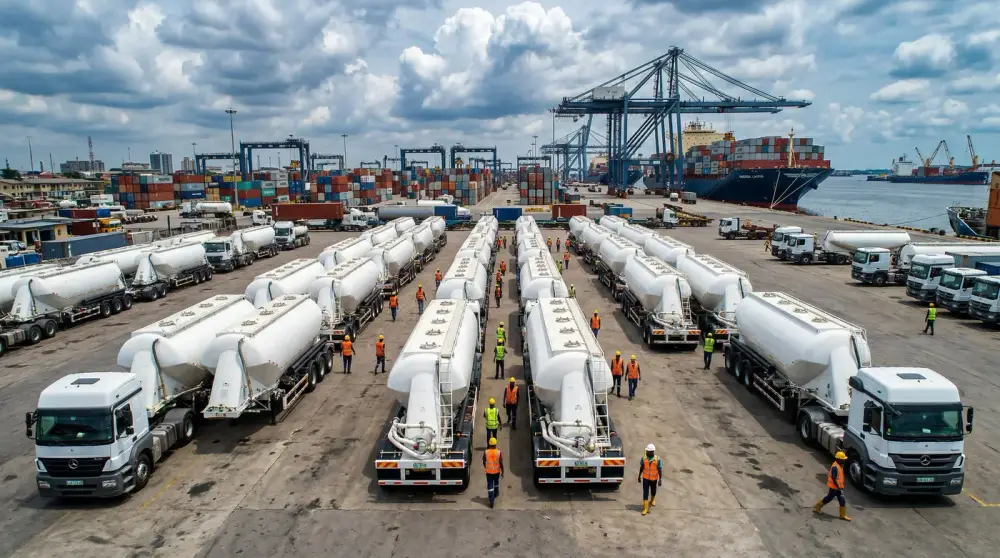
Nigeria is Africa's largest cement market. The construction boom across Lagos, Abuja, and the surrounding states has cement plants running at capacity, but getting powder from plant to site is where the supply chain breaks down. The client — one of the haulers servicing the southwestern route network — was losing money in two places: delivery turnaround was too slow with their open-transport fleet, and they were losing a measurable percentage of cement to wind and spillage on every run.
They came to us looking for enclosed bulk cement tankers that would fix both problems at once.
The Spec Sheet
The client needed tankers capable of handling Portland cement, fly ash, and other fine powder materials on routes that include both the Lagos–Ibadan Expressway and secondary roads to construction sites with limited maintenance. That combination — fine powder cargo plus rough roads — pushes the specification harder than either factor alone.
What they asked for:
- 45 CBM V-shaped tank — the V-profile ensures complete discharge without powder residue collecting in the tank floor. Residual cement hardens over time and progressively reduces effective capacity
- WEICHAI diesel engine + BOHAI double-cylinder air compressor — powers the pneumatic discharge system. WEICHAI parts availability across Nigeria was a non-negotiable requirement from the client
- 3-axle mechanical suspension — same reasoning as most of our West African orders. Road conditions demand rugged suspension with straightforward field repair
- JOST 28T landing gear — rated for the loaded tanker weight with margin. Undersized landing gear on a 45 CBM tanker is a failure waiting to happen
- Full pneumatic braking — standard for the weight class
Building 30 Tankers
Bulk cement tankers are more complex to manufacture than flatbed or side wall trailers. The V-shaped tank body requires precision forming and continuous welding to maintain structural integrity under internal pressure during discharge. Every tank goes through pressure testing before leaving the welding station.
We built the 30 units in three production batches of 10, staggering them through the line over 60 days. Rather than rushing all 30 through simultaneously and stretching QC resources thin, the batched approach gave each group full attention through the inspection process.
Tank body construction used Q345B steel at 5mm wall thickness — a deliberate choice for cement hauling. Five millimeters provides enough abrasion resistance for a 5–7 year service life with regular use, while keeping tare weight reasonable for Nigerian road weight limits. For more abrasive materials like fly ash, we'd go to 6mm, but for standard Portland cement, 5mm is the right balance.
Two safety valves per unit were installed as standard. The enclosed tank design eliminates the powder loss that was cutting into the client's margins on every trip with their previous open-transport method.
Each completed tanker went through discharge rate testing in addition to our standard quality inspection: brake pressure test, electrical verification, and dimensional checks.
Delivery
The 30 tankers shipped from Qingdao to Lagos port in two vessel bookings of 15 units each. We provided operator training documentation covering pneumatic discharge system operation, compressor maintenance intervals, and tank cleaning procedures. Pneumatic discharge is straightforward once operators understand the valve sequencing, but trained operators discharge faster and put less wear on the compressor.
Results After Deployment
The client deployed the fleet across three cement plant routes within two weeks of clearing port inspection.
40% reduction in per-delivery turnaround time. Pneumatic discharge is dramatically faster than the manual shoveling and gravity discharge their previous open trailers relied on. On a typical 45-ton cement load, the time savings at the delivery point alone recovered most of the additional vehicle utilization the client was targeting.
Near-zero material loss. The enclosed tank eliminated the wind-blown cement loss that had been a persistent line item on their cost reports. Across 30 vehicles running 20+ trips per month, the recovered material value is a meaningful contributor to fleet ROI.
The client has indicated interest in a follow-up order for larger capacity tankers as they expand into the northern Nigerian market.