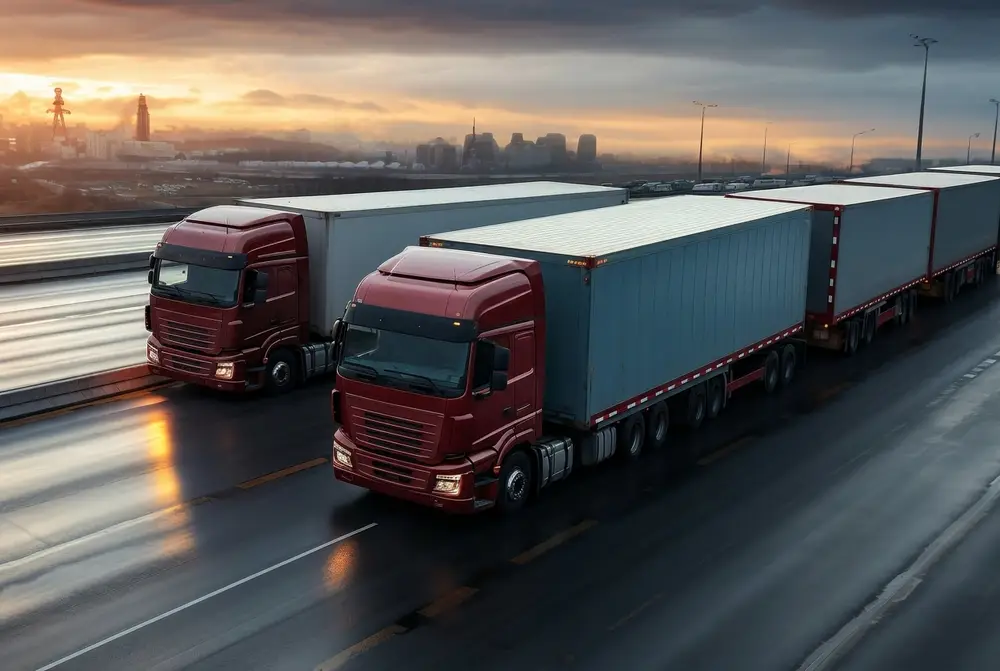
Inside HUAYU Factory: Our Production Process and Quality Control
Published Feb 15, 2026
25 engineers · ISO 9001 · 3C certified · Liangshan factory since 2001
Updated 2026-06-11
6 min read
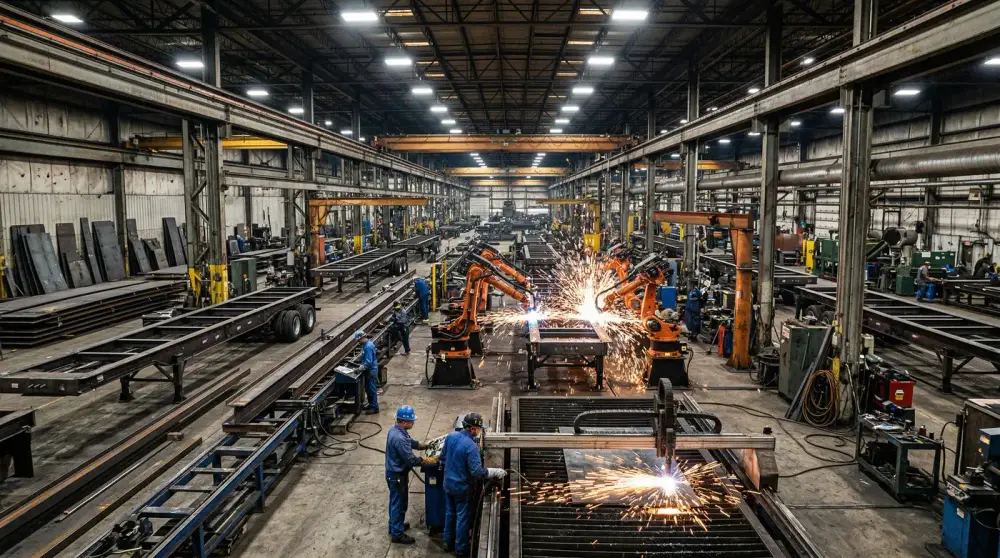
Walk through the front gate of our Liangshan factory at 7am and the first thing you hear is plasma cutters. By the time the morning shift is fully running, 10 production lines are operating simultaneously across 600,000 square meters of workshop floor — flatbed trailers, side wall trailers, bulk cement tankers, low bed trailers, tipper trailers, and more, each on its own dedicated line.
We've been building semi trailers here for 25 years. Annual output sits around 10,000 units, and a significant share goes to export markets across Africa, Southeast Asia, Central Asia, and the Middle East. Here's what the production process actually looks like, from raw steel to finished trailer.
It Starts with the Steel
Every trailer is only as good as the steel it's built from. Our main beams use Q345B high-strength structural steel — that's 345 MPa yield strength, the standard for heavy-duty trailer frames across the Chinese manufacturing industry. For applications that demand lighter weight without sacrificing strength, we use T700 high-tensile steel on select models.
When a steel delivery arrives, it doesn't go straight to the cutting floor. The incoming inspection team checks thickness tolerances, tensile strength certificates, and surface condition. We've rejected entire batches over thickness variation outside our tolerance window. Accepting borderline steel to keep production moving is the kind of shortcut that shows up 18 months later as a cracked main beam on a highway in Nigeria or Tanzania.
For bulk cement tanker bodies, we use 5mm–6mm wear-resistant steel or stainless steel depending on what the customer is hauling. Cement powder is abrasive. Fly ash is worse. The wall thickness spec is a direct tradeoff between tank weight and service life, and we work through that calculation with every tanker customer individually.
Cutting: Where Precision Gets Locked In
CNC plasma cutters and laser cutting machines handle the steel plate shaping. Automated cutting does two things: it minimizes material waste (steel isn't cheap, and every square meter of scrap is money), and it holds dimensional tolerances that manual cutting can't match consistently.
This stage matters more than most people realize. A main beam flange cut 2mm off-spec creates a cascading alignment problem that follows the trailer through every subsequent station. Our cutting operators run first-piece inspections against the engineering drawings before cutting a full batch.
For bulk cement tankers and fuel tankers, the V-shaped and cylindrical tank bodies require hydraulic press brake forming before welding. Getting the forming radius right on a 12-meter tank section takes operators with experience — this isn't a job you hand to someone fresh off training.
Welding: Robots for the Straight Runs, Humans for Everything Else
We run a mixed welding operation. Robotic welding cells handle the main beam longitudinal seams — long, straight welds where consistent penetration depth and travel speed produce a stronger, more uniform joint than manual welding can deliver over a 12-meter span.
Manual welding handles the complex geometry: cross-member attachments, suspension brackets, landing gear mounts, and all the connection points where you need a welder reading the joint and adjusting technique in real time. Every manual welder on our floor holds certified qualifications, and each joint type has documented parameters for current, voltage, wire feed speed, and shielding gas flow.
Structural seams get ultrasonic testing. Any weld that fails gets ground out and re-done. There's no "that's close enough" at this stage — a structural weld failure under load is a safety issue, and we treat it that way.
The assembly sequence after welding follows a fixed path: main beam fabrication, then cross-member attachment, suspension mounting, axle installation, landing gear fitting, brake system, and electrical wiring. Each station has a sign-off checklist. The trailer doesn't move forward until that checklist is complete.
Shot Blasting and Paint
Bare steel coming off the welding line has mill scale, welding spatter, and surface contaminants that prevent paint from bonding properly. Our shot blasting line strips all of that down to clean metal and leaves a surface profile that acts like tiny mechanical teeth for the primer to grip.
Painting runs primer first, then topcoat in whatever color the customer specified. We measure coating thickness at multiple points per trailer with an electronic gauge — not by eyeballing it. Thin spots are where corrosion starts, and corrosion on a trailer frame in a coastal climate like Lagos or Manila can go from surface rust to structural concern within 2–3 years if the coating wasn't applied correctly.
For customers operating in tropical or coastal environments, we offer an enhanced coating package — zinc-rich primer with marine-grade topcoat. We used this specification on a recent fleet delivery to the Philippines and the client specifically requested it because of their experience with salt air corrosion on previous equipment.
Final Inspection: 50+ Checkpoints Before Anything Ships
Every completed trailer runs through a final inspection process covering:
- Dimensional accuracy — main beam straightness, overall length and width, deck height, twist lock positions
- Weld quality — visual inspection of all welds, ultrasonic re-check of any structural joint flagged during production
- Brake system — full pneumatic test. Every brake chamber must activate. The air system must hold pressure without dropping more than 0.5 bar over 15 minutes
- Electrical system — all lights, indicators, reflectors, and ABS (when fitted) tested under power
- Suspension — spring deflection check under simulated load, alignment verification
A trailer that fails any checkpoint goes back to the relevant station. It doesn't get a quality certificate, and it doesn't get loaded for shipping. Our inspection rejection rate runs around 8–10% on first pass — meaning roughly 1 in 10 trailers gets sent back for a correction before clearing final QC. That number sounds high until you consider the alternative: sending a defective trailer to a customer 8,000 km away.
Certifications
We hold ISO 9001 quality management system certification, environmental management certification, and occupational health certification. Over 100 product models have passed China's national 3C mandatory certification. These certifications get audited externally on a regular cycle — they're maintained through continuous improvement, not achieved once and filed away.
Customers who want to arrange a factory visit before placing a fleet order are welcome. We host buyer inspection visits regularly, and walking the production floor firsthand is the fastest way to evaluate whether a manufacturer's quality claims hold up in practice.