
What Is an Extendable (Telescopic) Trailer? Wind Turbine Transport Guide
Published Jul 31, 2026
25 engineers · ISO 9001 · 3C certified · Liangshan factory since 2001
Updated 2026-07-31
15 min read
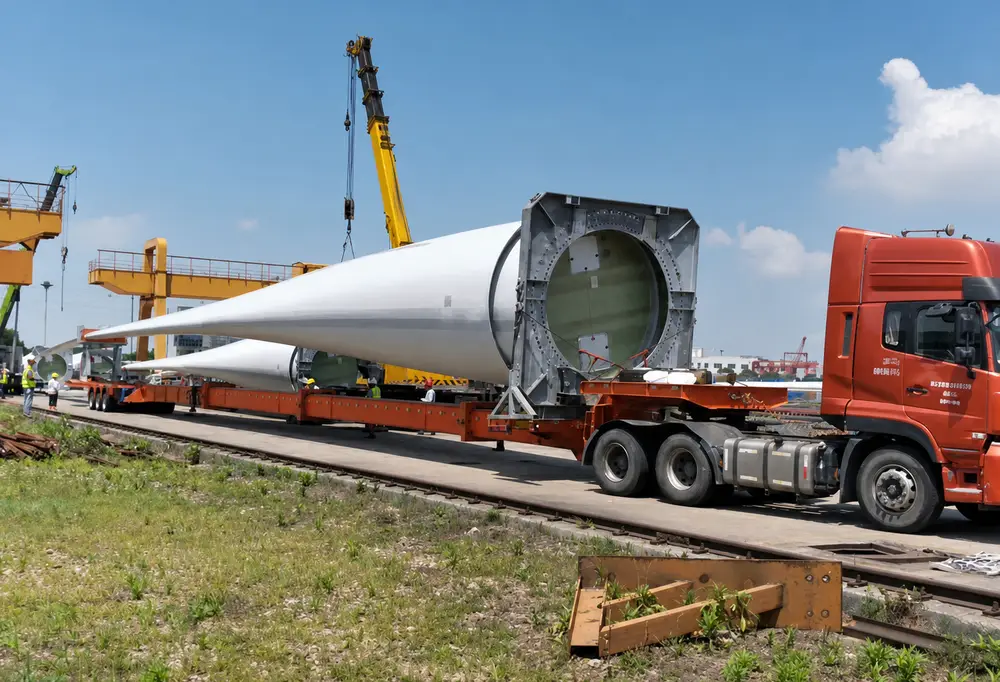
An extendable trailer, also called a telescopic trailer, is a semi-trailer with a sliding main beam that increases the trailer's usable length for overlength cargo. It is commonly used for wind turbine blade transport, wind tower sections, bridge sections, steel beams, tanks, and other loads that are too long for a fixed-length flatbed.
The trailer is extended and locked at the length required for the cargo. After unloading, it can be retracted to reduce its overall length for empty travel. Long configurations often use steerable rear axle groups to control off-tracking and tail swing on curves.
Important: Extension length, payload, axle load, steering angle, and travel speed are model- and project-specific. The figures in this guide describe reference configurations, not universal limits for every extendable trailer.
Quick answers
| Question | Short answer |
|---|---|
| What does an extendable trailer do? | It lengthens its load-carrying structure to support overlength cargo. |
| Is a telescopic trailer the same thing? | In heavy-haul transport, the terms are commonly used interchangeably. |
| What cargo can it carry? | Wind turbine blades, tower sections, bridge sections, steel beams, tanks, and similar long loads. |
| Why do long trailers need steering? | Rear steering reduces off-tracking and helps the combination negotiate curves and confined access roads. |
| Can one specification fit every project? | No. Cargo data, route geometry, axle-load limits, permits, and operating speed determine the required configuration. |
Extendable, telescopic, and stretch trailer terminology
These names overlap, but the context matters.
| Term | Typical meaning in heavy-haul transport | Search or purchasing note |
|---|---|---|
| Extendable trailer | A trailer that lengthens to carry overlength cargo | The broadest and most widely understood term |
| Telescopic trailer | An extendable trailer whose frame sections slide inside or alongside one another | The term can also describe unrelated telescopic dump trailers, so include the cargo context |
| Stretch trailer | A common name for an extendable flatbed, step-deck, double-drop, or RGN trailer | Often used in North American freight terminology |
| Wind turbine blade trailer | An extendable or specialized trailer configured to support a turbine blade | Blade supports, steering, swept path, and transport height are key |
| Wind turbine tower trailer | A trailer configured for cylindrical tower sections | Concentrated load, cradle design, center of gravity, and axle distribution are key |
This guide focuses on longitudinally extendable heavy-haul trailers. A width-expandable trailer is a different configuration designed to increase platform width rather than length.
How an extendable trailer works
The main beam contains two or more telescoping sections. Depending on the design, the sections are pulled out mechanically or moved with hydraulic assistance. Locking pins or another engineered locking system secure the selected extension position.
A typical operating sequence is:
- Confirm the approved transport drawing, cargo support points, axle loads, and route plan.
- Park the unloaded trailer on suitable level ground and follow the manufacturer's extension procedure.
- Release the specified locking devices.
- Extend the beam to the required stage and length.
- Engage and verify every required lock or pin.
- Position the supports, cradles, or tail platform specified in the loading plan.
- Load, support, and secure the cargo at its approved points.
- Test steering, brakes, lighting, hydraulic functions, and communications before travel.
- Retract and lock the trailer after unloading when the operating procedure and route permit it.
The exact sequence, exclusion zone, support method, and inspection checklist must come from the trailer manual and the project method statement.
Common cargo and wind-energy applications
Wind turbine blades
Wind turbine blades are long, relatively light for their size, and sensitive to support conditions. A blade transport configuration must account for:
- blade length, root diameter, weight, and center of gravity;
- approved root and tip support locations;
- trailer extension, rear overhang, off-tracking, and tail swing;
- transport height and lateral clearance;
- crosswind operating limits and project-specific securing requirements;
- road curvature, junction geometry, gradients, bridges, and wind-farm access roads.
Wind turbine tower sections
Tower sections can create higher concentrated loads than blades. Selection therefore depends on the section diameter, weight, center of gravity, cradle positions, tractor fifth-wheel load, axle-line distribution, and local road limits.
Other long cargo
Extendable trailers can also be configured for bridge sections, precast components, steel structures, long tanks, pipes, and industrial equipment. Cargo length alone is not enough to select a trailer; weight distribution and support conditions are equally important. For general cargo with flexible length requirements, see our 4 Axles 80Ton Extendable Sidewall Semi Trailer.
Main components of an extendable trailer
The principal systems are the gooseneck, steering system, extendable beam, axle groups, suspension, tail platform, brakes, hydraulics, electrical system, and power unit.
1. Gooseneck
The gooseneck connects the trailer to the tractor's fifth wheel. On some heavy-haul designs, hydraulic adjustment changes the coupling height or trailer attitude. The gooseneck can also transmit the tractor-trailer articulation signal to a forced-steering system.
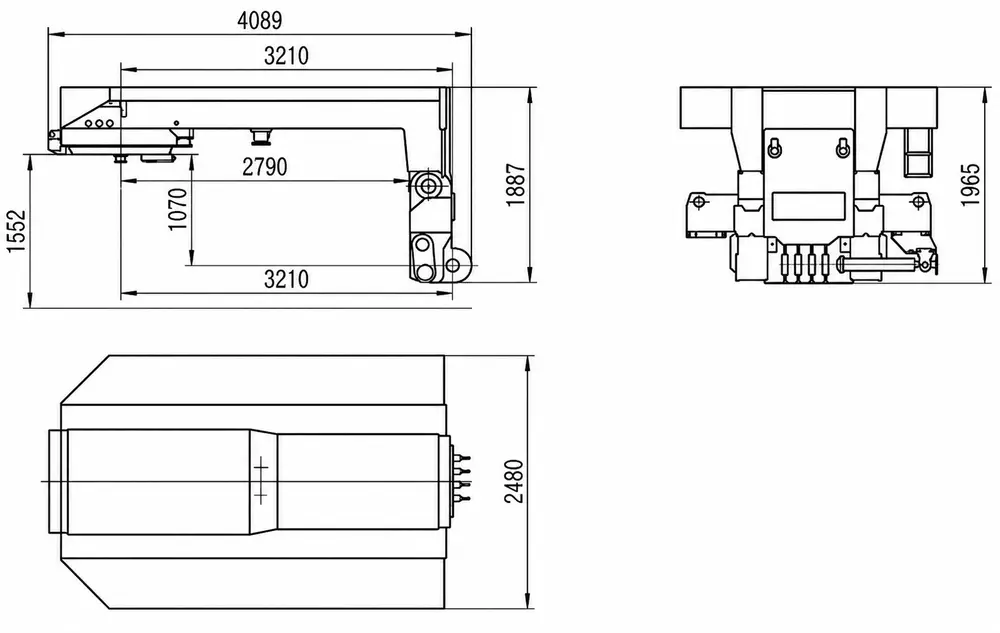 Dimensioned engineering drawing of a hydraulic gooseneck
2. Steering system
As the trailer becomes longer, fixed rear axles create more off-tracking and tire scrub. Steerable axle groups help the rear of the trailer follow the tractor's path and can reduce the swept path required at bends.
The correct steering geometry must be checked with a project-specific swept-path analysis. A steering angle by itself does not prove that a trailer can negotiate a route.
Steering configurations
Hydraulic steering bogies
Hydraulic steering bogies can provide high steering angles and allow automatic or operator-assisted correction. A reference design shows steering up to ±55°. This value is model-specific.
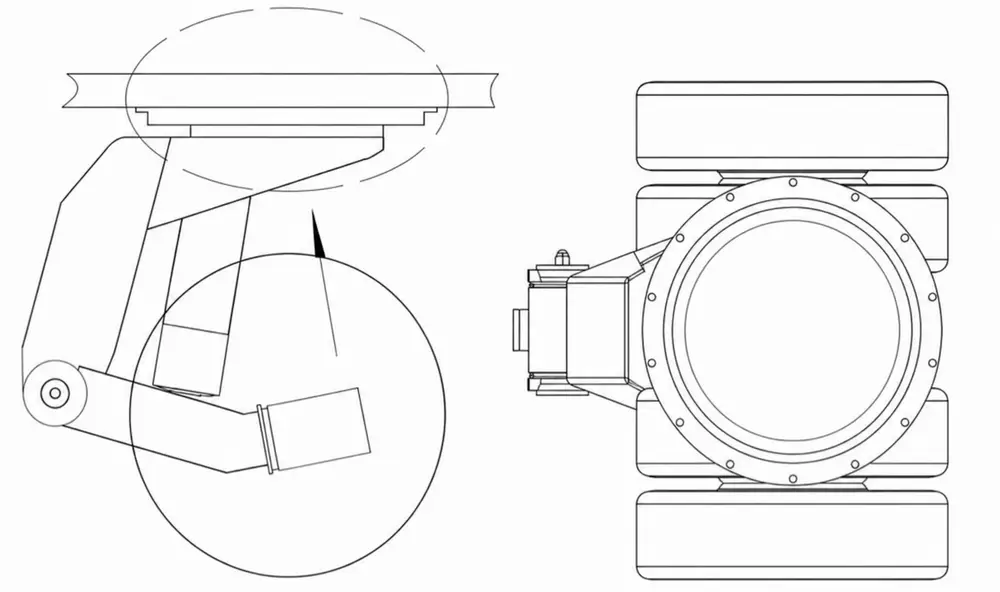 Hydraulic steering bogie for an extendable trailer
Hydraulic systems add capability but also require a power source, hoses, valves, controls, maintenance procedures, and a defined response to hydraulic or control failure.
Turntable steering
In a turntable arrangement, an axle group rotates on a turntable. A reference design shows a steering range of ±45°.
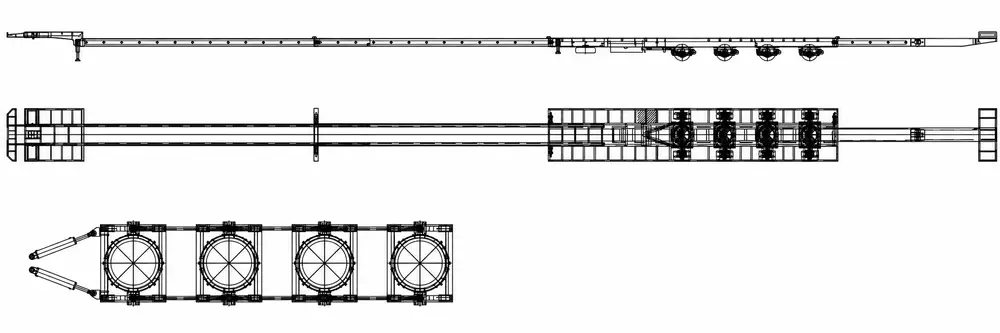 Turntable steering arrangement on a telescopic trailer
Self-steering axles
Self-steering axles are mechanically simpler than a fully forced hydraulic steering system. They can reduce tire scrub during forward travel, but their behavior during reversing and low-speed maneuvering must be considered.
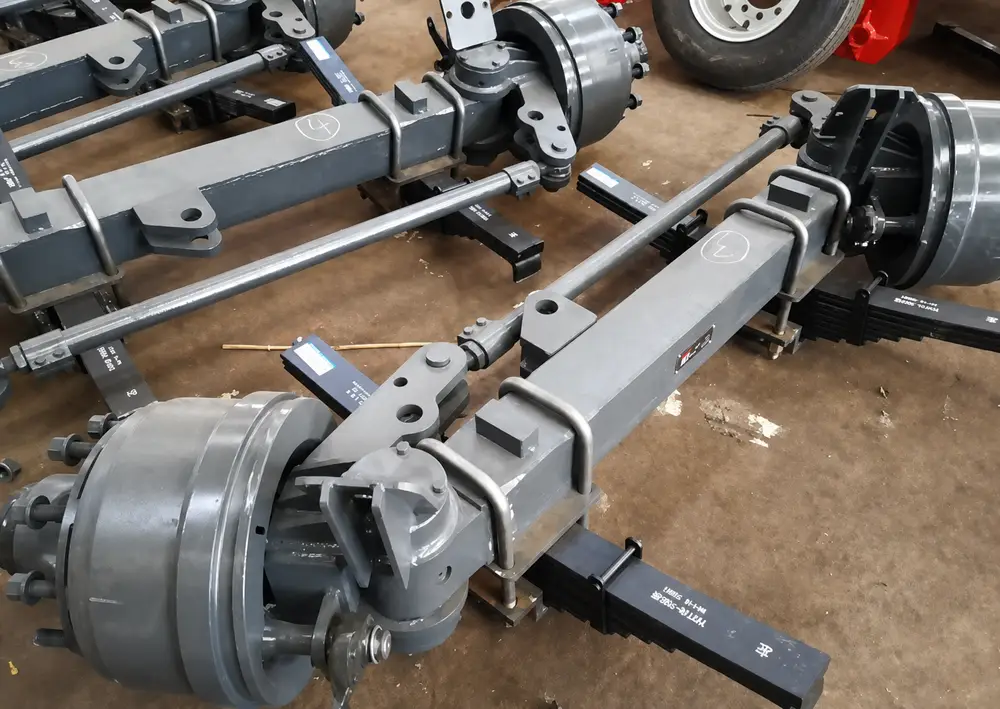 Self-steering axle assemblies and steering linkages
Extendable beam and tail platform
Extendable beam
The beam is the primary load-carrying structure. It must resist bending and torsion in both retracted and extended conditions. Hydraulic lines, electrical cables, and steering-control connections may pass through or alongside the telescoping structure.
Depending on the model, a trailer may have two, three, or four extension stages. More stages can provide a greater extension range, but every stage adds structural, locking, hose-routing, inspection, and maintenance requirements.
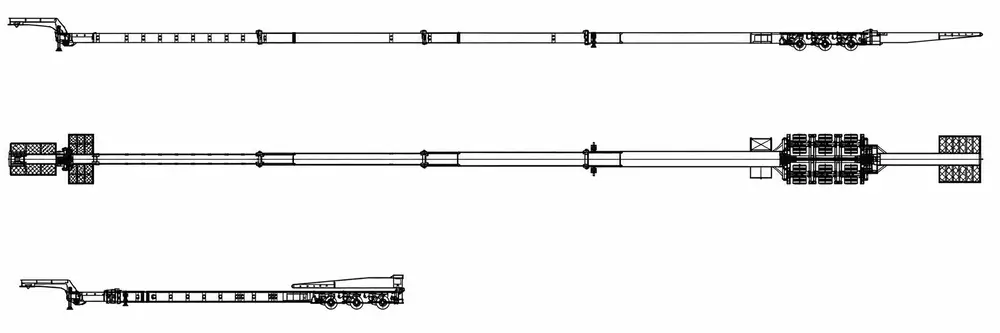 Engineering drawing of a three-stage extendable telescopic trailer
Tail platform
A tail platform provides additional support or working length at the rear. Two common arrangements are:
- Folding platform: folds onto the main structure when it is not required.
- Pull-out platform: slides into or out of the rear structure.
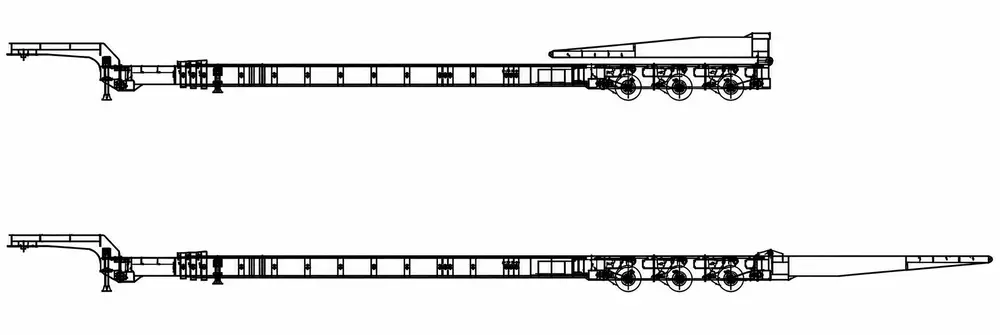 Folding tail platform in retracted and extended positions
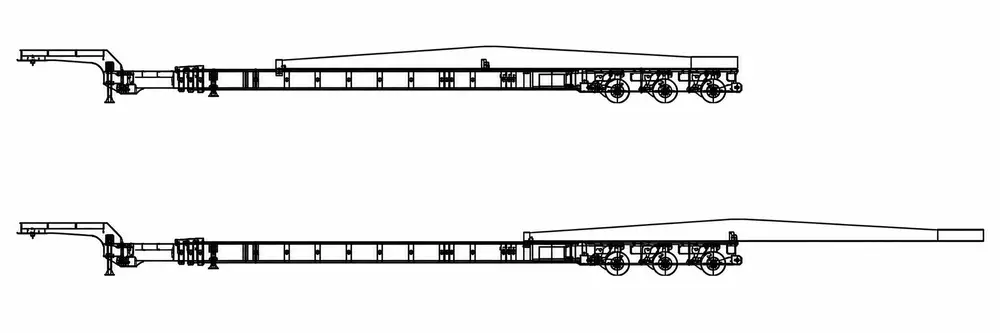 Pull-out tail platform in retracted and extended positions
Materials and structural design
Material grade is only one part of structural design. Beam geometry, weld details, stress concentrations, fatigue, extension position, support spacing, load distribution, travel speed, road inputs, and the required safety factors must also be evaluated.
Q460 high-strength structural steel is one example used for an extendable beam. The table below is a text conversion of a reference material-property sheet. Before using these values for design or procurement, confirm the governing steel standard, quality grade, delivery condition, thickness range, inspection requirements, and material certificates.
| Steel grade | Quality grade | Min. yield strength, ≤50 mm (MPa) | Min. yield strength, >50–100 mm (MPa) | Tensile strength (MPa) | Min. elongation A5 (%) | Charpy V, 0°C (J) | Charpy V, −20°C (J) | Charpy V, −40°C (J) | 180° cold-bend test |
|---|---|---|---|---|---|---|---|---|---|
| Q420 | C, D, E | 420 | 400 | 520–670 | 18 | 40 | 40 | 27 | d = 3a |
| Q460 | C, D, E | 460 | 440 | 550–710 | 17 | 40 | 40 | 27 | d = 3a |
| Q500 | D, E | 500 | 480 | 610–770 | 16 | — | 40 | 27 | d = 3a |
| Q550 | D, E | 550 | 530 | 670–830 | 16 | — | 40 | 27 | d = 3a |
| Q620 | D, E | 620 | 600 | 720–890 | 15 | — | 40 | 27 | d = 3a |
| Q690 | D, E | 690 | 670 | 770–940 | 14 | — | 40 | 27 | d = 3a |
In the bending notation, d is the bend diameter and a is the specimen thickness. A dash means the reference sheet did not list a value.
For more on how frame structure determines load limits, read our article on semi-trailer frame carrying capacity.
Steering control methods
Depending on the steering system and project requirements, control can include:
- Automatic follow steering: the gooseneck articulation signal commands the trailer steering system.
- On-trailer control box: an operator controls specified hydraulic functions from the trailer.
- Radio remote control: an operator makes permitted corrections during low-speed maneuvering.
Automatic steering is useful during normal travel, while manual or remote correction can help in confined areas. The operating procedure must define who controls the trailer, how the driver and steering operator communicate, the permitted speed, and the response to a lost signal or hydraulic fault.
Reference extendable trailer specifications
Two reference specification sheets have been converted into searchable text below. These are reference configurations only.
Reference A: 32.5 m extendable trailer with four axle lines
| Parameter | Reference value |
|---|---|
| Type | 32.5 m extendable trailer |
| Axle lines | 4 |
| Rated load per axle line at 1 km/h | 28,000 kg |
| Rated load per axle line at 5 km/h | 26,000 kg |
| Approximate dead weight | 32,000 kg |
| Stated total payload | 100,000 kg |
| Overall length | 23,380–36,510 mm |
| Total width | 3,000 mm |
| Loaded height | 1,080 ± 300 mm |
| Wheelbase | 1,550 mm |
| Track | 1,800 mm |
| Tire sizes | 7.5R15; 215/75R17.5 |
| Rim size | 6.00-15 |
| Number of tires | 32 |
| Steering angle | 55° |
| Power unit | 22 kW Deutz engine |
| Hydraulic gooseneck | ±400 mm movement; stated 30-ton capacity |
Reference B: 55 m extendable trailer with three axle lines
| Parameter | Reference value |
|---|---|
| Type | 55 m extendable trailer |
| Axle lines | 3 |
| Rated load per axle line at 1 km/h | 28,000 kg |
| Rated load per axle line at 5 km/h | 26,000 kg |
| Approximate dead weight | 30,000 kg |
| Stated total load | 55,000 kg |
| Overall length | 23,065–58,365 mm |
| Extension arrangement | Three-stage extension; 7 m folding flatbed at the tail |
| Total width | 3,000 mm |
| Loaded height | 1,080 ± 300 mm |
| Wheelbase | 1,550 mm |
| Track | 1,800 mm |
| Tire sizes | 7.5R15; 215/75R17.5 |
| Rim size | 6.00-15 |
| Number of tires | 24 |
| Steering angle | 55° |
| Power unit | 22 kW Deutz engine |
| Hydraulic gooseneck | ±400 mm movement; stated 30-ton capacity |
The low-speed axle-line ratings above must not be applied at a different speed without manufacturer approval. The final specification should state whether each figure is payload, gross combination load, structural capacity, fifth-wheel load, or axle-line capacity.
How to select an extendable trailer
Start with the cargo and route, not with a nominal trailer length.
1. Provide complete cargo data
- cargo drawing and description;
- length, width, height, and total weight;
- center of gravity;
- approved lifting, support, and securing points;
- maximum permitted support reactions;
- required ground clearance and transport orientation.
2. Complete a route and swept-path study
Check junctions, roundabouts, grades, crests, crossfall, bridge capacities, overhead clearance, roadside obstacles, access-road width, turning areas, and delivery-site conditions. Model the complete combination, including tractor, gooseneck, axle groups, cargo overhang, steering behavior, and tail swing.
3. Match the trailer configuration
| Selection item | What to confirm |
|---|---|
| Length range | Retracted length, each extension stage, maximum operating length, and lock positions |
| Load capacity | Structural payload, axle-line load at stated speed, fifth-wheel load, and load distribution |
| Steering | Type, maximum angle, automatic and manual modes, reversing behavior, and emergency procedure |
| Suspension | Type, lift range, leveling capability, and ground clearance |
| Gooseneck | Coupling height, movement range, fifth-wheel compatibility, and rated load |
| Tail support | Folding or pull-out platform, cradles, bolsters, and cargo interfaces |
| Brakes and electrical system | Applicable road standard, connectors, lighting, ABS/EBS where required |
| Tires and rims | Size, load rating, speed rating, availability, and spare-parts plan |
| Documentation | General arrangement, load chart, calculations, manuals, certificates, and inspection plan |
4. Confirm legal and operating limits
Oversize and overweight permits, escort requirements, travel windows, axle limits, signage, lighting, and route approvals vary by country and jurisdiction. The permitted road load may be lower than the trailer's structural capacity.
For selection criteria that apply to every trailer type, read our guide on how to choose the right semi trailer.
Extendable trailer vs. blade lifter
An extendable blade trailer normally carries the blade close to horizontal. A blade lifter can raise and rotate the blade to pass obstacles or negotiate some difficult mountain routes.
| Route or project condition | Extendable blade trailer | Blade lifter |
|---|---|---|
| Long route with adequate swept path | Often the simpler option | May add unnecessary complexity |
| Tight hairpins or severe roadside obstacles | May require road modification or a different combination | Can improve obstacle clearance when the engineered route and weather limits allow |
| Low transport height is critical | Often advantageous | Lifted blade position may increase height and wind exposure |
| Crosswind sensitivity | Blade remains relatively low, but project wind limits still apply | Lifted blade creates additional wind and stability considerations |
| Equipment and operator complexity | Lower in many projects | Higher; requires specialized controls, procedures, and trained operators |
The decision should be based on a route study, stability assessment, blade limits, weather criteria, and the transport contractor's method statement—not on blade length alone.
For available extendable configurations, see our 3 Axle 25m Extendable Flatbed Trailer and 20m 100Ton Extendable Lowbed Trailer.
Frequently asked questions
What is an extendable trailer?
It is a semi-trailer with a telescoping frame that can be lengthened and locked to carry overlength cargo, then shortened after unloading.
Is an extendable trailer the same as a telescopic trailer?
In heavy-haul and project-cargo transport, the two terms usually describe the same basic concept. The words “wind turbine,” “flatbed,” or “heavy haul” help distinguish it from telescopic dump trailers.
How is it different from a standard flatbed trailer?
A standard flatbed trailer has a fixed loading length. An extendable flatbed has one or more sliding beam sections and locking positions, allowing it to support longer cargo.
How long can an extendable trailer become?
There is no universal maximum. The reference configurations in this guide include a 55 m class trailer and an example described as extending to approximately 62 m. Other manufacturers and models use different length ranges and stage arrangements.
Can an extendable trailer carry wind tower sections?
Yes, if its cradles, structure, axle distribution, fifth-wheel load, tires, suspension, and route approvals match the tower section's weight, diameter, and center of gravity.
Does an extendable trailer have rear steering?
Many long heavy-haul models use forced hydraulic steering, turntable steering, or self-steering axles. The steering system and angle depend on the model.
Are the payload figures in this guide universal?
No. They are text conversions of two reference specification sheets. Request a project-specific load chart showing the extension position, support spacing, axle loads, fifth-wheel load, travel speed, and road conditions.
What information should I send when requesting a quotation?
Send the cargo drawing, dimensions, weight, center of gravity, support points, route conditions, target country, applicable standards, preferred tractor data, required delivery date, and any limits on length, width, height, axle load, or turning radius.
Conclusion
An extendable or telescopic trailer solves a specific heavy-haul problem: supporting cargo that is longer than a fixed trailer can safely carry. For wind turbine blades and tower sections, the extension range is only one selection factor. Steering geometry, support reactions, axle loads, route clearance, operating speed, controls, and local permits must all be matched to the project.
Before ordering, request a project-specific general arrangement, load distribution, swept-path model, material and welding documentation, operating manual, and inspection plan. That evidence is more useful than comparing maximum length or payload figures in isolation.
For a project review or quotation, provide your cargo drawing and route requirements through the HUAYU contact page.