
What Quality Inspections Are Performed After Oil Tank Semi-Trailer Production?
Published Apr 4, 2026
25 engineers · ISO 9001 · 3C certified · Liangshan factory since 2001
Updated 2026-05-11
7 min read
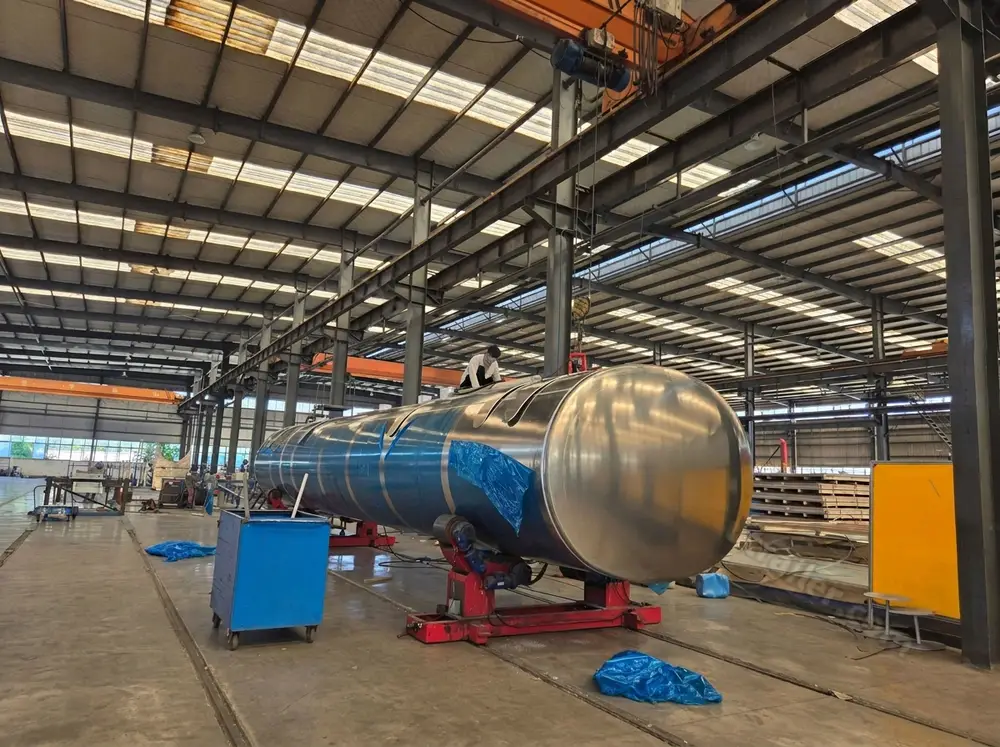
Every oil tank semi-trailer goes through a full inspection sequence before it ships. The cargo these trailers carry — gasoline, diesel, crude oil, benzene — does not forgive shortcuts. One missed weld defect or a seal that holds during a quick shop test but fails on the road turns into leaked fuel, road closures, and liability claims that cost more than the trailer itself.
Here is what a finished tanker trailer goes through at the factory, step by step.
Visual and Component Checks
What Does the Appearance Inspection Cover?
Inspectors walk the entire trailer looking for paint loss, surface cracks, deformation, and weld spatter that was not ground down. Bumpers, mirrors, fender brackets, and all bolt-on components get checked for tight fastening and correct alignment.
This is not cosmetic. Exposed steel on a tanker running coastal or high-humidity routes starts rusting within weeks. Corrosion weakens the shell wall, and on a pressure vessel carrying flammable liquid, wall thinning is a failure waiting to happen. Any paint defect found here gets stripped back to bare metal, re-primed, and recoated before the trailer moves to functional testing.
Why Does the Liquid Level Gauge Need Its Own Test?
The level gauge reading gets compared against a known reference volume in the tank. Electrical connections and signal output are checked. The seal around each gauge fitting is pressurized to confirm no vapor escapes.
An inaccurate gauge causes real operational problems. Overfilling creates pressure spikes that stress the safety valves. Underfilling means the customer disputes delivery volumes. Either way, the problem traces back to the factory.
Bottom Valve Inspection
Bottom valves handle the actual loading and unloading on most fuel tanker trailers. Inspectors cycle each valve through at least 10 full open-close operations under pressure. They check for smooth actuation, proper return-spring tension, and any trace of oil around the valve body or pipe connections.
Even a minor bottom valve leak is a hard rejection. The valve gets swapped, and the test runs again from scratch.
How Are Safety Valves and Filters Tested?
Safety valves protect the tank when internal pressure exceeds the design limit. Each valve is checked for secure mounting, correct trip pressure, and fast reset after actuation. A valve that trips too late or sticks in the open position defeats the purpose of having one at all.
Filters get checked for installation torque, flow resistance, and debris capture. A clogged filter restricts fuel flow during unloading. A loose filter lets particulates into the tank, which contaminates the cargo and creates downstream problems for the customer's equipment.
How Does the Air Tightness Test Work?
The tank is sealed and pressurized to a test differential — typically 36 kPa for atmospheric tank trailers. Inspectors hold the pressure for 30 minutes and watch the gauge. Any measurable pressure drop means a leak exists somewhere in the assembly.
This catches failures that no visual inspection can find: hairline weld cracks, gasket seats that look good but do not seal under pressure, fitting threads that are finger-tight but not wrench-tight. The inspector marks the trailer for rework, and it does not proceed to the next station until the retest reads zero decay.
Pressure and Material Testing
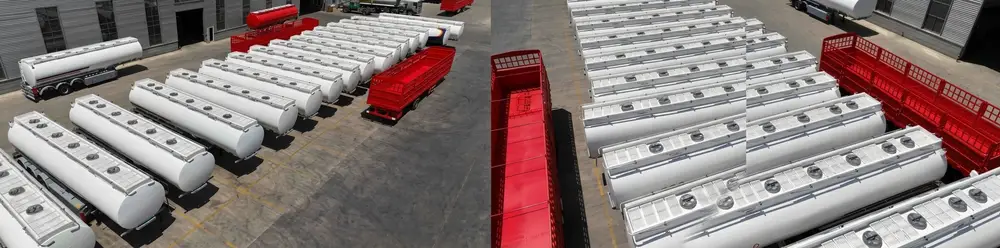 Hydrostatic and air pressure testing of oil tank semi-trailers
Hydrostatic (Water Filling) Test
The hydrostatic test is the single most important structural test for a tank trailer. The entire tank is filled with water, then pressurized above the rated working pressure. All pipe joints, valve connections, and manhole covers must be confirmed sealed before pressurization begins.
Inspectors hold pressure for the specified duration and watch for three things:
- Visible water seepage at any weld, fitting, or valve connection
- Permanent deformation of the tank shell (measured with dial indicators on large-volume tanks)
- Gauge pressure dropping over the hold period
One critical safety rule applies here: no joint, fitting, or cover may be loosened until the pressure inside the tank has returned to zero. Releasing a pressurized connection on a water-filled tank generates enough force to cause serious injury. This is not a suggestion. It is a hard procedural requirement.
Air Pressure Test
Air pressure testing works alongside the hydrostatic test, not as a replacement. A calibrated gauge is connected to the tank, pressure is raised to the target value, and inspectors hold it for the set period while monitoring for decay.
Why both tests? Water is incompressible, so it applies uniform stress across the tank wall. Good for finding structural weakness. But water does not escape easily through micro-defects — it seals small gaps by surface tension alone. Air does escape through those same micro-defects. Running both tests together catches the full range of potential failures, from structural deformation down to pinhole-sized weld porosity.
What Materials Are Tested and Why?
Tank body material directly determines what cargo the trailer can carry and how long the tank lasts. The standard build is Q345B carbon steel for petroleum transport. Weight-sensitive operations use aluminum alloy instead. Chemical and food-grade applications call for stainless steel.
Material testing checks four things:
- Tensile strength — can the steel handle full-load highway stress without permanent deformation?
- Corrosion resistance — will the tank wall survive years of contact with the specific liquid it carries?
- Pressure resistance — do the walls hold rated internal pressure with margin?
- Load bearing — does the full assembly support the rated payload weight, including dynamic loads from braking and cornering?
A material certificate from the steel mill is not enough on its own. The factory runs coupon tests from the same batch of plate used in the tank to confirm the mill specs match real performance.
Non-Destructive Testing (NDT)
Standard pressure and visual tests catch surface-level problems. NDT goes deeper. It finds defects buried inside the tank wall or hidden within weld cross-sections.
Ultrasonic Testing
An inspector places a piezoelectric probe on the tank surface and sends high-frequency sound pulses into the metal. Sound travels through solid steel at a consistent speed. When a pulse hits a crack, void, or slag inclusion, part of the energy reflects back earlier than expected. The instrument displays the reflected signal as a spike on a time-base screen.
By reading the spike position and amplitude, the inspector determines defect location, size, and type — all without cutting into the tank. Ultrasonic testing is the go-to method for detecting delamination, porosity, and incomplete weld fusion in tank walls and longitudinal seam welds.
Radiographic Testing
Radiographic testing works on the same principle as a medical X-ray. A radiation source sits on one side of the tank wall. A detector or film sits on the other. Radiation passes through solid metal at one intensity, but cracks, voids, and slag inclusions absorb or scatter it differently. The result is a permanent image showing exactly what is inside the weld.
That permanent record matters. Radiographic film gets archived with the trailer's quality file. If a weld fails in service years later, the factory can pull the original radiograph and compare it to the failure site. This creates traceability that pressure testing alone cannot provide.
What Happens If Quality Inspections Are Skipped?
Oil tank trailers run hard — long highway stretches, temperature cycles from hot cargo to cold ambient, constant vibration, and years of contact with corrosive fuel. Hidden defects do not stay hidden forever.
A weld crack that passes a cursory check will propagate under road vibration. After thousands of kilometers, it becomes a through-wall leak. A valve seal that barely holds during a 5-minute shop test will fail after several thousand loading cycles. And once a loaded tanker starts leaking fuel on a highway, the cleanup and regulatory costs typically exceed the value of the trailer several times over.
The inspection steps above are not optional extras. They are the baseline for any manufacturer building fuel tanker trailers intended for real-world service. If you are evaluating a tanker manufacturer and they cannot walk you through this testing sequence in detail, that tells you something worth knowing.
For a deeper look at how to choose a fuel tank trailer — materials, design, pricing — see our buying guide. Ready to talk specs? Contact our team for a quote on quality-inspected oil tank trailers.