Semi Trailer Landing Leg: Types, Selection, and Maintenance
Published Apr 4, 2026
25 engineers · ISO 9001 · 3C certified · Liangshan factory since 2001
Updated 2026-05-11
9 min read
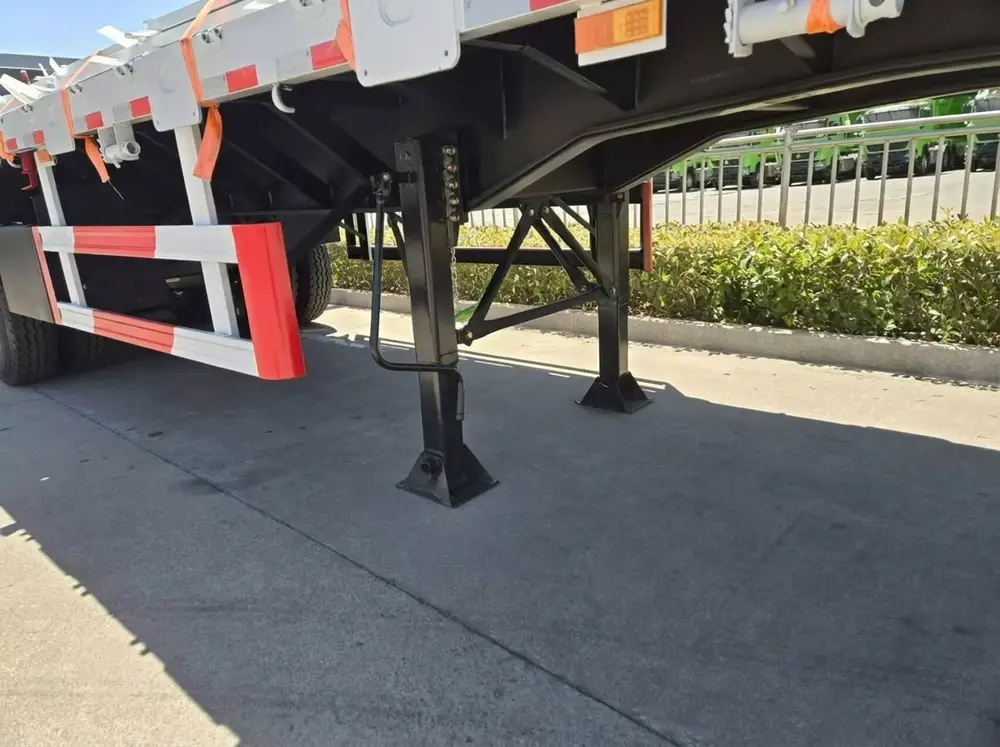
Every semi-trailer needs a way to stand on its own when the tractor drives away. That's the job of the landing leg — a pair of telescoping support devices bolted to the front underside of the trailer frame. They hold the trailer level when it's parked, and they let the driver crank the front end up or down to match the tractor's fifth wheel height during coupling.
It sounds simple, but landing legs take a beating. They support 5 to 15 tonnes of static kingpin load while sitting on surfaces that range from flat concrete depot floors to muddy unpaved yards. A seized landing gear that won't crank down at a busy terminal holds up the entire loading queue. And a leg that collapses under load can drop the trailer nose onto the ground — damaging the frame, the kingpin, and whatever's sitting underneath.
We install landing legs on every trailer we build, and the spec decisions we make at the factory directly affect how that trailer performs in the field for the next 10-15 years. Here's what goes into those decisions.
What Does a Landing Leg Actually Need to Do?
Before getting into types and classifications, it helps to understand the three non-negotiable requirements:
Hold the trailer level when uncoupled. The legs must keep the front of the trailer at fifth wheel height — roughly 1,200-1,350mm from the ground — without settling, tilting, or walking on the surface. On a loaded 3-axle flatbed carrying 40 tonnes, the static load at the kingpin can reach 12 tonnes or more. Both legs share that load equally, so each leg needs to support at least 6 tonnes with a safety margin.
Raise and lower quickly during coupling. Drivers couple and uncouple trailers dozens of times per week in drop-and-hook operations. If cranking the legs takes 5 minutes each way, that's 10 minutes of unproductive time per swap — which adds up to hours per week across a fleet. Fast free-travel (the unloaded speed) and manageable loaded cranking effort are both essential.
Survive real-world abuse. Landing legs operate in dust, rain, mud, and road salt. Drivers bump them with forklifts. They sit extended for days in wet yards. The gear mechanism, tube surfaces, and foot pads all need to handle this without seizing, bending, or corroding through.
Types of Landing Legs by Operation Mode
This is the first decision when speccing a trailer, and it affects both cost and daily usability.
Linkage (ganged) legs connect both sides through a cross-shaft so operating one crank raises or lowers both legs simultaneously. One driver, one crank handle, both sides move at the same speed. This is what we install on most of our standard highway trailers — flatbeds, side walls, and skeleton trailers — because it halves the coupling time and guarantees even leg height.
Single-acting legs operate independently. Each side has its own crank. The upside is simpler construction and lower cost. The downside is real: the driver has to walk back and forth between both sides, and if one leg is cranked lower than the other, the trailer sits at an angle. We see single-acting legs mostly on budget trailers or specialty units where independent height control matters — like low beds that need one side lower for ramp loading.
Electric landing legs replace the manual crank with an electric motor powered by the trailer's electrical system or a standalone battery pack. The driver presses a button instead of cranking 50+ turns. For operations that swap trailers 10-20 times per day, the time savings and reduced physical strain pay for the higher upfront cost within months. We're seeing growing demand for electric legs in Middle Eastern and Central Asian markets where fleet sizes are large and driver retention matters.
Tube Shape: Why It's Not Just a Manufacturing Detail
The outer and inner tubes of a landing leg slide against each other thousands of times over the trailer's life. The cross-section shape determines how smoothly that happens and how well the leg resists twisting under load.
| Tube Shape | Rotation Resistance | Weight | Typical Use |
|---|---|---|---|
| Round | Low — can rotate under uneven load | Lightest | Light-duty, budget trailers |
| Square | High — flat faces lock against rotation | Medium | General-purpose highway trailers |
| Octagonal | High — combines anti-rotation with smoother extension | Medium-high | Heavy-duty and premium trailers |
Most landing legs from established brands use either square or octagonal tubes. Round tubes are cheaper to manufacture but offer almost no resistance to rotation, which means the foot can twist out of position on soft ground. For any trailer carrying over 30 tonnes gross, square or octagonal is the right spec.
Gear Stages: Matching Speed to Load
The gear mechanism inside a landing leg trades cranking speed for mechanical advantage. More stages means the driver can switch between fast travel (when the leg is unloaded) and high-torque lifting (when supporting the trailer's weight).
Single-stage gears have one fixed ratio. Cranking effort stays the same whether the leg is loaded or not. This works for trailers with light kingpin loads — under 5 tonnes — but becomes physically exhausting on anything heavier.
Two-stage (dual-speed) gears are the industry standard. High gear moves the leg quickly through the free-travel range (extending or retracting without load). Low gear engages when the foot touches the ground and the driver starts lifting the trailer's weight. The shift between gears happens automatically or with a simple lever pull. This is what we spec on virtually all our standard trailers.
Three-stage gears add a third ratio for extra-heavy kingpin loads. They're uncommon on standard highway trailers but show up on specialized units like heavy-duty low beds where the front-end weight can exceed 15 tonnes.
Fixed vs Folding Legs
Fixed legs telescope straight up into the trailer frame when retracted. The tube stays in one piece — simple, strong, and there's one less mechanism to fail. The trade-off is that the retracted leg hangs lower, reducing ground clearance. On most highway trailers, this isn't an issue.
Folding legs hinge the lower section upward when retracted, tucking the foot closer to the trailer frame. This gives better ground clearance for trailers that need it — ramp access on low beds, off-road clearance on tipper trailers working construction sites, or any route with uneven terrain. The hinge adds a failure point that requires periodic inspection, but modern folding designs are reliable when maintained.
Foot Type: Matching the Ground Surface
The foot is where the landing leg meets the ground, and picking the wrong type for your operating conditions causes problems fast.
- Rubber pad — A flat rubber cushion bonded to a steel plate. Best for paved depot floors and concrete yards. The rubber grips the surface and absorbs vibration. This is the default on most highway trailers.
- Articulated (swivel) foot — The foot pivots to maintain flat contact on uneven or sloped ground. Essential for trailers that park on unpaved surfaces where both feet rarely sit at the same angle.
- Ball-and-socket foot — Similar to articulated but with multi-axis movement. Used on heavy trailers in rough terrain where the ground surface is unpredictable.
- Roller foot — Has a built-in wheel so the trailer can be pushed sideways by hand or with a yard tractor. Common in container terminals and distribution centers where trailers get repositioned without a road tractor.
Landing Leg Maintenance: What Gets Skipped and What It Costs
Landing legs fail for one reason more than any other: lack of lubrication. The gear mechanism and tube surfaces need grease to operate smoothly. Without it, the gears bind, the tubes seize, and what should be a 60-second crank becomes a 20-minute fight — or a call for a mobile mechanic.
Here's the maintenance schedule we recommend, which is also covered in our trailer maintenance guide:
| Task | Interval | What Happens If Skipped |
|---|---|---|
| Grease gear mechanism and screw | Every 3 months or 10,000 km | Gears seize, crank handle won't turn |
| Lubricate inner tube surface | Every 3 months | Tubes stick, jerky extension/retraction |
| Inspect foot pad for damage | Every service | Cracked pad slips on wet concrete, trailer shifts |
| Check cross-shaft alignment (linkage type) | Every 6 months | Uneven leg operation, one side drags |
| Inspect for corrosion on tubes and housing | Every service | Pitting weakens tube wall, reduces load rating |
Sand and dust environments — Central Asia, the Middle East, sub-Saharan Africa — accelerate wear on the tube surfaces. Grit trapped between the inner and outer tubes acts like sandpaper every time the leg extends or retracts. In these regions, increase the lubrication frequency to every 5,000 km or monthly, and wipe down the exposed inner tube before retracting.
How to Pick the Right Landing Leg for Your Trailer
Match the leg spec to three things: kingpin load, operating environment, and coupling frequency.
For standard highway use on paved roads — hauling containers on a flatbed, dry goods on a side wall trailer, or fuel on a tanker — linkage legs with two-stage gearing and rubber pad feet handle the job. This covers 80% or more of trailers on the road.
For heavy or specialized applications — 100-tonne low beds, construction site tippers, or off-road operations — step up to folding legs with articulated feet and consider three-stage gearing if the kingpin load exceeds 12 tonnes.
For high-volume drop-and-hook fleets where time is money, electric legs pay for themselves fast.
If you're speccing a new trailer and want to discuss landing leg options, get in touch. We can match the configuration to your operating conditions, load profile, and budget.