
How Does a Tanker Trailer Work? A Manufacturer's Mechanical Walkthrough
Published May 7, 2026
25 engineers · ISO 9001 · 3C certified · Liangshan factory since 2001
Updated 2026-05-11
18 min read
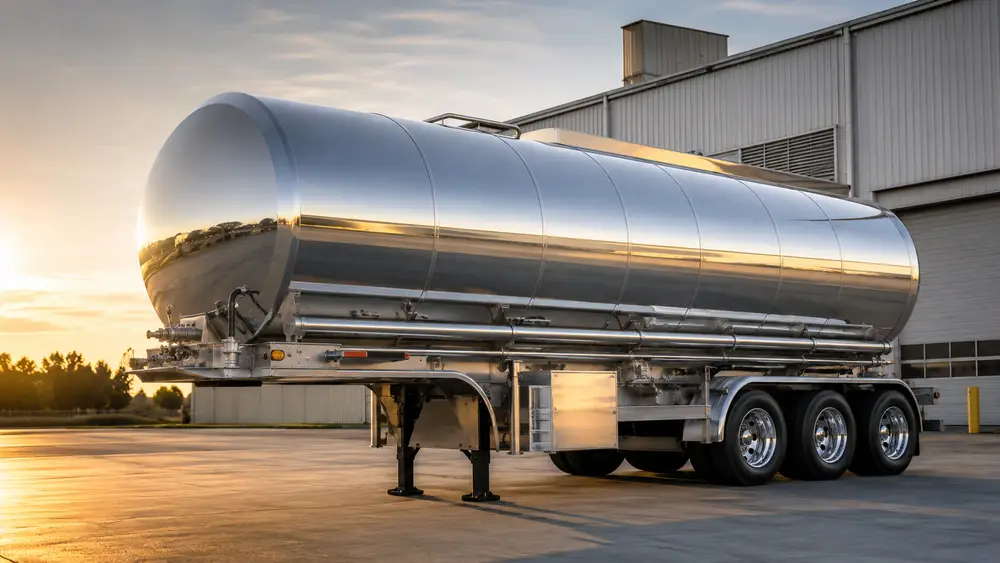
In our Liangshan plant the question we hear most from first-time buyers is not about price. It is "how does a tanker trailer work" — what is the metal cylinder really doing, why does the half-load roll over, why won't a centrifugal pump empty the last few hundred liters. A tanker trailer is a system, not a tube on wheels: shell, baffles, bottom valves, vapor vents, pumps, suspension, and a driver whose inputs interact with a moving mass of liquid. This guide walks the cargo's path from terminal to discharge and explains, step by step, what each piece of hardware does and why it is built that way.
What Is a Tanker Trailer, and Why Cylindrical?
A tanker trailer is a wheeled pressure vessel built to move bulk liquids, gases, or fluidized powders behind a tractor unit. The cylindrical or oval shape is not styling. It is a stress-distribution choice.
Liquids inside a sealed shell push outward against the wall. A flat side concentrates that force at the corners and creates fatigue cracks within a few thousand load cycles. A pure cylinder spreads the same force evenly along the wall as hoop stress, so the wall can be thinner and the tank lighter. The trade is height. A tall cylinder pushes the loaded center of gravity above the 4-meter European bridge envelope and the 13-foot 6-inch United States limit, and a high center of gravity is the single biggest predictor of rollover.
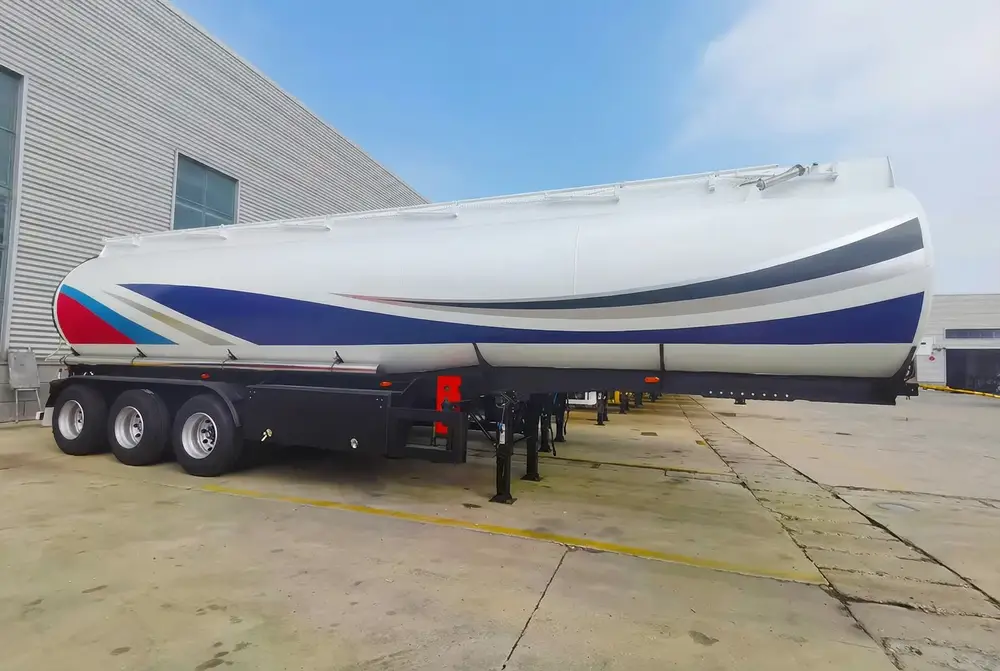
Most fuel and water tankers solve this with an oval cross-section. The oval keeps the corner-free wall geometry and drops the loaded center of gravity by roughly 100 to 200 mm compared with a same-volume true cylinder. Pure cylinders survive on the road only where pressure makes them mandatory — LPG, propane, and cryogenic builds running 250 psi and above. Our 40,000-liter carbon steel oil tanker uses a 11,600 × 2,500 × 3,700 mm oval shell for exactly this reason.
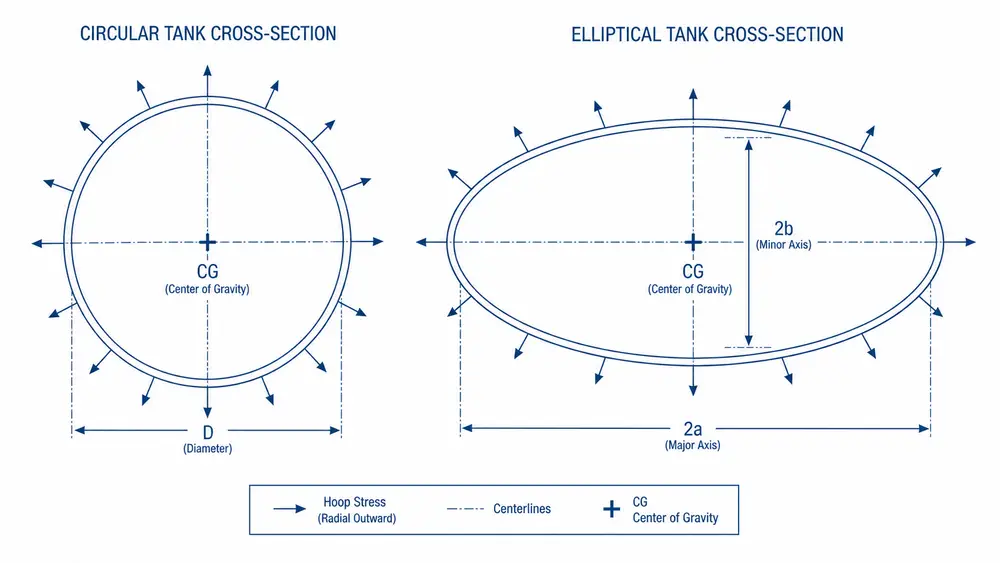 Cylindrical vs elliptical tank cross-section comparing center of gravity
What's Inside the Tank? Baffles, Bulkheads, and Compartments
Inside a fuel tanker shell you will find vertical steel plates running across the diameter at 1.2-2.0 meter intervals. They look identical from the outside. They behave very differently in service.
Bulkheads vs. Baffles — The Critical Difference
A bulkhead is a fully sealed transverse partition that splits the shell into independent compartments. Each compartment carries its own product, its own manhole, its own bottom valve, and its own vent stack. Six-compartment fuel tankers are common because a single trailer can deliver gasoline, diesel, and kerosene on the same dispatch run without any cross-contamination between products.
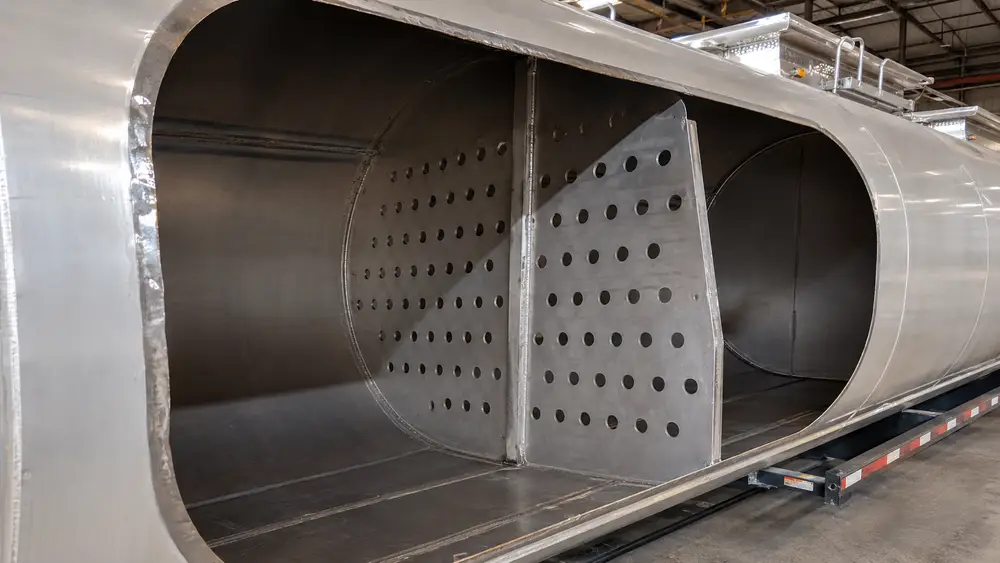 Internal baffle plates with staggered hole pattern inside a fuel tanker shell
A baffle is a perforated plate. The shell is one continuous space; liquid flows through the holes. Per United States 49 CFR §178.346-2, a DOT 406 fuel tank can have at most 60 inches (about 1.52 m) between any two transverse stiffeners — bulkhead, baffle, or ring stiffener. Industry build practice for our export-spec tankers runs 1.2-2.0 m baffle spacing with 30-50% open hole area. The hole pattern is staggered so a tank inspector can crawl the full length for weld and corrosion checks.
What Baffles Cannot Do
This is the part most online guides get wrong. Baffles cut longitudinal surge — the front-to-back rush of liquid under hard braking — by about 40-60%. They do almost nothing for lateral surge, the side-to-side movement that triggers rollovers in turns. The baffle plates run perpendicular to the truck's length, so liquid flowing left-to-right in a corner sees no obstruction at all. A tanker with perfect baffles can still roll over in a sharp curve. Baffles solve a different problem from the one drivers most need solved.
How Does Loading Work? The Bottom-Loading Sequence Step by Step
A modern fuel terminal loads through a 4-inch API adapter on the side of the tanker, not through the manhole on top. The procedure has eight ordered steps and every one of them is gated by a safety interlock.
The 8-Step Bottom-Loading Procedure
- Park the tractor square to the loading rack and chock the trailer wheels.
- Connect the rack's grounding clip to the truck's dedicated ground stud. A continuous monitor verifies the loop reads ≤10 ohms; if it doesn't, the rack pump will not start.
- Plug the overfill probe cable into the truck's socket. The rack runs a self-test pulse on every compartment's optic probe.
- Couple the vapor recovery hose to the trailer's vapor adapter on the dome.
- Couple the API liquid adapter to each compartment's bottom inlet.
- The rack ramps flow at less than 1 m/s linear velocity until the inlet is submerged to twice the pipe diameter, then climbs to working rate around 600 GPM.
- Flow stops automatically when the optic probe makes contact with rising liquid, or when the rack's pre-set volume meter trips.
- Disconnect in reverse order: API liquid first, vapor recovery second, overfill plug third, ground clamp last.
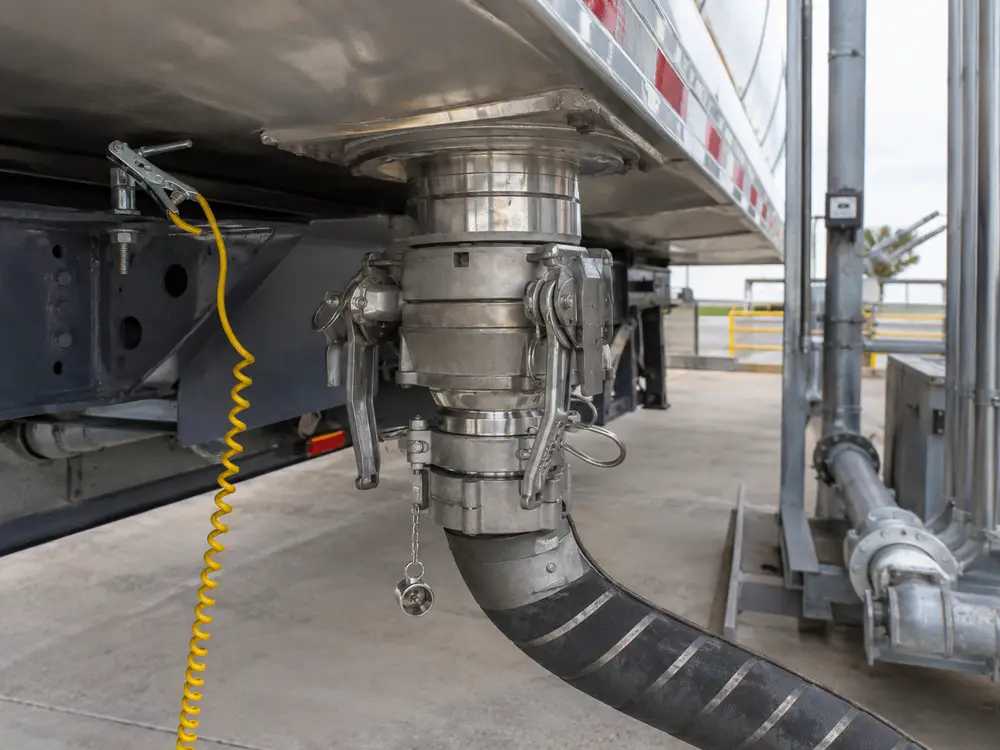 API bottom adapter connection with grounding clamp and vapor recovery hose
The Pneumatic Interlock — Why You Cannot Drive Away with Hoses Connected
Connecting the vapor recovery coupler or the API liquid coupler bleeds the trailer's spring-brake air supply to atmosphere. Spring brakes lock on. The same air signal is required to actuate the bottom valves, so the valves can only open while the brakes are locked. Together this means a driver cannot pull away while a hose is attached, and cannot open a valve while the trailer is mobile. It is a structural lockout. Pull-aways with hoses still connected — once the most common terminal incident category in the United States — became almost impossible after pneumatic interlocks went mandatory.
Why the 1 m/s Slow-Start Rule
Splash-loading at high velocity charges the gasoline up to 30 kV against the tank shell, even with the ground clamp connected. Air breaks down at roughly 3 kV per millimeter, so a charged liquid surface spans a 10 mm air gap to a metal probe and you have a spark in a vapor-rich compartment. The 1 m/s start rate keeps the inlet submerged before the velocity ramps up, which prevents the splash that builds the charge in the first place. Speed comes after the inlet is wetted, not before.
How Does the Bottom Valve Work? The Shear Groove Story
Each compartment has one internal bottom valve sitting flush in the floor. It is a poppet-style valve loaded by a spring, opened by 80-120 psi shop air on a control line that runs to the manifold cabinet. Pressing the cabinet button raises the poppet off its seat and the compartment is gravity-fed into the pipework below.
The Internal Bottom Valve (Foot Valve / Emergency Valve)
The valve body is steel or aluminum forged in one piece, threaded into a flange welded to the tank floor. A return spring closes it the instant air pressure drops — power loss, hose burst, control box failure, all default to closed. We pressure-test every API valve through 10 cycles before the tank ships, and a single drop of weep around the seat is a hard reject.
The Shear Groove — Engineered to Break in the Right Place
Look closely at an API-spec bottom valve and you will see a circumferential groove machined into the body just below the seat. That groove is a deliberate weak point. In a drive-under collision — say, the trailer is hit on the side and the external piping is torn away — the pipe shears off cleanly at the groove and the valve seat stays put, sealed against the flange in the tank floor. Without the groove, the impact would rip out the seat and a few seconds later 9,000 gallons of gasoline would be running across the road. This is the single most important reason API-compliant valves cost two to three times what generic brass valves cost. You are paying for that engineered failure plane.
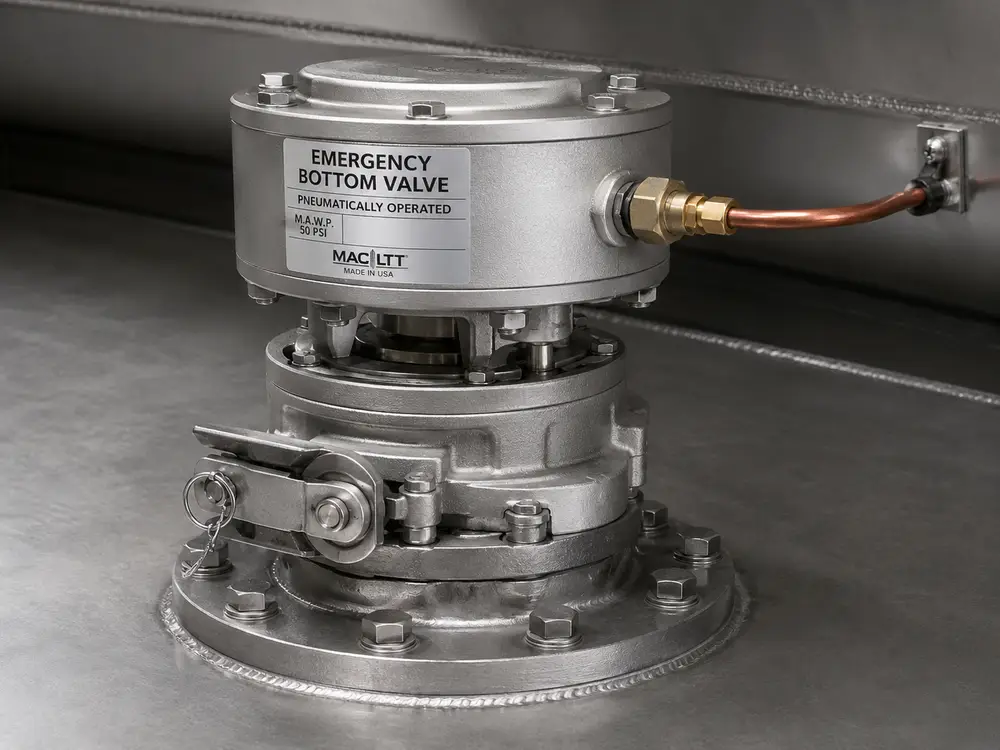 Pneumatic emergency bottom valve with shear groove on the tank floor
How Does Unloading Work? Gravity vs. Pump vs. Pneumatic
Discharge depends on what the customer site can accept. Three patterns cover almost everything we ship.
Gravity Discharge at a Gas Station
The trailer's API outlet sits 18-30 inches above grade. The service station's underground tank top is 4-8 feet below grade. That 6-10 foot head differential is enough to push 300-600 GPM through a 4-inch drop hose, no pump needed on the trailer. Gravity discharge is why most fuel tankers ship without an onboard pump — saves 200-425 lb of tare weight and one major maintenance item per trailer.
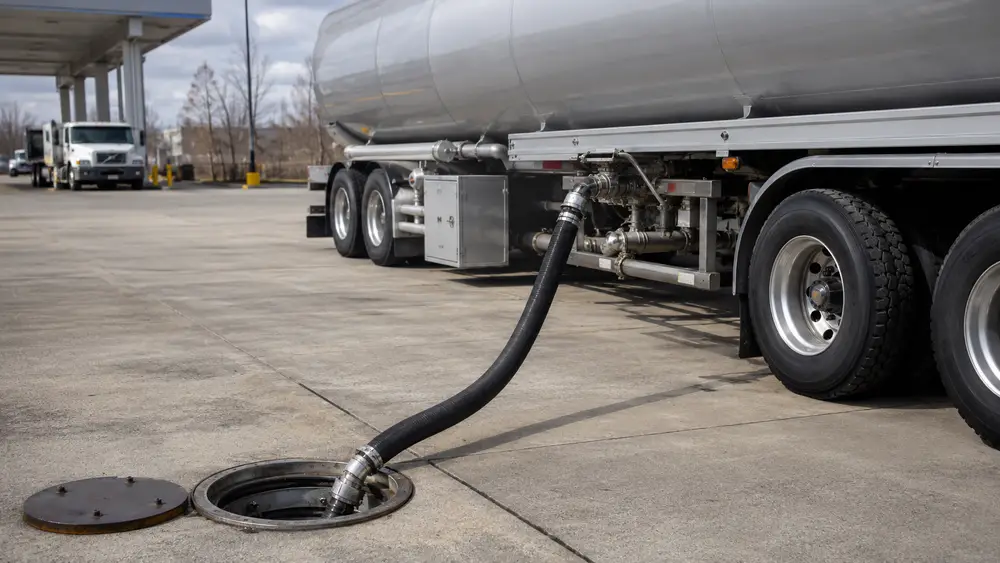 Tanker delivering fuel to an underground service-station tank
Pump-Assisted Discharge for Industrial Sites
Some destinations need the fuel pumped uphill into above-grade storage. That changes the pump choice in a way most online guides skip. A centrifugal pump cannot strip the last 3-5% from a tanker compartment. It loses prime as soon as suction breaks, which leaves residual fuel in the bottom of the shell. For long-haul same-product runs that doesn't matter. For multi-product distribution it matters a lot.
Positive-displacement pumps — gear, vane, or rotary lobe — keep pumping right down to the dregs. Petroleum tankers use gear pumps running 50-150 psi at 150-450 GPM, driven through a PTO from the tractor. Food-grade tankers use rotary lobe pumps with bi-lobe rotors that don't touch each other, so the pump introduces no shear into milk or food oil. Chemical service uses screw or progressing-cavity pumps for viscous corrosives. The pump choice locks in the cargo specialty.
Pneumatic Discharge for Bulk Cement and Powder
Cement, fly ash, and flour tankers use no liquid at all — they are pressure vessels for fluidized powder. A PTO-driven blower pressurizes the tank to 0.18-0.20 MPa (26-29 psi). Porous fluidization pads in each conical hopper bleed air upward through the cement, lifting it off the hopper floor and turning a 30-degree-repose powder into something that flows like a heavy liquid. When tank pressure exceeds the receiving silo pressure, the discharge butterfly opens and the cement transfers at over 1.2 tonnes per minute. Our 3-axle 45 cbm bulk cement tanker clears 97% of the load this way; the remaining 3% gets purged hopper-by-hopper from front to rear.
What Are the Vents on Top of the Tank For?
Walk around the dome of a DOT 406 fuel tanker and you will count four distinct openings. Each one solves a different problem.
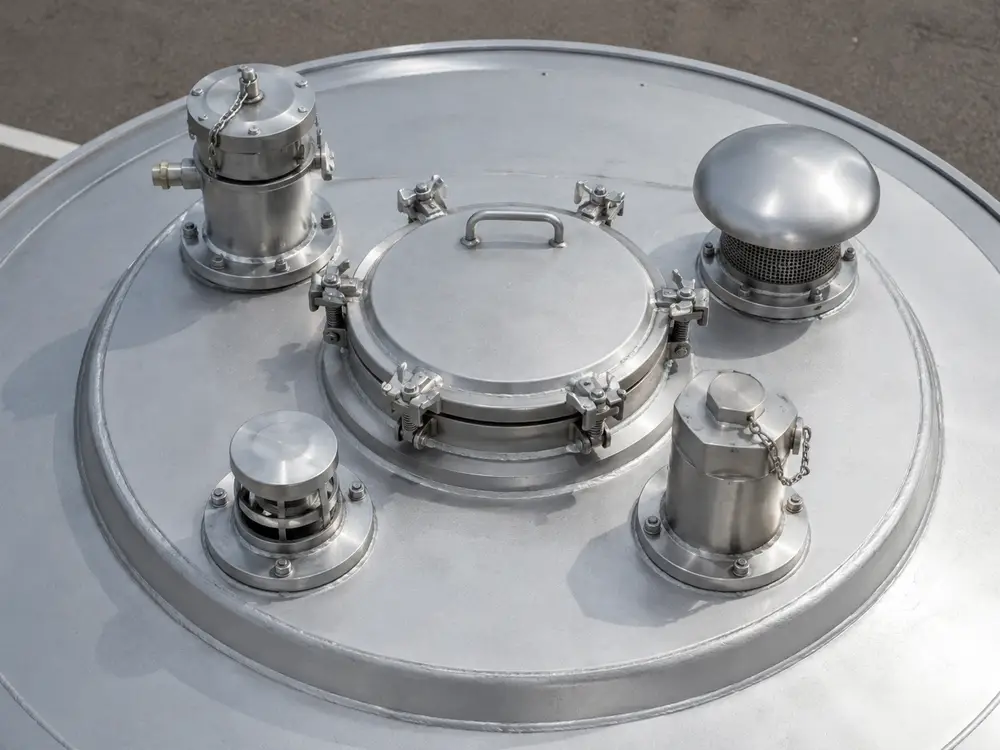 Tanker dome with PV vent, surge vent, vapor recovery, and overfill probe
| Device | Trigger | What It Does |
|---|---|---|
| Pressure-Vacuum (PV) Vent | ±0.5 psi | Daily breathing as fuel temperature changes; locks shut if the tank inverts past 60° |
| Emergency Surge Vent | ~3.6 psi or 250°F fusible link | One-shot full-bore relief if fire engulfs the tank, prevents BLEVE |
| Vapor Recovery Vent | Air signal from rack interlock | Returns displaced vapor to terminal storage during bottom loading |
| Overfill Probe Socket | Optic contact with rising liquid | Sends fail-safe stop signal to the rack pump |
The PV vent and the surge vent look similar and get confused all the time. They are not the same device. A PV vent cycles thousands of times in a year and resets after each event. A surge vent is destroyed by activation — the fusible link melts or the frangible disk ruptures, and the tank goes back to the shop for a new vent and a full inspection. Treating one as the other turns a routine summer pressure cycle into a five-figure repair.
Why Do Tanker Trailers Roll Over? The Surge Physics
The physics here is unforgiving and most drivers learn it the hard way. Tanker rollover is not random.
The Free Surface Effect — Why 50% Full Is the Worst Case
A full tank has no free surface. An empty tank has no liquid. A half-full tank has a free surface that swings sideways under lateral acceleration, and the liquid mass moves toward the outside of every turn. That moving mass shifts the loaded center of gravity outboard at exactly the wrong moment — adding to the rollover torque instead of opposing it. About 63% of cargo-tank rollovers in United States data happen on partial loads, even though partial loads are roughly 20% of total trips. The physics overrepresents the half-load by a factor of three.
Slosh Resonance — Rolling Over on a Straight Road
A 12-meter tank at 50% fill has a fundamental sloshing frequency around 0.3-0.6 Hz. If a driver's steering corrections cycle near that frequency, the liquid pushes the chassis into the turn at the moment the driver is recovering from it. Force amplifies instead of canceling. In the worst cases, a tanker can lift off in 0.5 seconds and complete a rollover in one second on a straight road at constant speed — no curve, no obstacle, no skid. Veteran drivers describe the sensation as the truck driving them, not the other way around.
The −5 / −10 mph Curve Speed Rule
Posted curve advisory speeds are calibrated for passenger cars with rollover thresholds around 1.2 g of lateral acceleration. A loaded fuel tanker tips at roughly 0.40 g — a third of that margin. United States Federal Motor Carrier Safety Administration guidance is to subtract 5 mph from the posted curve speed when fully loaded and 10 mph when half-loaded. Roll Stability Control (RSC) systems on modern Electronic Braking Systems will automatically apply trailer brakes when lateral G crosses about 0.35 g, before the driver feels the lift, and this reduces non-collision rollovers by 28-36% in fleet data. RSC works only if it is plumbed in. If your air suspension has airbag faults the same EBS often loses its yaw input.
How Are Tanker Trailers Built to Carry Different Liquids?
The cargo dictates the entire build. Get this match wrong and corrosion eats the shell within a year.
| Cargo | Shell Material | Wall Thickness | Inside Treatment |
|---|---|---|---|
| Drinking water / industrial water | Q235 carbon steel | 4-5 mm | Food-grade epoxy lining if potable |
| Diesel & gasoline (export carbon) | Q345B carbon steel | 5-6 mm | Bare, optional epoxy on long-storage |
| Diesel & gasoline (aluminum spec) | 5454-H32 aluminum | 5-6 mm shell, 7 mm heads | Bare — alloy resists petroleum |
| Light chemicals | 304 or 316L stainless | 4-6 mm | Polished interior to prevent residue |
| Concentrated acids | Carbon steel + lining | 6-8 mm + 12-22 mm liner | HDPE, polypropylene, or PTFE |
| LPG and propane | SA517B Q&T steel | 8-12 mm | None — no contact with corrosive |
| Asphalt and bitumen | 304 stainless | 4-5 mm | 50-100 mm polyurethane insulation + steam coil |
The reason 5454-H32 aluminum dominates the United States fuel tanker market comes down to three numbers. It does not spark on impact, which is mandated for gasoline transport in some jurisdictions. It cuts tare weight by 40-50% compared with carbon steel at the same wall, freeing 2-3 tonnes of payload per trip. And aluminum scrap value at end-of-life runs 5-8 times carbon steel, which changes the depreciation math over a 10-year service life. Our deeper guide on which liquids tank semitrailers can transport breaks the material-by-cargo decisions out further.
How Does the Trailer Connect to the Truck?
The fifth-wheel coupling is a cast iron horseshoe plate mounted on the rear of the tractor, with a C-shaped jaw assembly inside. The trailer carries a kingpin — a 2-inch or 3.5-inch hardened steel pin protruding from the front underside. The driver backs the tractor under the trailer's nose; the kingpin slides into the throat of the fifth wheel; the jaws snap shut behind it; the locking lever drops. The tractor and trailer pivot around that pin under load.
Putting the pivot directly above the tractor's drive axles is what makes a semi-trailer track straight at highway speed. Most of our export tankers ship with JOST 2-inch or 3.5-inch kingpins paired with JOST landing gear, which matches the fifth wheels installed on the tractors most fleets are already running. For more on what carries the trailer when it is not coupled, see our note on trailer landing gear.
What Are the Main Types of Tanker Trailers?
Cargo, pressure rating, and material define the type. The DOT and ADR codes group them.
| Type | DOT Spec | Typical Cargo | Key Design Feature |
|---|---|---|---|
| Atmospheric petroleum | DOT 406 | Gasoline, diesel, kerosene, jet fuel | Oval aluminum or carbon steel, multi-compartment, bottom-loading |
| Low-pressure chemical | DOT 407 | Solvents, crude oil, light chemicals | Stainless steel, 25-40 psi MAWP |
| Corrosive liquid | DOT 412 | Concentrated acids | Lined steel, top-loading mandatory |
| LPG and propane | MC-331 | LPG, propane, butane, anhydrous ammonia | Cylindrical pressure vessel, 250+ psi |
| Cryogenic | MC-338 | LIN, LOX, LH₂, LNG, refrigerated CO₂ | Vacuum-jacketed double wall |
| Dry bulk pneumatic | None (vacuum vessel) | Cement, fly ash, flour, plastic pellets | Conical hoppers, fluidization pads |
| Water | None | Potable, irrigation, dust suppression | Spray pump and adjustable nozzles |
HUAYU's main export catalog covers DOT 406-equivalent fuel tankers in carbon steel and 5454 aluminum, insulated bitumen tankers, stainless chemical tankers, and 40-50 cbm pneumatic cement trailers. Our full fuel tanker product line lists current specifications and capacities.
How Does a Tanker Trailer Work — FAQ
How long does it take to unload a tanker trailer?
Gravity discharge of a 40,000-liter fuel tanker into a service-station underground tank takes 12-18 minutes through a 4-inch hose, depending on the head differential. Pump-assisted discharge to above-grade industrial tanks runs 20-30 minutes at 300-400 GPM. Pneumatic cement unloading takes 45-75 minutes for a 45-cbm load because the air-to-cement ratio limits the transfer rate.
Can a tanker trailer carry different liquids at the same time?
Yes — multi-compartment trailers are designed for it. A six-compartment fuel tanker delivers gasoline 92, gasoline 95, diesel, and kerosene on a single run, each compartment with its own bottom valve and vent. Compatible products only: cross-compartment cleaning is required between switches, and immiscible products like diesel and water demand a flush cycle.
Why do tanker trailers have ladders on top?
The dome carries every venting and overfill device, and inspectors and operators need access to all of them. DOT 406 also mandates a top-mounted rollover rail running the length of the tank. The rail protects the vent stack if the trailer ever rolls onto its top, keeping product inside instead of pouring it onto the road.
How often does a tanker trailer need inspection?
DOT 406 atmospheric petroleum tanks need an annual external visual and leakage test, plus an internal visual inspection and pressure test every 5 years. Pressurized DOT 407 and 412 tanks need 1.5× MAWP hydrostatic retesting on the same 5-year cadence. Every HUAYU fuel tanker passes both water tightness and air tightness factory tests before shipment.
Can you load a tanker without a pump on the trailer?
Loading is always done by the terminal's high-volume pump pushing fuel into the trailer through the API adapter. The trailer pump, when fitted, only handles discharge. Most fuel tankers we ship have no onboard pump at all — gravity drops at gas stations cover 90% of last-mile distribution use cases.
What's the difference between a tanker truck and a tanker trailer?
A tanker truck is a single rigid vehicle with the tank welded directly onto the chassis — typical capacity 5,000-15,000 liters, used for short-route urban delivery. A tanker trailer is a tank on its own wheels that couples to a separate tractor unit, runs 25,000-60,000 liters, and is used for long-haul interstate or international hauls. The detachable design lets one tractor swap between several tanker trailers, which is why fleet buyers choose them for higher daily utilization. Our in-depth tanker trailer buying guide covers material and configuration choices in more detail.
Closing — A Tanker Is a Chain of Decisions
A working tanker trailer is a chain: shell geometry → baffle placement → valve safety design → vent stack → pump choice → suspension → driver behavior. Change one link and you change the whole. An aluminum shell saves 2 tonnes of payload but eliminates carbon-steel field weld repair. A pneumatic interlock makes pull-aways impossible but adds two extra hoses to manage at every load. A 5-mph speed cut on a curve buys back the 0.40-g rollover margin that physics took away.
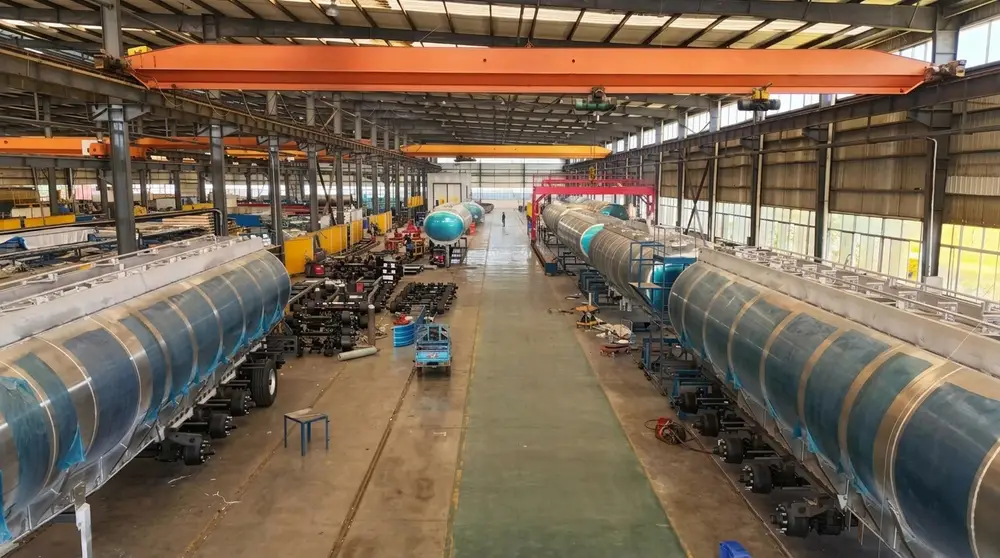
HUAYU has been building these systems at our Liangshan plant since 2001, with current production lines covering 12 fuel tanker variants from 30,000-liter carbon steel to 45,000-liter aluminum, plus insulated bitumen and pneumatic cement builds. If you're sizing a fleet against a specific cargo or route, browse our fuel tanker product line or reach our engineering team — we will quote against your real route, not against a generic spec sheet.
Continue Reading
May 9, 2026
How Much Does a Tank Trailer Hold? A Manufacturer's Capacity Guide for Fuel, Water, Milk, Chemical, and LPG
Tank trailer capacity ranges 5,500 to 11,600 US gallons or 21,000 to 44,000 liters. HUAYU explains capacity by cargo, DOT class, ullage, and region.
Apr 4, 2026
How to Buy a Fuel Tank Trailer?
Practical guide to buying a fuel tank trailer: materials (carbon steel vs aluminum vs stainless steel), tank shapes, loading systems, safety equipment, and real pricing.
Apr 4, 2026
What Liquids Can Tank Semitrailers Transport?
Tank semitrailers carry petroleum, chemicals, acids, edible oils, and water — each requiring different tank materials, pumps, and metering. A manufacturer's guide.