
How Much Does a Tank Trailer Hold? A Manufacturer's Capacity Guide for Fuel, Water, Milk, Chemical, and LPG
Published May 9, 2026
25 engineers · ISO 9001 · 3C certified · Liangshan factory since 2001
Updated 2026-09-11
27 min read
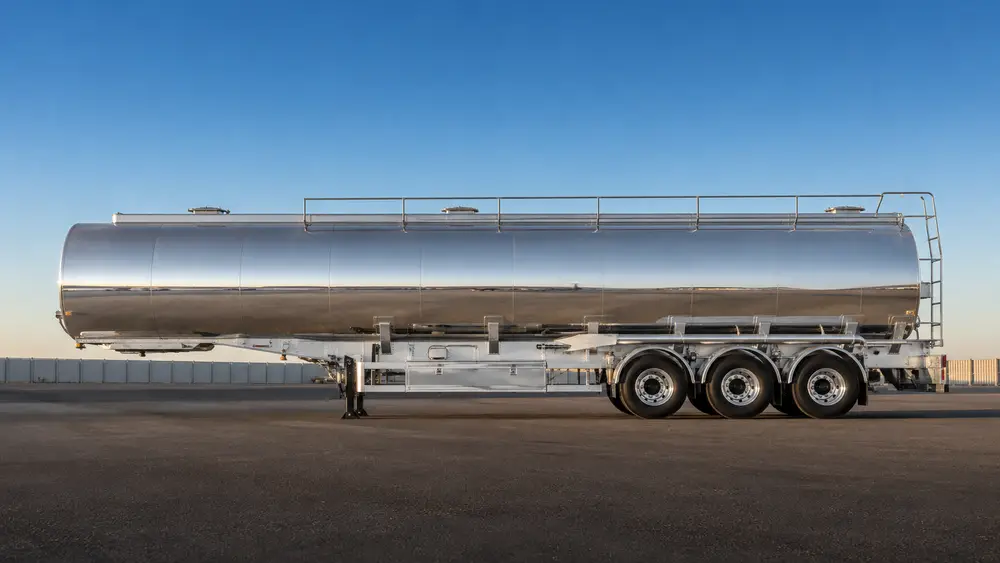
How much does a tank trailer hold? The short answer is 5,500 to 11,600 US gallons (21,000 to 44,000 liters) for a standard tractor-trailer combination, with imperial-gallon equivalents running 4,580 to 9,650. The longer answer is the one we walk buyers through in our Jinan office every week, because the headline number is geometric capacity, and what you actually load on a working trip is something else. Three layers decide it: what the shell physically holds, what the road weight law in your country lets you carry, and what physics plus regulation force you to leave empty for thermal expansion. This guide walks each layer with real numbers from HUAYU's export-spec tankers, plus the cargo-by-cargo capacity ranges for fuel, water, milk, chemicals, and LPG.
The Quick Answer: Tank Trailer Capacity Ranges at a Glance
A standard fuel tanker semi-trailer holds 7,500 to 11,600 US gallons (28,000 to 44,000 liters). The same shape of trailer holds 5,000 to 7,000 US gallons of light chemicals, 4,000 to 5,500 US gallons of concentrated acid, or 4,500 to 6,000 US gallons of cryogenic liquid. The cargo class sets the wall thickness, pressure rating, and inner lining, and those three things change the geometric capacity even when the outer envelope is identical.
| Cargo Class | DOT/MC Spec | US Gallons | Liters | Imperial Gallons | Typical Build |
|---|---|---|---|---|---|
| Petroleum fuel | DOT 406 / MC-306 | 7,500–11,600 | 28,000–44,000 | 6,200–9,650 | 5454 aluminum or Q345B carbon |
| Light chemical | DOT 407 / MC-307 | 5,000–7,000 | 19,000–26,500 | 4,160–5,830 | 304 or 316L stainless |
| Corrosive liquid | DOT 412 / MC-312 | 4,000–5,500 | 15,000–21,000 | 3,330–4,580 | Lined steel with HDPE or PTFE |
| LPG / propane | MC-331 | 5,000–11,600 | 19,000–44,000 | 4,160–9,650 | SA517 quench-tempered pressure steel |
| Cryogenic | MC-338 | 4,500–6,000 | 17,000–22,700 | 3,750–4,990 | Vacuum-jacketed double wall |
| Drinking water | None (food grade) | 5,000–7,000 | 19,000–26,500 | 4,160–5,830 | 304 SS or epoxy-lined Q235 |
| Milk and food liquid | None (food grade) | 6,000–6,800 | 22,700–25,700 | 4,990–5,660 | 304 SS, polyurethane insulated |
| Asphalt / bitumen | None | 5,000–11,800 | 19,000–45,000 | 4,160–9,820 | 304 SS, 100 mm insulation, steam coil |
Cubic-meter and barrel readers can convert: one cubic meter equals 264.2 US gallons, 219.97 imperial gallons, or 6.29 oil barrels. A 45,000-liter shell is 11,888 US gallons, 9,898 imperial gallons, or 283.1 barrels. Crude oil traders should keep the barrel column close to hand because the freight pricing moves on barrels, not on gallons.
Why Tanker Capacity Has Three Layers, Not One
Every capacity number on a brochure is the geometric volume the shell holds. The number you load on a working trip is two layers below that. Skip the layering and you book overweight loads, undersize fleets, and write contracts you cannot honor at scale.
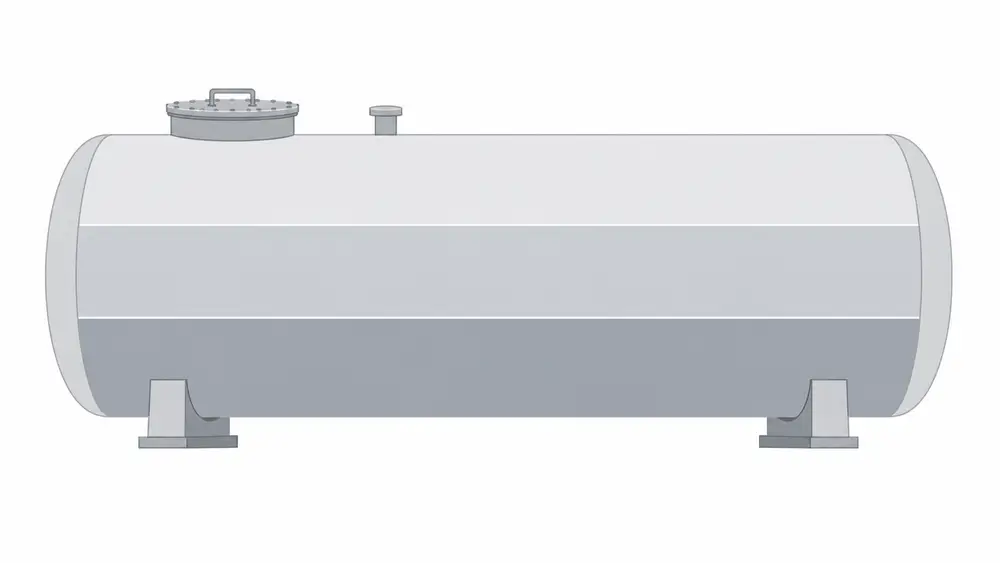 Three capacity bands inside a fuel tanker shell
Layer 1: Geometric Capacity
The geometric volume is the internal shell volume, computed from the cross-section area and the cylinder length. An oval cross-section with major axis 2,400 mm and minor axis 1,800 mm gives an area of 3.39 m², and an 11.8-meter cylinder length gives 40 cubic meters or 40,000 liters. The number on the brochure subtracts the volume taken up by internal hardware: bulkheads, baffles, manhole rings, vapor stacks, and bottom valve flanges. Subtraction runs 1 to 3% on a fuel shell and as much as 7% on a multi-compartment chemical trailer.
Layer 2: Legal Capacity
The road law in the country of operation caps the gross combined weight, and that cap converts back into liters or gallons of cargo. The United States federal interstate cap is 80,000 pounds (36,287 kg). European Union member states under Directive 96/53/EC run 40 to 44 tonnes. Africa, Middle East, and most of Central Asia legalize 50 to 54 tonnes. Australia permits B-double and B-triple road train combinations at 68 to 130 tonnes. The same shell holds the same cargo with no change in geometry, but the legal payload moves by a factor of three across regions.
Layer 3: Usable Capacity
After geometric and legal limits, two more deductions apply. Outage (also called ullage) is the air space the regulator forces you to leave for thermal expansion of the liquid. Compartment subdivision adds wall thickness inside the shell that reduces total liquid volume. The "95% rule of thumb" you see on broker blogs is the casual form of these two deductions stacked together. The detailed form is the subject of the ullage and multi-compartment sections later in this article.
Capacity by Cargo Type
The cargo dictates the build. Get the match wrong and the shell corrodes within a year, the seal pops within a month, or the tank bursts on the first warm afternoon. Below is the catalog as we ship it.
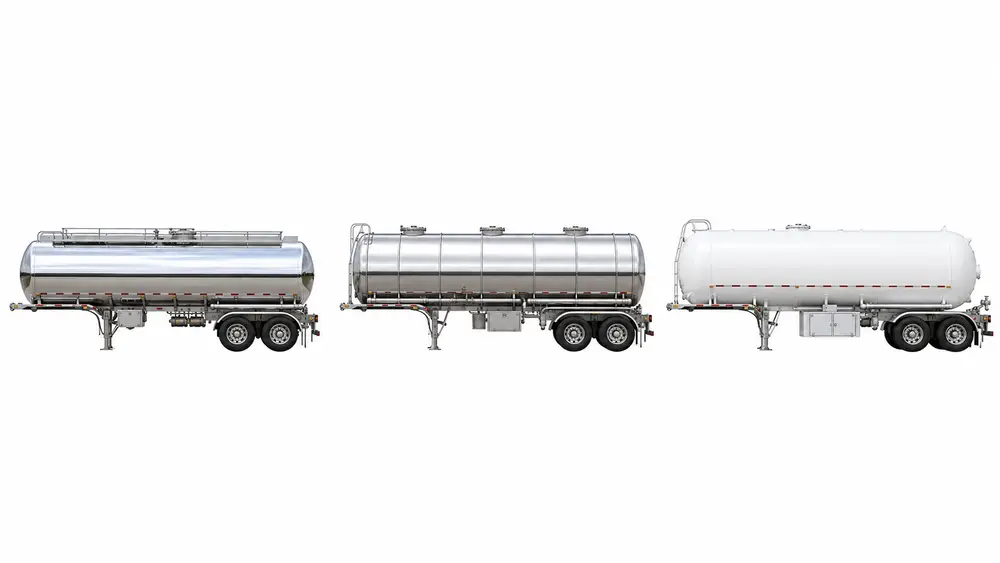 DOT 406 fuel, DOT 407 chemical, and MC-331 LPG tankers compared
Petroleum Fuel Tankers (DOT 406 and MC-306)
The biggest road-tanker category by unit volume. Standard US-spec DOT 406 fuel tankers run 8,500 to 9,800 gallons (32,000 to 37,000 L), with the high end on aluminum shells and the low end on heavier carbon steel. Export-spec fuel tankers we ship to Africa, the Middle East, Central Asia, and Southeast Asia run 30,000 to 50,000 liters because the destination weight law is more permissive. Multi-compartment is standard: six compartments of 1,500 to 2,500 gallons each lets one trailer carry gasoline 92, gasoline 95, diesel, and kerosene on a single dispatch. Our 3-axle 45,000-liter aluminum fuel tanker is the build we ship most often in this band.
Chemical Tankers (DOT 407 and MC-307)
The DOT 407 covers low-pressure chemical and crude oil service. Capacity sits at 5,000 to 7,000 US gallons, with maximum allowable working pressure (MAWP) of 25 to 40 psi. The shell is almost always 304 or 316L stainless to handle solvents and crude. The horseshoe cross-section common on US chemical trailers is a packaging trade: it lowers the loaded center of gravity by about 80 mm versus a true cylinder while keeping the smooth-bore profile that makes the tank washable between products.
Corrosive Liquid Tankers (DOT 412 and MC-312)
DOT 412 covers concentrated acids and bases. Capacity runs 4,000 to 5,500 US gallons (15,000 to 21,000 L), smaller than fuel because corrosive cargo is dense. Sulfuric acid runs 1,830 kg/m³, hydrochloric acid 1,180, and nitric acid 1,500. A 5,000-gallon shell of sulfuric weighs as much as a 15,000-gallon shell of gasoline, and the law caps payload by mass not by volume. The MAWP runs 35 to 50 psi, the shell is carbon steel or stainless under an HDPE, polypropylene, or PTFE liner 12 to 22 mm thick. The liner is what costs money. A 5,500-gallon DOT 412 trailer with a fresh PTFE liner runs three to five times the price of an unlined fuel tanker of the same volume.
LPG and Propane Tankers (MC-331)
MC-331 is the road-going pressure vessel. ASME-coded SA517 quench-and-tempered steel walls 8 to 12 mm thick hold 250 to 265 psi MAWP. Transport-class MC-331 trailers run 9,000 to 12,000 gallons gross volume but load only to 80% (sometimes lower) because LPG expands sharply with temperature. Useful cargo runs 7,200 to 9,600 gallons. Bobtail-style propane delivery trucks are the smaller cousin: 3,200-gallon vessel mounted on a single rigid chassis, used for last-mile residential propane drops.
Cryogenic Tankers (MC-338)
MC-338 carries cryogenic liquids: liquid nitrogen, liquid oxygen, liquid hydrogen, refrigerated CO2, and LNG. Capacity runs 4,500 to 6,000 US gallons (17,000 to 22,700 L). The build is a vacuum-jacketed double wall: an inner shell holds the cryogen at 25 to 500 psi, an outer shell seals against the atmosphere with the annular space pumped to 10⁻⁴ torr. A single gallon of cryogenic liquid expands to roughly 900 gallons of gas at room temperature, and that 1:900 expansion ratio is why MC-338 leaves much more ullage than any other class.
Water Tankers
On-road water tankers run 5,000 to 7,000 US gallons (19,000 to 26,500 L) for potable and food-grade service in 304 stainless or epoxy-lined Q235 carbon. Construction water trucks running on closed mine sites or quarries push much higher, with 60,000-gallon haulers built on rigid 100-tonne chassis specifically because the off-road cap does not apply. Water is heavy, with density 1,000 kg/m³ versus 720 for gasoline. A water tanker that physically holds 9,000 gallons of fuel can legally only haul 6,500 gallons of water under 80,000 pound rules.
Milk and Food-Grade Tankers
North American semi-trailer milk tankers carry 6,000 to 6,800 US gallons of cold milk in a single 304 stainless compartment with 50 to 100 mm of polyurethane insulation. Some Michigan operators run permitted combinations close to 9,000 gallons of milk on dedicated dairy routes. European and Australian milk tankers run smaller because the road weight cap is tighter: 18,000 to 22,000 liters is typical. The polish on the inner shell is mandated to a 0.6 micrometer Ra surface roughness so cold milk does not grow biofilm in the welds.
Asphalt and Bitumen Tankers
Hot asphalt and bitumen tankers run 5,000 to 11,800 US gallons (19,000 to 45,000 L). The cargo travels at 150°C to 180°C, so the shell is double-walled with 80 to 100 mm of glass-wool or polyurethane insulation, plus a steam-jacket coil that lets the driver maintain temperature in transit. Discharge depends on the receiving site: gravity for paving plants, pump-assisted for refineries. Our 3-axle 45,000-liter insulated bitumen tanker carries a BALTUR diesel burner that keeps cargo at 180°C for 18 hours during transcontinental hauls.
Dry Bulk and Pneumatic Tankers
Cement, fly ash, flour, and plastic-pellet tankers carry their cargo as fluidized powder, not liquid. Capacity is in cubic feet or cubic meters, not gallons. Volumes run 1,000 to 1,800 cubic feet (28 to 50 m³), with payloads of 25 to 40 tonnes depending on the bulk density of the powder. Cement at 1,400 kg/m³ fills the lower half of the volume range; flour at 600 kg/m³ uses the upper half. The discharge mechanism is pneumatic (a PTO blower pressurizes the tank to 0.18 MPa and porous fluidization pads lift the powder off the hopper floor), so the cargo math depends on the air-to-solid ratio as well as the geometric volume. The full HUAYU bulk cement trailer line covers the 40 to 50 m³ band that makes up most cement-route work.
Capacity by Trailer Length and Axle Count
Trailer length sets a hard ceiling on geometric volume. Axle count sets the legal payload at any given gross weight law, because more axles spread the load across more bridge points and the bridge formula tolerates higher gross weights. The two interact: a 53-foot tri-axle DOT 406 maxes out around 11,000 US gallons of gasoline, while a 53-foot quad-axle of the same shell unlocks an extra 3 tonnes of payload that often gets used to upgrade the cargo from gasoline to diesel without re-derating fill.
| Trailer Length | Geometric Capacity (US gal) | Geometric Capacity (L) | Common Cargo |
|---|---|---|---|
| 30–35 ft | 3,000–4,500 | 11,400–17,000 | Local fuel, water trucks, small chemical |
| 40–45 ft | 5,500–7,000 | 21,000–26,500 | Regional fuel, food liquid, asphalt |
| 48–53 ft (tri-axle) | 8,000–11,000 | 30,000–42,000 | Long-haul fuel, milk, LPG |
| 53 ft (quad-axle) | 9,500–11,600 | 36,000–44,000 | Higher-density fuels, jet fuel |
| Super-B (double trailer) | 12,000–16,800 | 45,400–63,600 | Crude oil, North American long-haul |
| Australian road train | 26,000–32,000 | 100,000–120,000 | Fuel, water across continental routes |
A common buyer mistake is to size the fleet by length alone. We get inquiries every month asking for a "53-foot fuel tanker" without specifying axle count, and the difference between three and four axles changes the legal payload by 4,000 to 6,000 pounds depending on the bridge formula at the destination. Specify both, and ask the destination ministry for the route's effective Bridge Formula B coefficients before ordering.
The Density Math: How Cargo Weight Decides the Real Fill Rate
Geometric capacity does not put cargo on the road. Mass does. A tanker holds liquid by volume, but the road weight law caps you by mass, and the bridge between the two is density. The math is straightforward, but it is the part most online guides skip past.
Density of Common Tank Cargoes
| Cargo | Density (kg/m³) | Density (lb/US gal) | Mass per 45,000 L (kg) |
|---|---|---|---|
| LPG (liquefied) | 510 | 4.25 | 22,950 |
| Gasoline | 720 | 6.01 | 32,400 |
| Methanol | 791 | 6.60 | 35,595 |
| Ethanol | 789 | 6.58 | 35,505 |
| Jet A-1 | 800 | 6.67 | 36,000 |
| Diesel | 830 | 6.92 | 37,350 |
| Light fuel oil | 880 | 7.34 | 39,600 |
| Heavy fuel oil | 960 | 8.01 | 43,200 |
| Water | 1,000 | 8.34 | 45,000 |
| Milk (whole) | 1,030 | 8.59 | 46,350 |
| Sulfuric acid (98%) | 1,830 | 15.27 | 82,350 |
A Worked Example: The HUAYU 45,000-Liter Aluminum Fuel Tanker
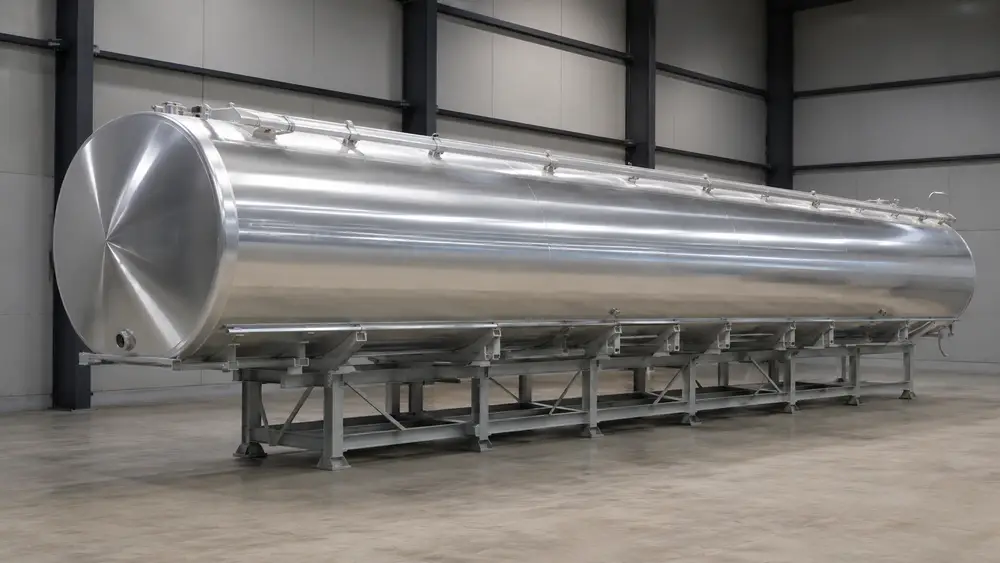 Aluminum fuel tanker shell on the factory assembly stand
Take a HUAYU 5454-H32 aluminum fuel tanker shipped to a North African 50-tonne route. Tare weight as it leaves Qingdao runs 7,200 kg (a typical export-spec build with 5 mm shell, 7 mm heads, and three FUWA axles). Pair it with a 6×4 day-cab tractor at 8,500 kg empty. Empty combination weight is 15,700 kg. Subtract from the 50-tonne legal cap and the cargo budget is 34,300 kg.
Now run the cargo column against that budget:
- Gasoline at 720 kg/m³: a full 45,000-liter fill is 32,400 kg. Fits with 1,900 kg of headroom. Load to 100%.
- Diesel at 830 kg/m³: a full fill is 37,350 kg, over budget by 3,050 kg. Cap fill at 91.8% (41,300 L), or do not load above 41,000 L on this route.
- Jet A-1 at 800 kg/m³: full fill is 36,000 kg. Cap at 95.3% (42,900 L).
- Methanol at 791 kg/m³: full fill is 35,595 kg. Cap at 96.4% (43,400 L).
- Water at 1,000 kg/m³: full fill is 45,000 kg. Cap at 76.2% (34,300 L).
- Sulfuric acid at 1,830 kg/m³: cap at 41.6% (18,750 L). The shell becomes a half-empty acid carrier and the buyer should be running a DOT 412 build at 5,500 gallons instead of a fuel tanker at 11,888.
The same shell, the same axles, the same legal weight cap, eight different real fill rates. If a fleet sales engineer quotes you "45,000 liters" without asking what cargo runs in it, they are quoting brochure volume, not road volume. We size against the cargo column every time. For a deeper walk-through of the same logic applied to product selection, see our companion article on what liquids tank semitrailers can transport.
Outage and Ullage: Why You Never Fill 100%
Every regulator on Earth requires the operator to leave space at the top of the tank. The space goes by two names: outage in the United States Code of Federal Regulations, and ullage in international shipping. The space exists for two reasons: thermal expansion of the liquid, and pressure relief geometry that needs vapor headspace to work.
The 2% Minimum Outage Rule
US 49 CFR 173.24a sets a 2% minimum outage at the cargo's reference temperature, which in most US specifications is 50°C (122°F). The rule reads as a minimum, not a target. Specific cargo classes layer additional ullage on top: portable tanks above 7,500 liters under 49 CFR 173.32 may not be loaded above 95% at the maximum reference temperature. Compressed gases under 49 CFR 173.315 set fill density limits expressed as pounds of liquid per pound of water capacity, and those limits drop the effective fill to 60 to 80% depending on product.
Why Ullage Varies by Cargo
A 1°C temperature rise expands liquid volume by an amount fixed by the cargo's volumetric thermal expansion coefficient. The coefficient is small for water and large for hydrocarbons.
| Cargo | Expansion Coefficient (1/°C) | Volume Increase from 15°C to 50°C |
|---|---|---|
| Water | 0.00021 | +0.74% |
| Crude oil | 0.00075 | +2.63% |
| Diesel | 0.00083 | +2.91% |
| Gasoline | 0.00097 | +3.40% |
| Ethanol | 0.00110 | +3.85% |
| LPG (liquid phase) | 0.00250 | +8.75% |
A gasoline tanker loaded to 99% at 15°C in a Lagos morning becomes 102% at noon in a Niamey afternoon. The 2% it could not fit goes through the pressure-vacuum vent as vapor and fuel mist if you are lucky, or through the emergency surge vent as a fountain if you are unlucky. The 95-to-97% rule of thumb you see on broker blogs derives directly from this physics, and it is the floor not a target.
Why LPG and Cryogenic Tankers Demand Higher Ullage
LPG expands almost three times as much as gasoline per degree, so MC-331 trailers fill at 80% rather than 97%. Cryogenic liquids hold an even larger margin: a single liter of liquid nitrogen at -196°C boils to 700 liters of gas at 21°C, so MC-338 trailers carry vapor return systems and route the boil-off through pressure-build coils that maintain operating pressure during transit.
Vent Setpoints and the Climate Problem
A pressure-vacuum vent on a DOT 406 fuel tanker opens at ±0.5 psi. The setpoint stays the same in cold and hot climates, but the cargo behavior does not. We adjust the loading templates we send to customers in the Sahara differently from those we send to operators in northern Kazakhstan, because the same gasoline cargo behaves differently in both places. Loading at 50°C ambient in Mauritania means starting fill density 8% lower than the Astana equivalent loaded at -10°C. The tanker physical hardware is the same. The fill spreadsheet is not.
Multi-Compartment Math: Trading Capacity for Flexibility
A single-compartment tanker can carry one product per trip. A multi-compartment tanker can carry several. Each compartment is a tank-within-a-tank: its own bulkhead, its own bottom valve, its own vent stack, its own manhole. The walls cost capacity. The flexibility costs capacity. The trade-off shows up in the geometric volume and the brochure number does not always disclose the number of compartments.
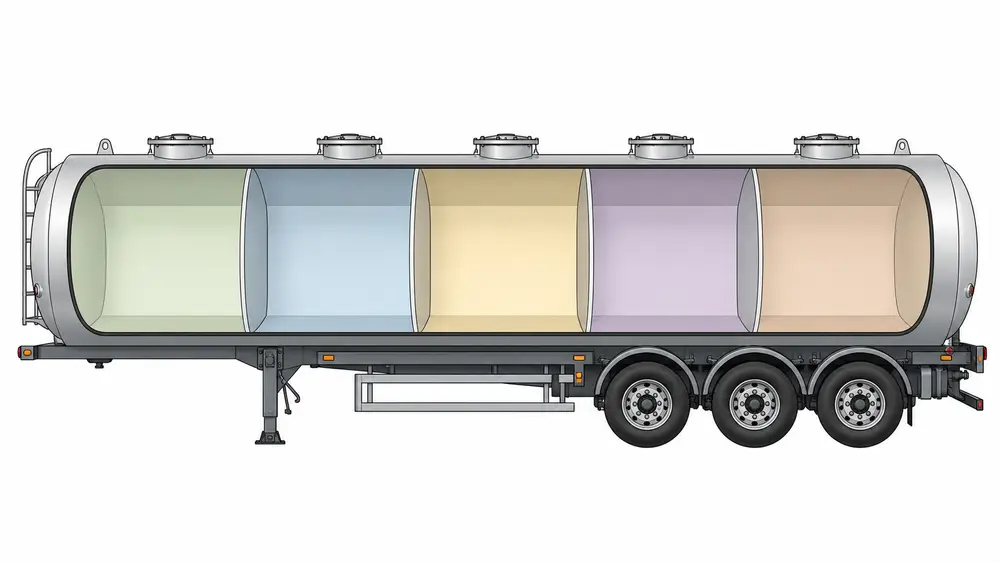 Five-compartment fuel tanker cutaway with vertical bulkhead plates
The 3 to 7% Capacity Loss per Bulkhead
Each internal bulkhead consumes 30 to 50 mm of shell length plus the volume of stiffener rings, weld beads, and clearance pockets. The loss runs 3% on a heavily-engineered five-compartment fuel tanker, 5 to 7% on six and seven compartment chemical tankers with isolation pockets between every compartment.
Standard 4, 5, and 6 Compartment Layouts
A 9,500 US gallon (36,000 L) DOT 406 fuel tanker is a useful reference because it is the most common US-spec build. Below is how the same shell volume gets distributed across different compartment counts.
| Compartments | Compartment Volumes (US gal) | Total Useful (US gal) | Capacity Loss vs Single |
|---|---|---|---|
| 4 (front-to-rear) | 2,400 / 2,300 / 2,400 / 2,400 | 9,500 | 0% (ref) |
| 5 (balanced) | 1,900 / 1,900 / 1,900 / 1,900 / 1,900 | 9,500 | 0% on shell, 3% on usable |
| 6 (urban delivery) | 1,500 / 1,500 / 1,750 / 1,750 / 1,500 / 1,500 | 9,500 | 0% on shell, 5% on usable |
When to Choose Each Layout
A long-haul fuel tanker that carries one product per trip wants a single compartment or a 2-compartment layout because every bulkhead costs payload. A dispatch tanker that delivers to gas stations with mixed product slates wants 5 or 6 compartments because the alternative is multiple round trips. Crude oil and chemical service almost always go single-compartment because the loss is unjustifiable when the product is uniform. Multi-compartment fuel trailers are a retail-distribution solution, not a long-haul one.
Free Surface Effect: Why Partial Loads Roll Tankers
A tanker with a half-full compartment behaves nothing like a tanker with a full compartment. Liquid moves inside the shell, and the moving mass shifts the loaded center of gravity at the worst possible moment. United States crash data shows that 63% of cargo-tank rollovers happen on partial loads, even though partial loads are roughly 20% of total trips. The physics overrepresents the half-load by a factor of three.
 Tanker cross-section showing liquid slosh shifting the center of gravity
The Surge Danger Zone: 40% to 74% Fill
Below 40% fill the liquid mass is small enough that center-of-gravity travel cannot exceed the rollover threshold of the tanker. Above 74% fill there is too little free surface for the liquid to slosh meaningfully. Between those bounds the surge pendulum has both the mass and the free surface to move the chassis past its rollover threshold, and that band is where most non-collision rollovers happen. The single most common scenario is a 6-compartment fuel tanker that has dropped four compartments at gas stations and is running back to the terminal with two compartments still half-full.
Why Baffles Help Some Cargo and Not Others
Baffles are perforated plates inside a single-compartment tank, oriented perpendicular to the truck's length. They cut longitudinal surge (front-to-back rush under hard braking) by 40 to 60%. They do almost nothing for lateral surge (side-to-side movement that triggers rollovers in turns), because the baffle plates run the wrong way relative to the lateral flow direction. A tanker with full baffle complement can still roll over in a sharp curve. The deeper tanker mechanism walkthrough covers this in more detail.
Roll Stability Control and the Margin That Buys Back Physics
A loaded fuel tanker has a static rollover threshold of about 0.40 g of lateral acceleration. A passenger car tips at roughly 1.2 g, so the posted curve advisory speeds you see on the road are calibrated for cars and offer no margin to a tanker. United States Federal Motor Carrier Safety Administration guidance cuts 5 mph from the posted curve speed for fully loaded tankers and 10 mph for half-loaded ones. Roll Stability Control on modern Electronic Braking Systems applies the trailer brakes when lateral G crosses about 0.35 g, before the driver feels the lift, and reduces non-collision rollovers by 28 to 36% in fleet data.
Regional Capacity Standards Across Four Continents
The capacity number on the side of the tanker reflects the road law of the country it operates in. The same shell, shipped to four different regions, carries four different "advertised" capacities, because the legal payload changes.
United States: 80,000 Pounds and the DOT/MC Class System
The federal interstate gross combined weight cap is 80,000 pounds (36,287 kg), set by the Surface Transportation Assistance Act of 1982 and unchanged on the federal interstate since. State exceptions apply: Michigan permits 164,000-pound combinations on specified routes for raw materials, Wyoming allows 117,000 pounds on certain coal corridors, and several agricultural states grant harvest-season permits. The cargo-class regime is DOT 406 (atmospheric petroleum), DOT 407 (low-pressure chemical and crude), DOT 412 (corrosive), MC-331 (LPG), MC-338 (cryogenic), with mandatory annual external visual and 5-year internal pressure tests under 49 CFR 180.
European Union: ADR L4BH and 40 to 44 Tonnes
EU Directive 96/53/EC caps standard road combinations at 40 tonnes, with 44 tonnes permitted for combined transport (rail-road intermodal) and 50 tonnes available under specific national derogations. The cargo-class regime follows the European Agreement concerning the International Carriage of Dangerous Goods by Road (ADR), with codes like L4BH for atmospheric corrosives and L1.5BN for low-pressure flammables. EU tanker capacities run lower than US-spec: 36,000 to 46,000 liters is the typical fuel tanker band.
Australia: B-Doubles and Road Trains
Australian road train rules permit B-double combinations at 68 tonnes, B-triples at 95 tonnes, and full road trains up to 130 tonnes on designated routes. Fuel tankers running across the Pilbara or Northern Territory carry 90,000 to 120,000 liters in two or three trailers behind a single prime mover, because the road network is scaled to it.
Africa, Middle East, Central Asia, and Southeast Asia: 50 to 54 Tonnes
Most countries across these four regions cap road combinations at 50 to 54 tonnes, with national exceptions. Nigeria, South Africa, Saudi Arabia, the UAE, Kazakhstan, and Indonesia operate close to 50 tonnes. Local enforcement varies. The HUAYU export catalog targets this band by default, and our 45,000-liter aluminum and 40,000-liter carbon steel fuel tankers are sized exactly to the African and Middle Eastern weight regime. For the engineering walk-through behind those choices, see how to buy a fuel tank trailer.
Material Choice: How Aluminum Buys Extra Cargo Per Trip
The shell material decides how much of the legal payload goes to cargo and how much to the empty tanker. A lighter tanker leaves more weight budget for cargo. The four shell materials in HUAYU's catalog give a clear payload payoff table.
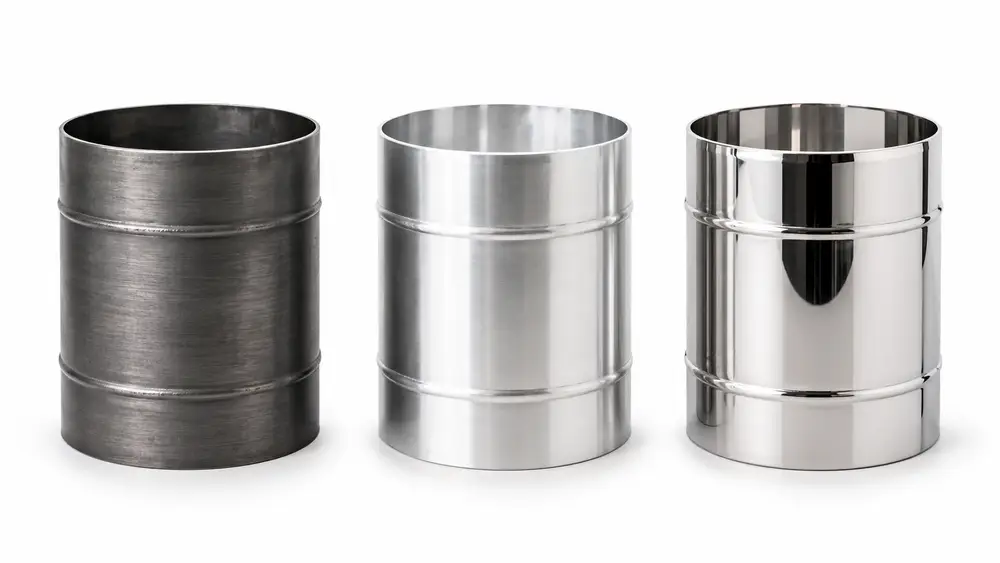 Carbon steel, aluminum, and stainless steel tanker shell sections
| Shell Material | Tare for 45,000-L Build | Cargo Headroom (50-tonne Cap) | Best Use |
|---|---|---|---|
| Q345B carbon steel | 9,500 kg | 32,000 kg cargo | Bitumen, asphalt, crude, dense chemicals |
| 5454-H32 aluminum | 7,200 kg | 34,300 kg cargo | Gasoline, diesel, jet fuel |
| 304 stainless | 9,800 kg | 31,700 kg cargo | Light chemicals, crude, food liquid |
| 316L stainless | 10,200 kg | 31,300 kg cargo | Aggressive chemicals, pharmaceutical service |
Aluminum saves 2,300 kg of tare versus carbon steel on a 45,000-liter shell. At gasoline density that converts to 3,200 extra liters of cargo per trip, or 845 US gallons, on the same legal weight cap. Over a 10-year service life running 250 trips a year, that is 800,000 extra gallons hauled per tanker without a single change to the road law or the engine spec. That math is why 5454-H32 dominates the US fuel-tanker market and is now a growing share of HUAYU's African exports. The ones still building carbon-steel fuel tankers do so because the welding crews, the field repair shops, and the spare-part supply chains in their region are tooled for steel and not for aluminum. Our 3-axle 40,000-liter carbon steel oil tanker ships exactly to those markets.
Frequently Asked Questions
What is the standard capacity of a fuel tanker trailer?
Standard fuel tanker trailers ship in two main bands. The US market centers on 7,500 to 11,600 US gallons (28,000 to 44,000 L), set by the 80,000-pound federal weight cap and the bridge formula. Africa, the Middle East, Central Asia, and most of Southeast Asia run the 30,000 to 50,000 liter band on 50 to 54-tonne legal weight rules. Australian B-doubles and road trains push into the 90,000 to 120,000 liter range because the legal envelope changes.
How many gallons of milk fit in a milk tanker?
Most North American semi-trailer milk tankers carry 6,000 to 6,800 US gallons (22,700 to 25,700 L) of cold milk in a single 304 stainless compartment with 50 to 100 mm of polyurethane insulation. State overweight permits allow Michigan operators to run combinations carrying close to 9,000 gallons of milk on dedicated dairy routes. Outside North America, milk tankers run smaller because of road weight rules: 18,000 to 22,000 L is typical in Europe and Australasia.
What is the difference between DOT 406, DOT 407, and DOT 412?
DOT 406 is the atmospheric-pressure tanker for petroleum fuels: gasoline, diesel, kerosene, jet fuel. DOT 407 is the low-pressure tanker for chemical and crude oil service, rated at roughly 25 to 40 psi MAWP, almost always 304 or 316L stainless. DOT 412 is the corrosive-liquid tanker, used for concentrated acids and bases, with internal HDPE, PTFE, or rubber liners over a smaller-diameter pressure shell. The three look similar at a distance but the wall section, the pressure rating, and the inner lining are different.
How is MC-331 different from MC-338?
MC-331 is the road tanker for liquefied compressed gas at ambient temperature: LPG, propane, butane, anhydrous ammonia. It is an ASME pressure vessel with 250 to 265 psi MAWP and SA517 quench-and-tempered steel walls 8 to 12 mm thick. MC-338 is the road tanker for cryogenic liquids: liquid nitrogen, liquid oxygen, liquid hydrogen, refrigerated CO2, and LNG. It is a vacuum-jacketed double wall, with the inner shell holding the cryogen at low pressure and the outer shell sealed against the atmosphere through a high-vacuum annular space.
Why can't I fill a tank trailer to 100%?
Two reasons. The first is thermal expansion: liquids gain volume when warmed, and a 100% fill at 15°C will rupture a seal or pop the relief valve at 50°C. United States 49 CFR 173.24a requires a minimum 2% outage at the cargo reference temperature. The second is regulation specific to dangerous goods: portable tank rules under 49 CFR 173.32 cap fill density to keep the shell legal under upset conditions, and compressed-gas rules under 49 CFR 173.315 cap LPG fill at 80% by weight. The 95% rule of thumb is the casual form of these stacked compliance rules.
What is the maximum legal weight for a tanker on US highways?
The federal limit on the United States Interstate system is 80,000 pounds (36,287 kg) gross combined weight, set by the Surface Transportation Assistance Act of 1982. State exceptions apply: Michigan permits combinations up to 164,000 pounds on specified routes for raw materials, Wyoming permits 117,000 pounds on certain coal corridors. Outside the US, the equivalent limits are 40 to 44 tonnes in EU member states, 50 to 54 tonnes across most of Africa and the Middle East, and 68 to 130 tonnes for Australian B-double and B-triple road train combinations.
How do I convert tank trailer capacity from gallons to liters and barrels?
One US gallon equals 3.785 liters. One US gallon equals 0.833 imperial gallons. One oil barrel equals 42 US gallons or 159 liters. One cubic meter equals 264.2 US gallons, 219.97 imperial gallons, or 6.29 barrels. For the standard fuel tanker shell sizes the catalog uses, the round figures are: 30,000 L = 7,925 US gal = 6,600 imp gal = 188.7 bbl, 40,000 L = 10,567 US gal = 8,800 imp gal = 251.6 bbl, 45,000 L = 11,888 US gal = 9,898 imp gal = 283.1 bbl, 50,000 L = 13,209 US gal = 10,998 imp gal = 314.5 bbl.
Does a bigger tanker always cost less per gallon to operate?
No. Bigger tankers cost less per gallon only when the legal weight cap, the loading rack throughput, and the destination receiving capacity all support the higher volume. A 50,000-liter tanker on a 36-tonne weight cap loads to 25,000 liters of gasoline and runs less efficiently than a 35,000-liter tanker on the same route loaded to 32,000 liters. Sizing always traces back to cargo density times legal weight cap, not to brochure volume. The HUAYU sales engineering team runs that calculation against your specific cargo and route, and our tanker quality inspection guide walks the rest of the buy-side audit checklist.
Spec the Right Tanker for Your Operation
HUAYU has built tank trailers at our Liangshan plant since 2001, with current production lines running 12 fuel tanker variants from 30,000-liter carbon steel to 50,000-liter aluminum, plus insulated bitumen tankers, stainless chemical tankers, and 40 to 50 cubic meter pneumatic cement trailers. If you are sizing a tanker against a real cargo and a real route, not a brochure number, share the cargo class, the destination port, and the local weight law on our contact page or browse the full fuel tanker product line. We reply inside one working day with a payload-anchored spec that matches your actual fill rate, not against a generic catalog page.
Continue Reading
May 7, 2026
How Does a Tanker Trailer Work? A Manufacturer's Mechanical Walkthrough
How does a tanker trailer work? A factory engineer walks through baffles, bottom valves, vapor recovery, pumps, and the surge physics that makes tankers tip over.
Apr 4, 2026
What Liquids Can Tank Semitrailers Transport?
Tank semitrailers carry petroleum, chemicals, acids, edible oils, and water — each requiring different tank materials, pumps, and metering. A manufacturer's guide.