
What Is a Side Loader Trailer? Container Side Lifter Design & Specs
Published Aug 28, 2026
25 engineers · ISO 9001 · 3C certified · Liangshan factory since 2001
Updated 2026-08-28
19 min read
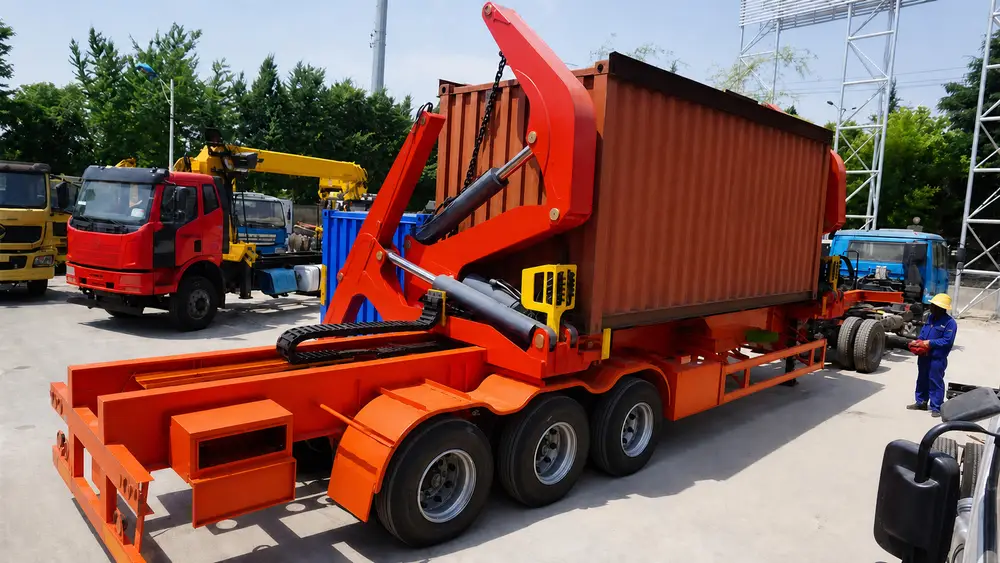
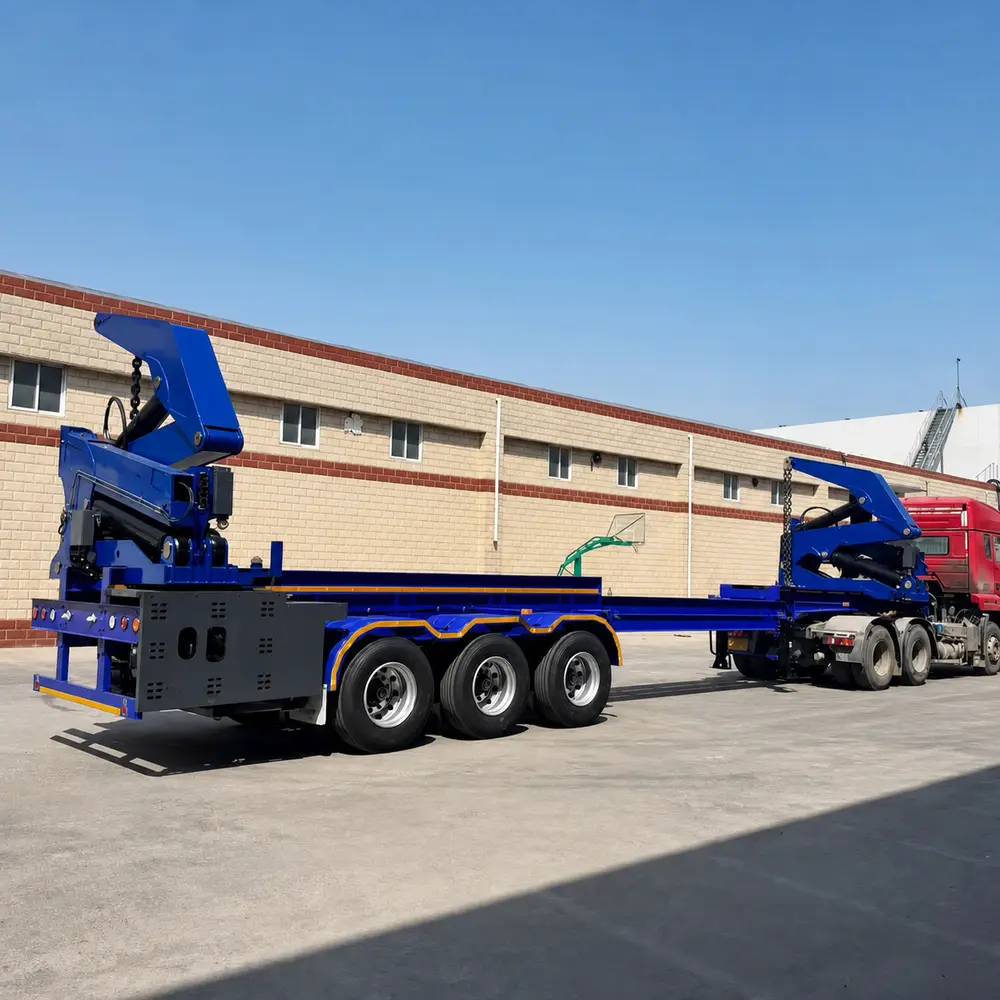
A container side lifter is a specialized semi-trailer built to hoist and transport standard ISO containers over long distances. Also called a side loader trailer, sidelifter, container side loader, or self loading container trailer, it does one job above all: container transfer between the ground, its own chassis, and other vehicles, with no outside crane.
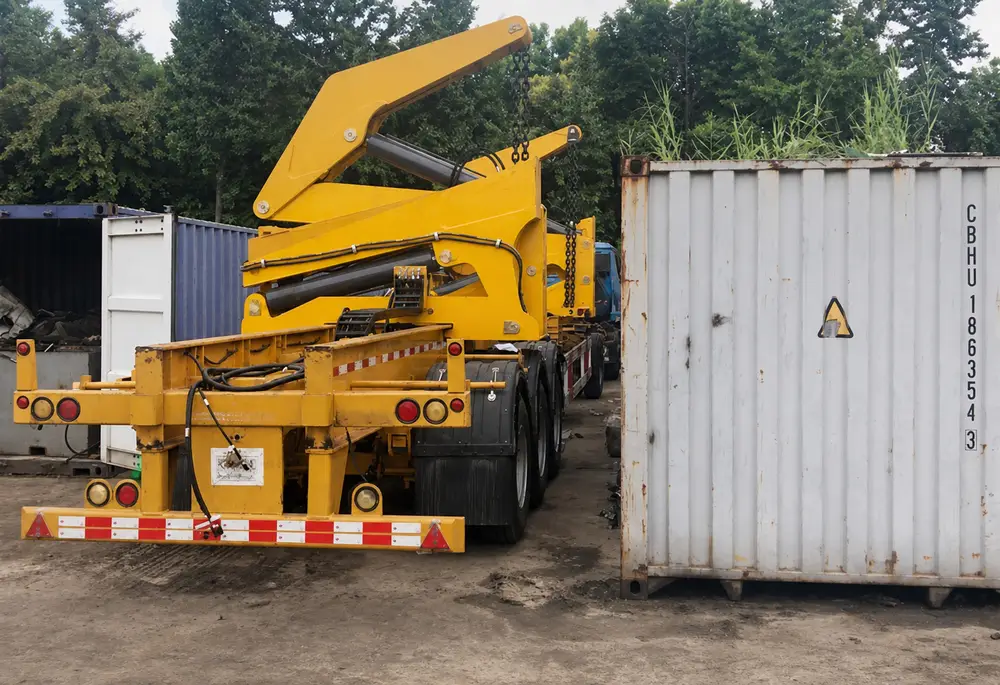
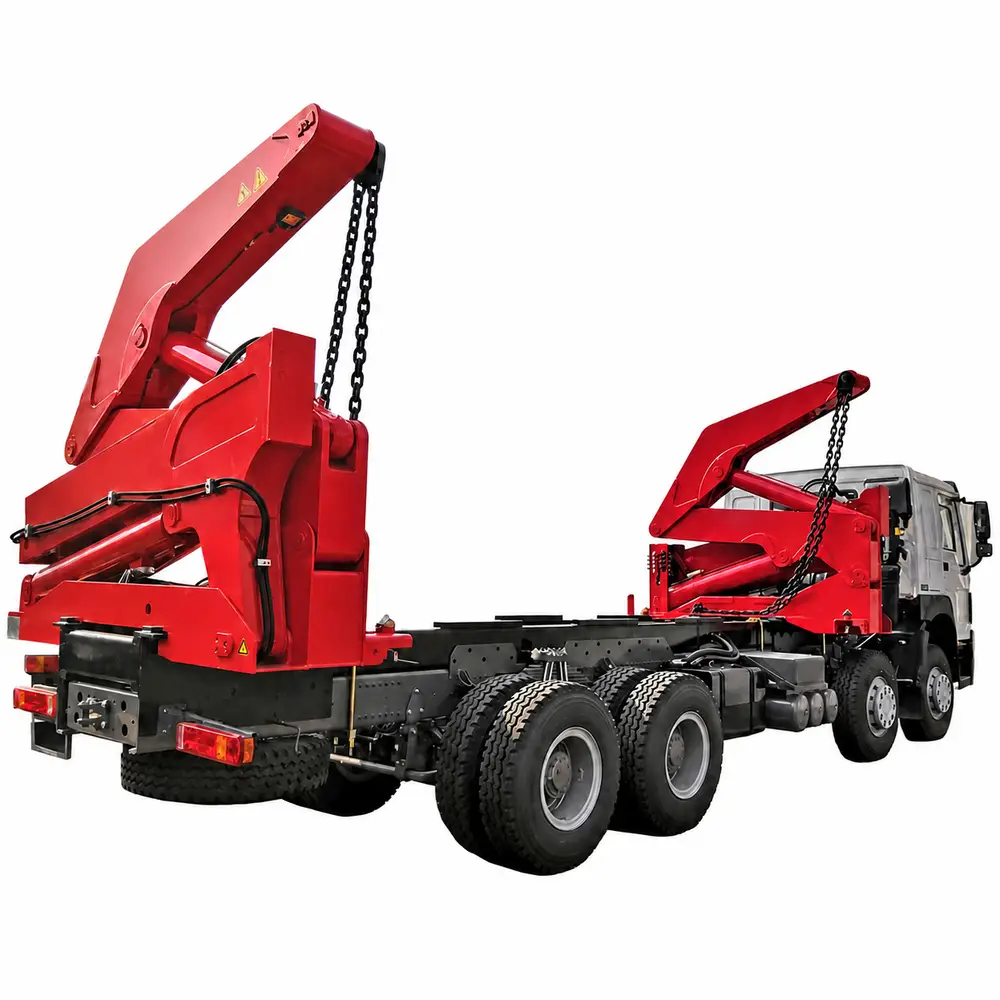
The machine carries its own lifting gear. Two lift modules, hydraulically powered cranes built from proven high-tensile steel, mount on the trailer chassis, and the same modules can be fitted to a sub-frame on a rigid truck. Wide-reach stabilizer jibs and legs work through a hydraulic unit powered either by the tractor's power take-off (PTO) or by an auxiliary power unit (APU) on the trailer. The modules slide inwards or outwards along the chassis to lock into 20ft, 40ft, or 45ft working positions.
Demand for this capability keeps growing. According to DynaLiners figures reported by Container News, world container port throughput reached 1.01 billion TEU in 2025, up 8% year on year, and Africa was the fastest-growing region, up 12%. Every one of those boxes touches the ground somewhere. A World Bank analysis of Malawi's trade costs shows why that matters: the 500 km inland leg from the port of Beira cost about $3,000 more per container than the entire 8,000-plus-km ocean leg from China. Inland container handling is where logistics money is won or lost, and much of it happens far from any crane.
The machine itself is not new. Kaspar Klaus built the first sidelifter in 1960s Germany for military use, and manufacturers in Australia and New Zealand spent the following decades cutting its tare weight and proving it as a road delivery tool. If you are still mapping trailer types to your operation, our semi-trailer selection guide is the wider starting point.
Container Side Lifter Specs: Capacity, Dimensions and Parameters
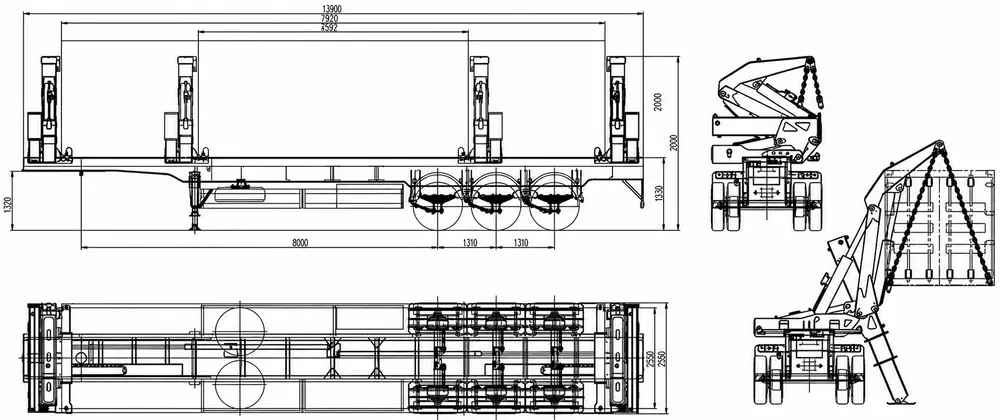
Container side lifter trailers run from 12 to 45 tonnes of rated capacity, with 36 to 37 tonnes the common standard class. The table below lists the dimensions and specs of a typical 37-tonne class machine, the kind used for fully laden 20ft and 40ft boxes.
Note: These figures describe one reference 37-tonne configuration. Capacity, dimensions, and engine options vary by maker and model, so treat the sheet as a baseline for comparison, not a universal standard.
| Item | Specification |
|---|---|
| Max. lifting capacity | 37,000 kg |
| Max. working range | 4,000 mm |
| Max. stabilizer outreach | 3,200 mm |
| Curb mass | 14,500 kg |
| Mass of sidelifter (lifting modules) | 7,250 kg |
| Maximum gross mass | 40,000 kg |
| Outline dimension, semi-trailer (L×W×H) | 14,100 × 2,500 × 4,000 mm |
| Outline dimension, sidelifter module (L×W×H) | 1,020 × 2,500 × 2,490 mm |
| Wheelbase | 8,000 + 1,350 + 1,350 mm |
| Track (axles) | 1,820 / 1,820 / 1,820 mm |
| Rear overhang | 2,370 mm |
| Departure angle | 13° |
| Engine | Kubota V2403-class diesel, 36.5 kW at 2,600 rpm, off-road Euro III |
Two numbers on this sheet deserve a second look when you compare makers. The first is lifting capacity versus real container weight: a fully laden 40ft container plates at 30,480 kg maximum gross under its CSC safety plate, so a 36 to 37-tonne class lifter covers legal container weights with working margin. The second is curb mass. Every kilogram of trailer weight comes off your legal road payload, yet few sellers publish it. Ask for it.
One distinction matters here. The 37-tonne figure is the lifting rating, not the road payload. Road payload is the maximum gross mass minus the curb mass, about 25.5 tonnes on this sheet, so the machine can lift a box that it cannot legally carry on the road in every jurisdiction. Check both numbers against your local weight laws before matching a machine to your heaviest containers.
 An engineering drawing of a container side lifter chassis showing side and top views with millimetre dimension callouts.
Types of Container Side Lifters
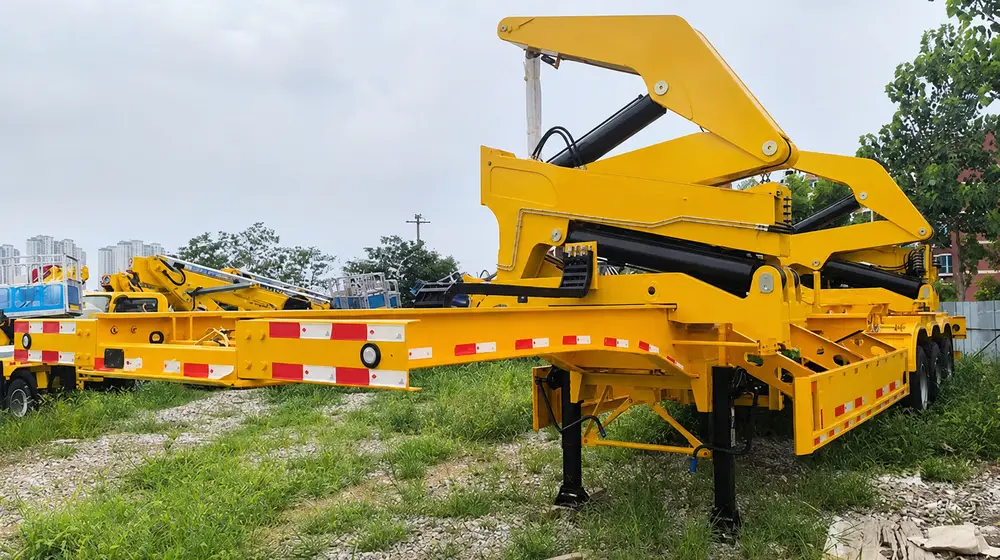
Start with how the machine travels. A trailer-mounted side lifter is a semi-trailer: pin it to any tractor unit and the rig works as normal road haulage. A truck-mounted version bolts the same lifting modules to a sub-frame on a rigid truck, which suits short shuttle work where one vehicle does everything.
Stabilizer layout is the second split. A conventional container side lifter is the typical inline model, with the stabilizer leg inline with the lifting jibs. Other models pair the dual side loader layout with dagger-leg or leg-over stabilizers, which plant the support foot further outboard for a wider stability base.
The chassis frame is the third decision, and buyers get three real choices.
- Lattice chassis. The original design and still the most preferred standard type. It keeps tare weight down without giving up strength.
- I-beam chassis. Introduced as an alternative benchmark, adding torsional stiffness for heavier work. Buyers choose it on their own comparisons and duty cycle.
- Telescopic (trombone) chassis. Extends and contracts to take 20ft, 40ft, and 45ft boxes on one trailer. The same extension principle shows up in wind-energy haulage, where telescopic flatbeds stretch for turbine blades.
| Split | Options | What it decides |
|---|---|---|
| Mounting | Semi-trailer or truck-mounted sub-frame | Fleet flexibility versus single-vehicle shuttle work |
| Stabilizer layout | Inline, dagger leg, or leg-over | Stability margin and footprint on soft or tight ground |
| Chassis frame | Lattice, I-beam, or telescopic trombone | Tare weight, stiffness, and 45ft capability |
 A green truck-mounted container side loader with stabilizer legs deployed lifting a container onto its own bed.
 A blue telescopic sidelifter chassis extended during a 45-foot container reach test at the factory.
Container Sidelifter Design Features
A container sidelifter is a chassis plus a handful of working systems, and the lift cycle ties them together. A typical cycle runs in six steps.
- Park alongside the container, close and parallel.
- Drop the stabilizer legs on the working side and take the suspension load off the axles.
- Slide the crane modules to match the container length.
- Lower the chains and hook them into the bottom corner castings.
- Lift smoothly, bring the container over the bed, and set it down.
- Stow chains and legs, then drive.
Hammar publishes a full handling cycle of 2 to 4 minutes for its machines, about the lift moment of a 100 to 120 tonne-metre crane. That is a test-condition figure; a real job with positioning, chain work, and a walk-around takes longer.
Lifting cranes. The crane modules are hydraulically powered and ride the length of the chassis on sliding carriages, shifted by hydraulic motors or cylinders. They lift a container from the ground, another vehicle, a loading dock, a railway wagon, or off the top of a second container. One point buyers miss: the pair shares the rated load. A 37-tonne sidelifter lifts 37 tonnes with both modules working together, not per side. Side lifting is no trailer-maker workaround, either. ISO 3874 lists it as a recognized handling method, and sets a minimum 30-degree sling angle from the bottom corner castings for a loaded 40ft box.
Driving power unit. The cranes run on a trailer-mounted diesel engine or on PTO from the tractor. A Kubota V2403-class unit around 36 kW is a common fit; Steelbro publishes the same engine family at 48 HP for its SB363. An independent pack frees the trailer from any particular tractor and idles a small engine for hydraulic work instead of a large one. PTO saves the weight and cost of a second engine but ties the trailer to a PTO-kitted truck.
Stabilizing legs. These hydraulic legs keep the vehicle planted while lifting a fully laden container and stop it from tilting. They adjust to help on uneven ground, and they extend and tilt to reach extra positions in confined locations like trailer decks. On soft ground, outrigger pads or mats at three to four times the foot area spread the point load.
Chains. Chains run from the upper part of each crane to the corner castings at the container base. A special connecting device placed between two 20ft containers locks them together, so the side lifter hauls them as though they were one 40ft box. Chains are lifting accessories and live inside inspection regimes: UK LOLER rules call for a thorough examination of lifting chains every 6 months and of the crane itself every 12. A stretched chain, visibly longer than its pair, comes out of service.
The cab/tractor. The tractor pulls the trailer, supplies PTO power in that configuration, and provides compressed air for the trailer brakes. In practice the side lifter works with the tractor attached: even when the trailer carries its own power pack, the tractor supplies brake air and adds stability during the lift.
Chassis. The chassis carries the weight of the loaded container and supports the cranes. Its frame choice loops back to the lattice-versus-I-beam decision covered in the types section.
The remote control. A pushbutton and joystick handset, wired by multi-pair cable or radio-linked, lets the operator move around the container and watch the lift from the safest angle instead of standing near the crush zone. Current machines add proportional levers and safety interlocks. Steelbro's SMARTLift system, one example, weighs the load to within ±100 kg and blocks unstable lifts under the AS 1418.11 crane-safety standard.
 A red hydraulic crane module of a side loader trailer mid-lift with the container suspended on chains.
 Lifting chains running from the crane module to the bottom corner castings of a red container during a stacking lift.
 An operator holding a wireless radio remote control while standing clear of the side lifter lift zone.
 A diesel power pack mounted on a side lifter trailer frame driving the hydraulic pump for the crane modules.
Design Considerations: Stability, Space and Payload
A container sidelifter trailer is designed around three productivity gains: fast, safe, and flexible container handling. Get those right and the machine cuts your transport expenses, increases your capacity to move boxes, and pays for itself in quick, safe operations. Five design considerations carry most of that weight.
Container transfer. Moving a container from the side lifter to a flat-topped or skeletal truck is straightforward. With the stabilizers extended, the receiving trailer backs into position beneath them; if that is not practical, the legs drop low once the trailer is alongside. More than 300 mm of clearance sits on each side of the transferring trailer. Turnaround is fast even with a container already on board, and a load can move to a quad-axle trailer behind a four-axle tractor without jack-knifing either unit. The lift modules never need to rest stabilizer legs on the adjacent trailer, and boxes up to 9ft 6in high-cube clear the arc. For the receiving side of that transfer, a standard 40ft flatbed semi trailer is the usual partner.
Stability. A side lift is an off-center lift, so the stabilizer geometry is the machine's foundation. A wide span between the stabilizer leg and the outboard jib pivot keeps operations quick and safe even in difficult settings, and balanced containers up to 45 tonnes stay manageable because the container's center of gravity sits about a metre inside the stabilizer support line. Other options place the center of mass outside the support line, which makes the setup less stable. The leg-over design earns its reputation here: leg designs that extend downwards in a triangular manner from the lift modules act as pivot points and can tip the machine with a heavy container on the hook.
Geometry is only half of stability. Ground and weather finish the job. Keep setup slopes near 1 degree and never load beyond about 2 degrees. Put pads or mats under every stabilizer foot on soft ground, test-lift a few centimetres, and check for sinking before committing. Treat unloading as the dangerous direction, because a foot that held during loading may punch through rain-softened ground on the way back. Postpone lifts in strong wind.
Control. The container side lifter can be remotely controlled by radio. A compact one-hand pushbutton unit enhances safe working conditions, with two depression levels on a single button: quick speed for fast movement, slow speed for accurate positioning. Fully proportional systems with a toggle handset let the operator manage crane direction and speed directly.
Working space. The side loader gives you the possibility of working in limited space. The leg-over option in particular has been designed and proven against failure during loading and offloading in restricted spaces, and through this capability you can place your container against a wall. For site planning, operators ask for roughly 5 to 6 metres of clear working width alongside the trailer and an overhead check for cables, branches, and canopies before the lift.
Payload carrying capabilities. The range of container side lifters on the market can manage great payload capacity for faster work, made possible by ultra-high-tensile chassis and lightly engineered lift modules that keep tare weight down. The trade runs in one direction: every kilogram saved on the chassis is a kilogram of legal payload gained on the road.
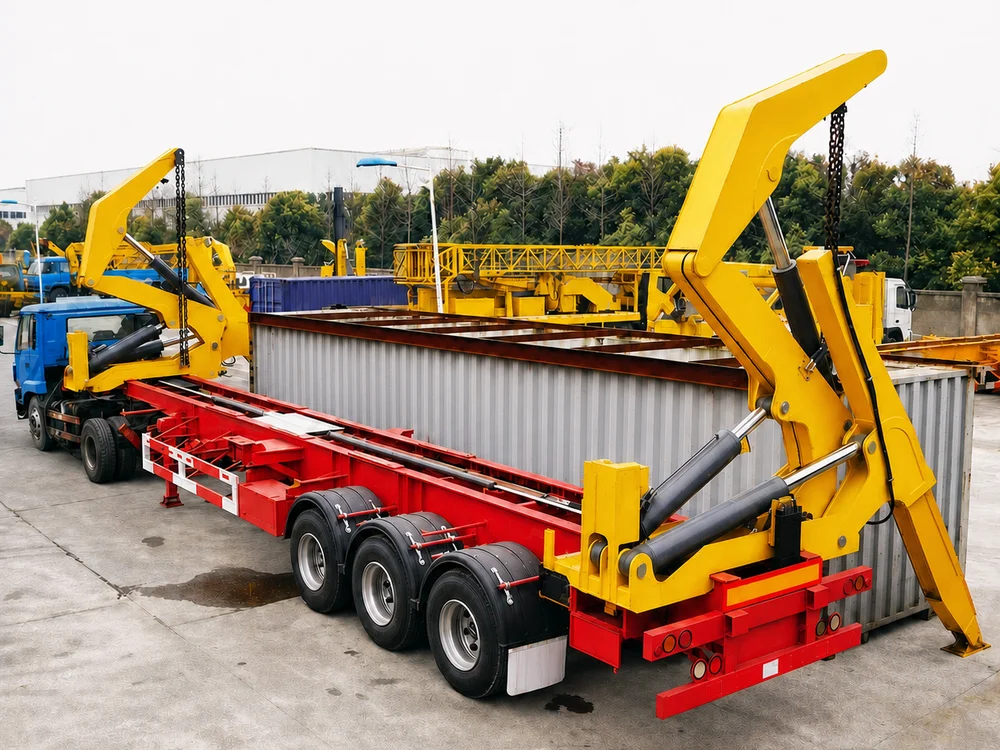 A container side lifter transferring a loaded shipping container across to an adjacent skeletal trailer at a depot.
Benefits of Using a Container Side Lifter
The design considerations above translate into practical benefits for container logistics.
- More container movements per day. Transfers to the ground finish in minutes, not hours, which compounds into real efficiency and productivity gains over a working week.
- One person, one machine. The trailer driver offloads the container on his own in a matter of minutes and handles 20ft and 40ft boxes with the same equipment. No extra personnel, no hired crane. That makes operations cost-effective in a way few machines match.
- Tough machine, low maintenance. The container side lifter is a tough machine that keeps working on any terrain, including a low-cost dry terminal. Routine care is simple: regular hydraulic oil and filter attention covers most of it.
- Gentle with difficult cargo. Fragile, valuable, and hazardous cargo loads and offloads without rough handling, and the sidelifter action places containers at the exact spot needed for easy access.
- Transport anywhere, anytime by road. The machine operates independently of support equipment at either end, so containers move by road on your schedule.
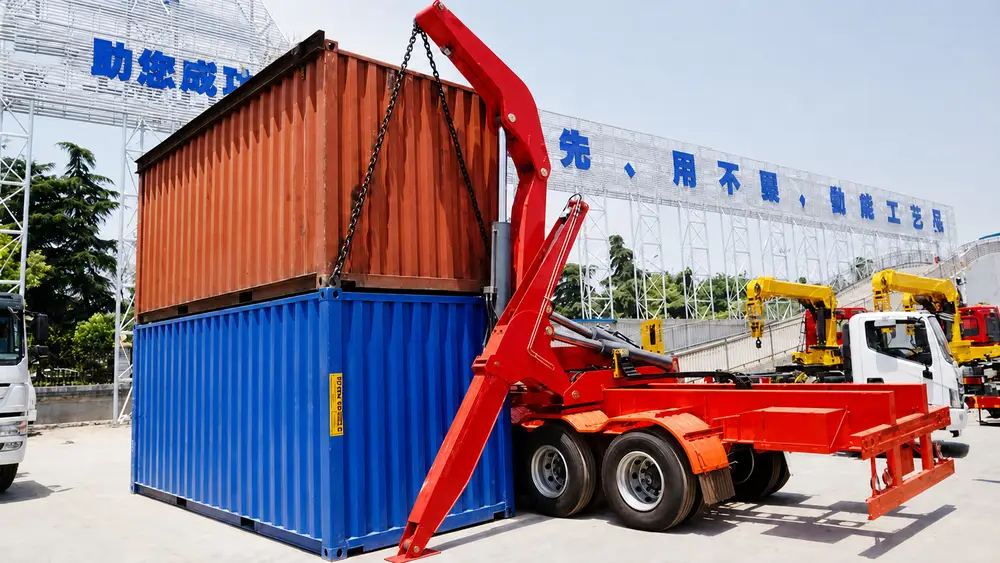
- Double stacking. In restricted space, a side loader can safely and quickly stack fully loaded 20ft and 40ft containers on top of each other, two high with the stacking option fitted.
- Lower operating cost. With a container side lifter, the container, not the trailer, stays with the customer. A conventional trailer left behind at a customer's site is unproductive equipment; the side lifter works all day, loading, transporting, and offloading from one job to the next.
- More than containers. The same machine handles industrial equipment and specialized boxes like portable buildings and fuel containers. For loads beyond container dimensions, specialized haulage starts with RGN trailers and goes up from there.
Two corrections are worth making here, because buyers hear both claims. First, side loaders are not just for empty boxes: mid and upper classes, 36 tonnes and above, handle fully laden containers at the plated 30,480 kg gross. Second, these machines do not simply tip over. Rollovers trace to procedure: swinging over the unsupported off side, ignoring slope limits, or skipping pads on soft ground. Current units interlock the lift until the stabilizers carry weight.
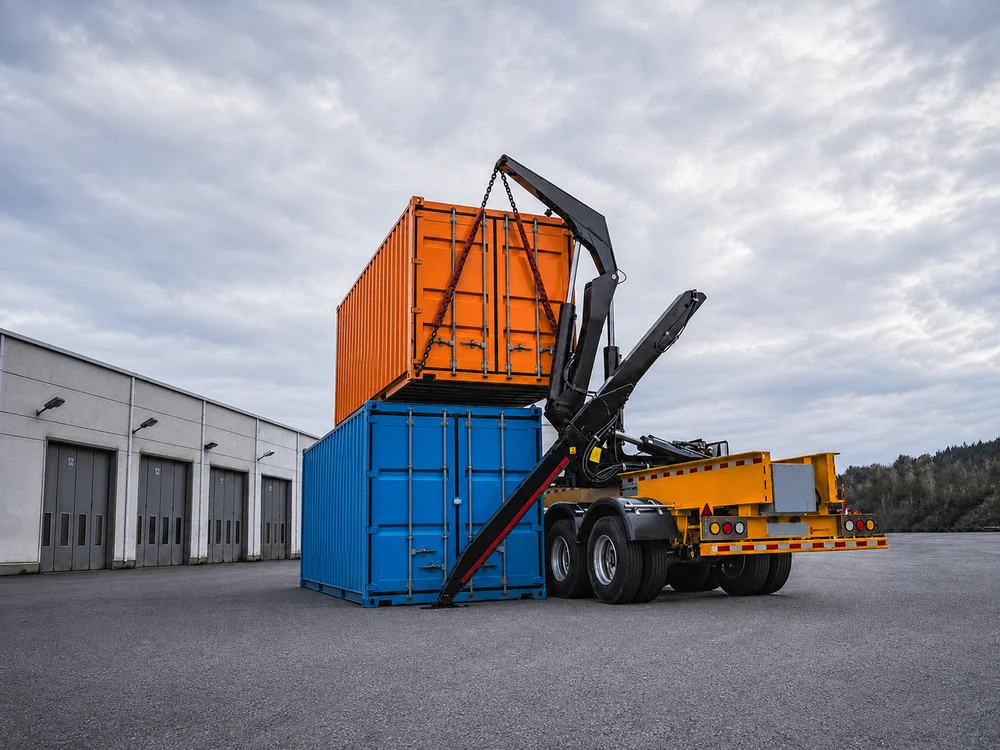 A container side loader double stacking a loaded orange container on top of a blue one at ground level.
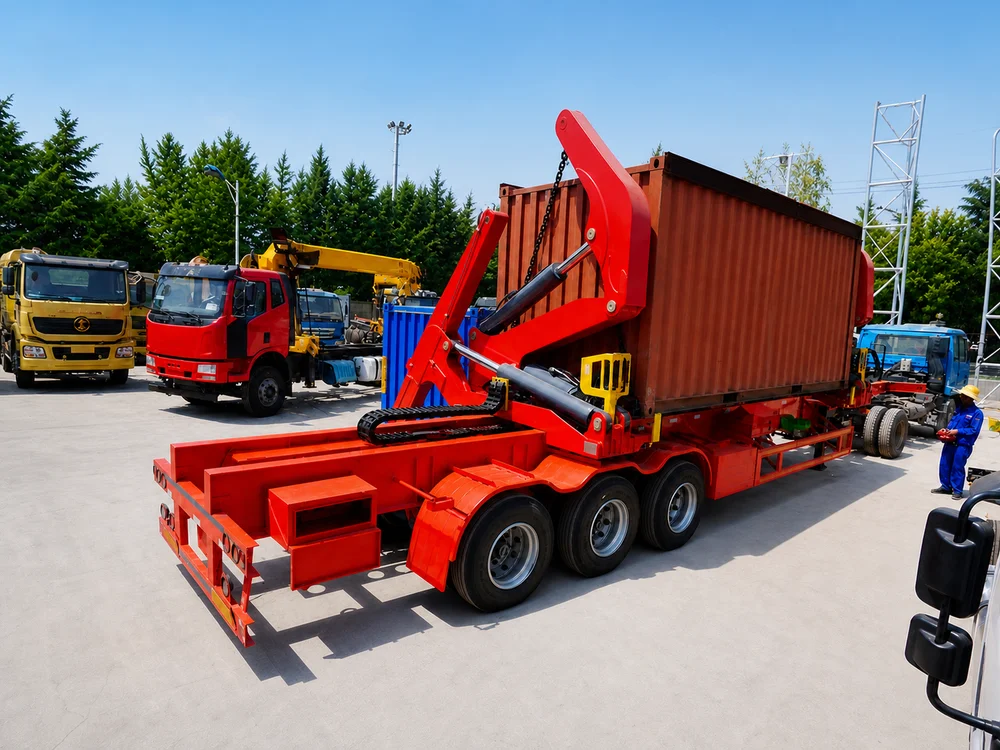 A single operator unloading a container to bare ground with a radio remote, no crane or forklift involved.
Side Loader vs Reach Stacker vs Container Forklift
Buyers weigh three machines against each other for container handling, and the honest answer is that they do different jobs. A reach stacker lifts around 45 tonnes in the first row, stacks up to five high, and reaches into the second and third rows, but it needs a paved yard and a specialist operator, and the machine never leaves the site. A heavy container forklift carries the same limits with less reach. The side loader wins where the work is scattered: road-legal, self-loading, and needing nothing at either end but firm, level ground.
| Machine | Lifts | Stacks | Mobility | Site requirement |
|---|---|---|---|---|
| Side loader trailer | 36 to 45 t SWL by class | 2 high, with stacking option | Road-legal, self-loading | Firm level ground alongside the box |
| Reach stacker | Around 45 t, first row | 5 high, reaches 3 rows deep | Yard-bound | Paved yard, specialist operator |
| Container forklift | Heavy loads, shorter reach | Limited | Yard and depot | Paved yard, specialist operator |
Fleets that run both keep the reach stacker inside the port fence and send side loaders beyond it. Complementary, not interchangeable.
Loading Applications of a Container Sidelifter
For handling containers on the ground, few machines match the container sidelifter on cost-effectiveness. It delivers and retrieves containers with precision, placing loads where they are easiest to work with: transportation depots, rail yards, or any suitable rail siding. From there it can transfer to other trucks or trailers, offload to the ground, or double-stack boxes on depot platforms.
Ground-level loading and offloading reduces injury risk, because nobody works at height on top of containers. There is no waiting time, since no other machinery is needed for the lift, and ground preparation with additional equipment is eliminated. That saves operating money and considerable time for manufacturers, importers, and distributors, and it is the reason logistics companies, sole transport operators, and fleet managers keep sidelifters on their fleets.
Demand clusters where containers outnumber cranes. Africa is the fastest-growing container port region in the 2025 tallies, and inland legs like the Beira-to-Malawi corridor cited earlier show the cost pressure pushing boxes onto roads. In Central Asia, ERAI figures show China rail container traffic up 31% in the first eight months of 2025. Every new dry port along that corridor needs ground handling with no quay crane in sight. Small ports tell the same story: facilities under one million TEU grew 21% in 2025, and World Food Programme logistics assessments count fleets of 30 to 40 side lifter trucks running the entire container hinterland of ports like Honiara. Military and disaster-relief fleets lean on the machines for the same reason: the truck brings its own crane.
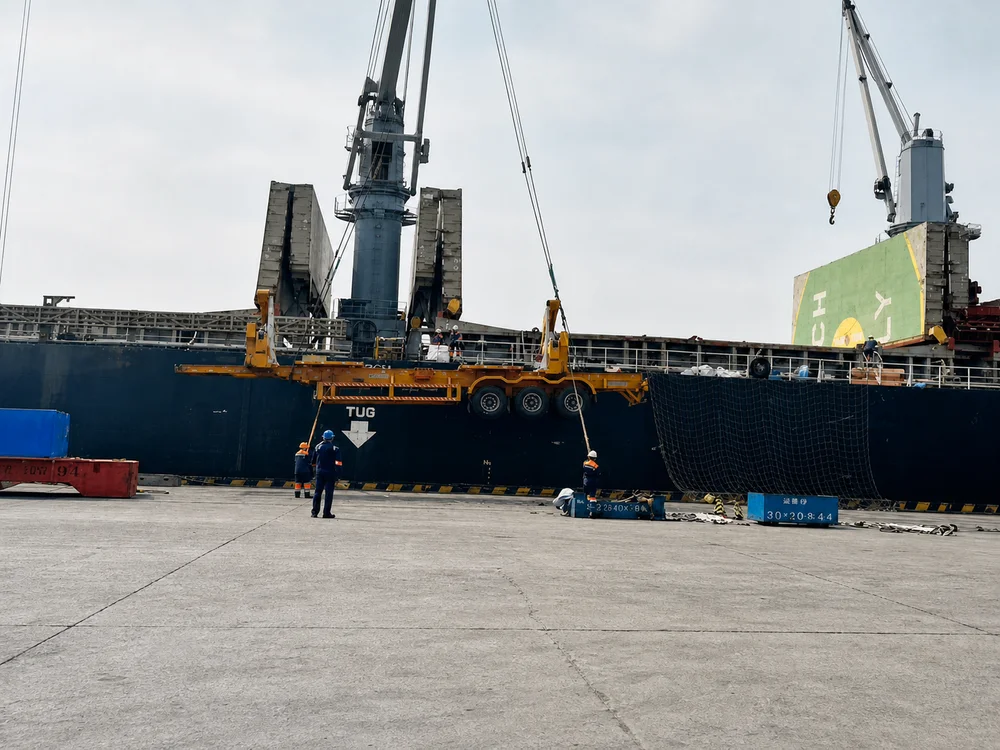 A new side lifter trailer being lowered by a ship's crane onto the quay at a small island port, with dock workers watching.
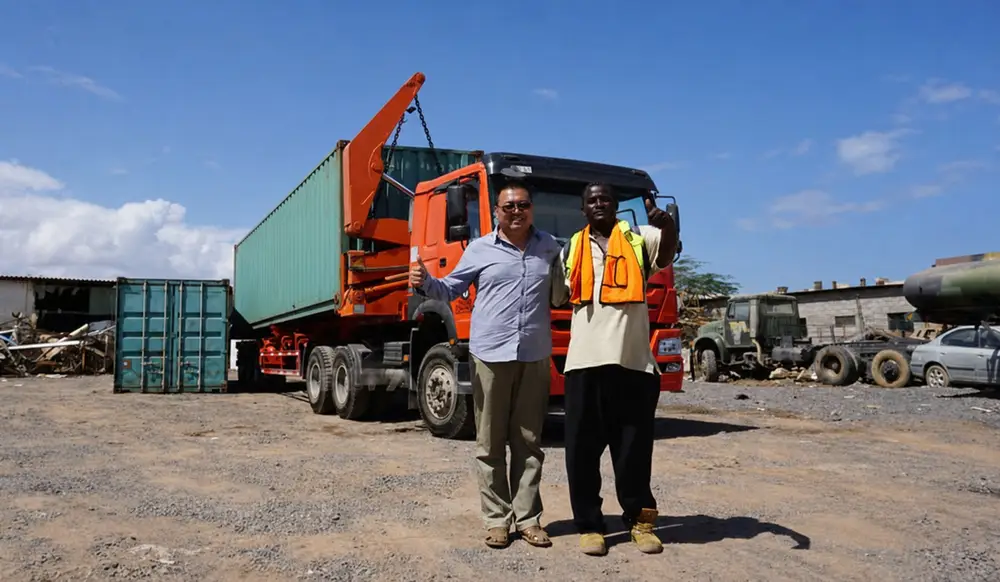
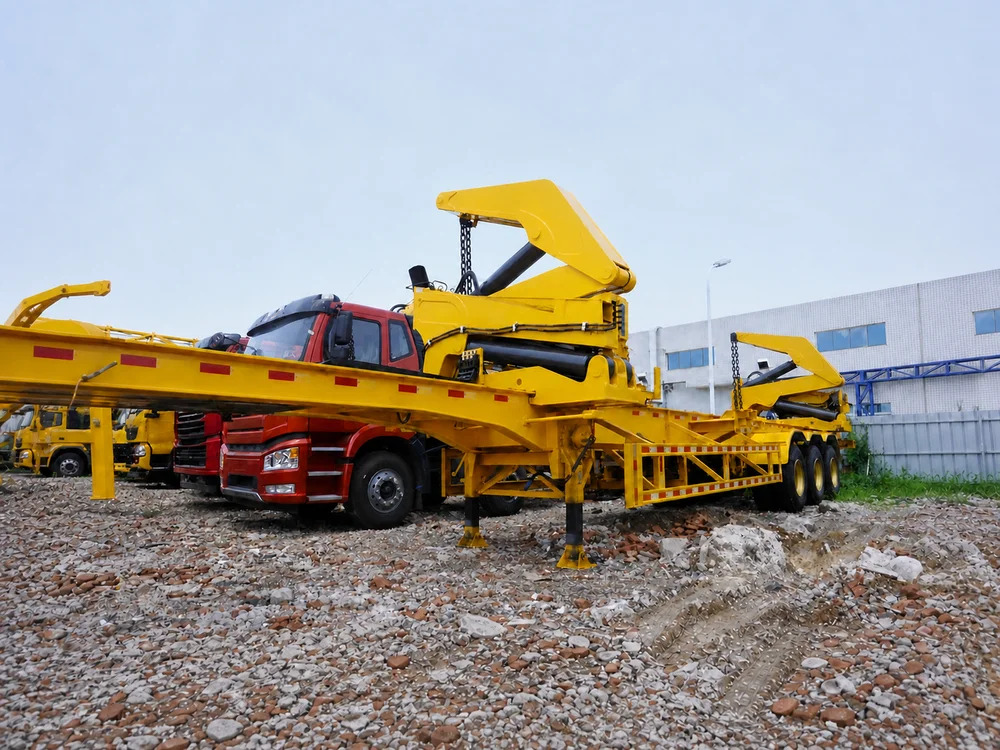 A side loader trailer and tractor unit delivering a container on a bare dirt worksite with hills behind.
Frequently Asked Questions
How much weight can a container side lifter lift?
Market classes run from 12-tonne light units up to 45-tonne heavy models, with 36 to 37 tonnes the common standard. A fully laden 40ft container plates at 30,480 kg maximum gross under the CSC safety convention, so a 36-tonne machine covers it with margin. Every rating applies at a stated stabilizer outreach, so compare nameplate load curves, not headline tonnage.
Can one side loader trailer handle both 20ft and 40ft containers?
Yes. The two crane modules slide along the chassis to match container length, covering ISO 668 sizes from the 6,058 mm 20ft box to the 12,192 mm 40ft, and telescopic trombone chassis extend to 45ft. Because the cranes hook ISO 1161 corner castings, two 20ft boxes can also be locked together and lifted as a single 40ft load.
What is the difference between a side loader and a reach stacker?
A reach stacker is a yard machine: current models lift around 45 tonnes in the first row, stack up to five high, and reach into the second and third rows, but need a paved yard and a specialist operator. A side loader is road-legal and self-loading, stacking two high at most with the optional kit. Terminals keep reach stackers inside the fence; side loaders deliver beyond it.
How much does a side loader trailer cost?
Price follows specification, and marketplace listings range from bait offers to genuine quotes, so two prices only compare at equal configuration. The main drivers are safe working load class (12 to 45 tonnes), chassis type (a telescopic trombone frame costs more than a fixed lattice), power unit (tractor PTO or independent diesel pack), stabilizer style, and stacking options. Send your container mix and route for an exact quote.
Do you need training or a licence to operate a side lifter?
No country issues a sidelifter-specific licence, but competency rules apply in most markets. Australia trains operators under the TLID0017 unit for container side lifter operation, and larger truck-mounted units can also fall under the CV-class high-risk work licence that covers vehicle loading cranes of 10 metre-tonnes and above. The UK requires LOLER thorough examinations of lifting chains every 6 months and of the crane every 12, and workplace safety regulators in New Zealand and the EU hold the employer responsible for trained, competent operators.
Conclusion
Modern sidelifter equipment is designed for a maximum weight of 45 tonnes, and continued development has seen recent designs take up to 47 tonnes. Smaller versions take lighter loads where a low tare weight matters, so the buyer has room to match the machine to the job. On site, they can tilt the chassis through the stabilizing legs to work uneven ground while controlling the lowering and raising of the cranes.
One last design detail matters for road work: the telescopic chassis, also known as the trombone chassis. It lets the unit contract and expand to make room for a 20ft, 40ft, or 45ft container, and trombone units answer a problem every operator knows: small secondary roads with no cornering room for a full-length 40ft trailer.
A side loader handles the box at each end of the trip. For the highway miles between, pair it with a 40ft skeleton semi trailer behind a road tractor. If you are sizing a machine for a specific route or container mix, send us your requirements and our engineers will spec the capacity class, chassis, and power unit around your operation.
Continue Reading
Apr 9, 2026
What Is an RGN Trailer? How Is It Different from a Low Bed Trailer?
Learn the key differences between RGN (removable gooseneck) trailers and lowboy trailers — specs, capacity, cost, stability, and front-loading vs rear-loading.
Apr 4, 2026
How to Buy a Fuel Tank Trailer?
Practical guide to buying a fuel tank trailer: materials (carbon steel vs aluminum vs stainless steel), tank shapes, loading systems, safety equipment, and real pricing.
Apr 4, 2026
How to Choose a Reliable Semi Trailer Manufacturer
A practical guide to evaluating semi trailer manufacturers in China — what to check on procurement, engineering, quality control, export experience, and after-sales support before placing your order.