
Fuel Tanker Trailer Materials Compared: Carbon Steel vs Aluminum vs Stainless Steel
Published May 26, 2026
25 engineers · ISO 9001 · 3C certified · Liangshan factory since 2001
Updated 2026-05-26
24 min read
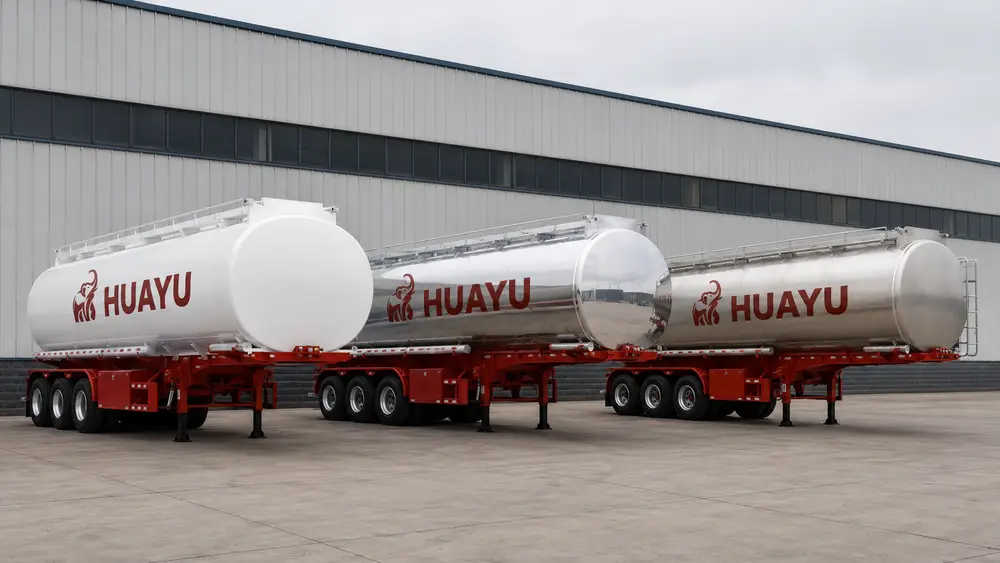
The material you choose for a fuel tanker trailer determines far more than what the tank looks like. It sets the ceiling on how much fuel you can carry per trip, how many years the trailer will last, what it costs to maintain, and whether a roadside welder can patch it when something goes wrong 400 kilometers from the nearest city.
Most comparison articles stop at "aluminum is lighter, steel is cheaper." That is true but not useful. The real question is which material makes you more money over 5 to 10 years of operation in your specific market — and the answer changes depending on whether you run highway routes in South Africa, deliver fuel to mining sites in the DRC, or supply petroleum depots across the Gulf states.
This guide compares all three fuel tanker trailer materials — carbon steel, aluminum alloy, and stainless steel — with the specific cost data, payload math, and maintenance realities that matter for fleet operators buying from China for African, Middle Eastern, and Southeast Asian markets.
The Master Comparison Table
Before diving into each material, here is the full picture at a glance. All figures are for a standard 45,000-liter, 3-axle fuel tanker trailer.
| Attribute | Carbon Steel (Q345B) | Aluminum Alloy (5083/5454) | Stainless Steel (304/316L) |
|---|---|---|---|
| Purchase price | $20,000–$23,000 | $28,000–$32,000 | $30,000–$35,000 |
| Tare weight | ~7,500 kg | ~5,500 kg | ~6,800 kg |
| Payload gain vs. steel | Baseline | +18–35% | Roughly equal to steel |
| Shell thickness | 5–6 mm | 5–6 mm (shell), 7 mm (heads) | 4–5 mm |
| Tensile strength | 450–630 MPa | 200–370 MPa | 515–690 MPa |
| Service life | 7–15 years | 15–25 years | 20–30 years |
| Annual maintenance | $2,000–$3,000 | $1,000–$1,500 | $500–$1,000 |
| Internal coating needed | Yes (epoxy, every 5–7 years) | No | No |
| Recoating cost per cycle | $8,000–$12,000 | None | None |
| Field weld repair | MIG/arc — any workshop | TIG only — specialist required | TIG — specialist required |
| Resale value at 10 years | 40–50% | 60–70% | Not widely quantified |
| Scrap recovery value | $1,000–$3,500 | $4,800–$12,000 | High |
| Fuel savings vs. steel | Baseline | 7.9–12.1% lower consumption | None |
Two patterns stand out from this table. First, aluminum costs more upfront but saves money everywhere else — fuel, maintenance, payload revenue, and resale. Second, stainless steel occupies a narrow but critical lane: it is the only viable option for corrosive chemicals, food-grade liquids, and certain regulatory environments, but it offers no weight or cost advantage over aluminum for standard petroleum service.
Carbon Steel Fuel Tanker Trailers
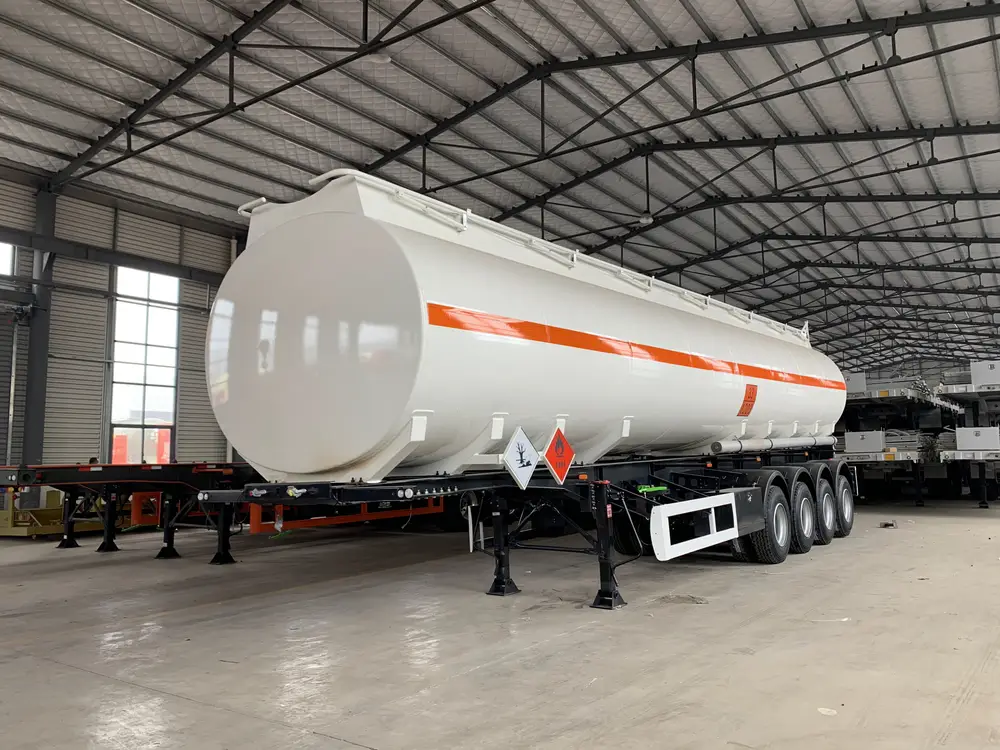 Q345B carbon steel fuel tanker trailer with hazard placards in factory warehouse
Material Properties and Common Grades
Q345B is the dominant carbon steel grade in Chinese-manufactured fuel tanker trailers exported to Africa, the Middle East, and Southeast Asia. Its mechanical properties make the reasoning clear:
- Yield strength: 345 MPa
- Tensile strength: 450–630 MPa
- Elongation: ≥21% (grades A–B)
- Carbon content: 0.03–0.23%
- Manganese: 1.00–1.60%
The international equivalents are A572 Grade 50 under ASTM (United States), S355 under EN (Europe), and SPFC590 under JIS (Japan). If your import documentation references any of these designations, they describe comparable structural performance.
Tank shell thickness for Q345B tankers runs 5–6 mm on the cylindrical body and 5 mm minimum on the dished heads. These walls handle the hydrostatic loads of a full 45,000-liter petroleum load without difficulty — carbon steel's tensile strength is roughly double that of aluminum, which is why the same wall thickness carries the same pressure rating despite the material's higher density.
Why Carbon Steel Dominates in Developing Markets
Three factors keep carbon steel as the default in price-sensitive markets:
The price gap is real. At $20,000–$23,000 for a 45,000-liter unit, a carbon steel tanker costs $7,000–$12,000 less than an equivalent aluminum trailer. For an operator purchasing their first trailer or expanding a small fleet with limited credit, that difference is the down payment on a second unit.
Any welder on the continent can fix it. Carbon steel responds to standard MIG and arc welding — processes that every truck workshop in Lagos, Mombasa, Addis Ababa, or Phnom Penh can perform. No special shielding gas, no precision current control, no oxide-layer preparation. When a tanker clips a gate post in a fuel depot at 2 AM, the repair happens that morning.
Structural strength absorbs punishment. On unpaved roads — and much of inland Africa's fuel distribution network runs on unpaved roads — repeated vibration and impact stress tests the weld joints. Carbon steel's 450–630 MPa tensile strength and 21%+ elongation absorb that abuse without propagating cracks as readily as a lighter material might under the same conditions.
The Corrosion Problem and the Epoxy Solution
Uncoated carbon steel in a tropical or coastal environment corrodes. The interior surface, constantly in contact with petroleum products containing trace water and sulfur compounds, pits and thins over time. Without intervention, the tank wall reaches minimum safe thickness in 7–9 years.
This is the number most aluminum manufacturers quote — and it is accurate for bare steel. But it leaves out the second half of the story.
Factory-applied epoxy lining changes the timeline. A high-quality internal epoxy coat, applied before the tank leaves the factory, creates a barrier between the steel and the cargo. The cost: $3,000–$5,000 added to the purchase price. The return: service life extends to 12–15 years, roughly doubling the uncoated figure.
The maintenance catch is that epoxy needs refreshing. The recoating interval runs 5–7 years, and each cycle costs $8,000–$12,000 including surface preparation, application, and curing. Over a 15-year life, that means two recoating events — adding $16,000–$24,000 to the total cost of ownership.
One material compatibility note: methanol softens most epoxy formulations. If your fleet occasionally hauls methanol or methanol-blended fuels, the lining degrades faster. Standard diesel and gasoline do not cause this problem.
Sacrificial anode systems provide a supplementary defense. Zinc or aluminum anodes bolted inside the tank corrode preferentially, protecting the steel substrate. Combined with epoxy, they extend the interval between recoats and provide a safety margin if the lining suffers localized damage.
Aluminum Alloy Fuel Tanker Trailers
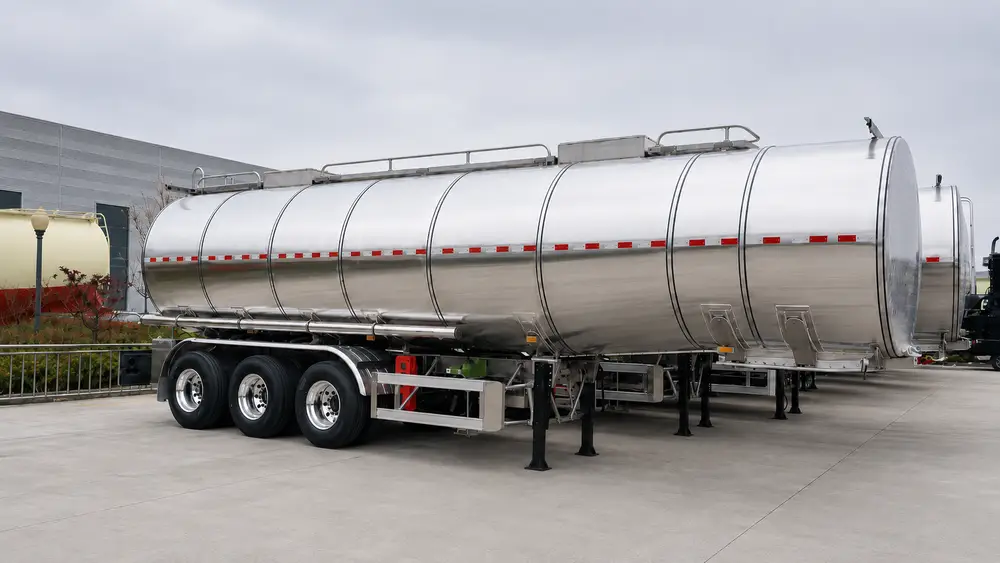 Polished aluminum alloy fuel tanker trailer parked in factory dispatch yard
Alloy Grades: 5083 vs 5454
Not all aluminum is the same. Fuel tanker trailers use alloys from the 5xxx (Al-Mg) series, and two grades account for the vast majority of production:
5083 is the workhorse. With 4.0–4.9% magnesium content, it delivers tensile strength of 290–370 MPa in the H32 temper and the best corrosion resistance of any non-heat-treatable aluminum alloy. Most fuel tanker bodies worldwide — including those built to DOT-406 specifications in North America — use 5083 as the default shell material.
5454 is the high-temperature option. Its yield strength reaches approximately 250 MPa in H32 temper, and it handles sustained exposure to temperatures that would degrade 5083. Saudi Aramco specifications for petroleum tanker trailers in the GCC region call for 5454 specifically. If your fleet operates in the Arabian Peninsula, confirm that your supplier uses this grade rather than defaulting to 5083.
Shell thickness on aluminum tanker trailers mirrors carbon steel: 5–6 mm for the cylindrical body in H32 temper. The difference shows up at the heads (dished ends), where aluminum runs thicker at 7–7.2 mm in O temper to compensate for its lower tensile strength relative to steel.
A third grade, 5182, appears occasionally in bulkhead and baffle applications. Its elongation of 26%+ exceeds both 5083 and 5454, making it suitable for components that absorb surge forces during braking. It is not used for the main tank shell.
The Payload Advantage in Real Numbers
The weight savings from aluminum translate into money. Here is how the math works for a 45,000-liter tanker operating at 150,000 km per year:
Tare weight reduction: approximately 2,000 kg. An aluminum tanker weighs roughly 5,500 kg against 7,500 kg for carbon steel. Some configurations save up to 4,000–4,900 kg depending on tank size and optional equipment, but 2,000 kg is the conservative figure for identical-spec 45,000-liter units.
Extra cargo per trip: 2,380 liters of diesel. At diesel's density of 0.84 kg/L, a 2,000 kg tare weight reduction allows 2,380 additional liters per load. At a conservative fuel margin of $0.05 per liter (transport operator's margin, not retail price), that is $119 of additional revenue per trip.
Annual revenue impact: $23,000–$28,000. At 200 loads per year, the extra payload generates $23,800 in additional revenue. Add the fuel consumption savings — 7.9% to 12.1% less diesel burned depending on average speed — and the combined annual advantage reaches $23,000–$28,000 compared to the same route served by a carbon steel tanker.
Payback period: 1–3 years. With an upfront premium of $7,000–$12,000 over carbon steel and annual operating savings of $23,000–$28,000, the aluminum premium pays for itself before the end of the second year at high utilization rates. At lower utilization (80,000–100,000 km per year), the payback stretches to 3 years.
These numbers explain why aluminum dominates long-haul, high-frequency fuel distribution routes — and why it makes less economic sense for an operator running 40,000 km per year on local delivery routes where the premium takes 5+ years to recover.
The Repair Reality
Aluminum requires TIG (Gas Tungsten Arc) welding. This is a slower, more precise process than the MIG or stick welding used on steel, and it demands equipment and skills that are not universally available.
The core challenge: aluminum oxide. The oxide layer that forms on aluminum's surface has a melting point of approximately 2,050°C — far above aluminum's own melting point of 660°C. Before any weld can proceed, the oxide must be mechanically removed by grinding or chemical cleaning. If the tank has been exposed to salt spray (coastal environments), the oxide layer thickens and becomes even harder to remove. One welding reference describes the problem bluntly: once thick aluminum oxide forms from salt exposure, welding becomes impossible without prior surface preparation.
The filler wire also matters. Aluminum tanker repairs use ER5183 or ER5356 filler with argon shielding gas. These consumables are standard stock in major-city welding suppliers but not in rural hardware stores.
Repair cost benchmarks (South Africa, 2025):
- TIG welding rate: ZAR 400–450 per hour (approximately $22–$24)
- Per-meter weld: ZAR 500–1,500 depending on position and access
- Equipment investment for a TIG-capable shop: $50,000–$70,000
The practical decision rule: if your tanker operates within 200 km of a city with TIG welding facilities — Johannesburg, Durban, Lagos, Nairobi, Dar es Salaam, Jeddah, Riyadh, Bangkok, Ho Chi Minh City — aluminum is repairable within a reasonable turnaround. If your routes run through landlocked regions more than 200 km from such a city, the repair risk tips the decision toward carbon steel.
Stainless Steel Fuel Tanker Trailers
304 vs 316L: Two Grades for Two Different Jobs
Stainless steel in tanker service means one of two grades:
304 is the general-purpose food and fuel grade. Its 18% chromium and 8% nickel content forms a passive oxide layer that regenerates after scratching — eliminating the need for internal coatings. It meets FDA and 3A sanitary standards, which is why it dominates food-grade liquid transport (edible oils, milk, fruit juice concentrates) and clean-fuel applications like aviation fuel.
316L adds 2–3% molybdenum for resistance to chloride-induced pitting. It is the choice for marine environments, coastal fuel depots exposed to salt air, and — critically — corrosive chemical cargoes. DOT-412 regulations for corrosive material transport require stainless steel or lined carbon steel, and 316L is the standard for the former.
Applications Where Stainless Steel Is the Only Option
For standard petroleum fuels (gasoline, diesel, kerosene), stainless steel works but offers no advantage over aluminum. It weighs more (6,800 kg vs. 5,500 kg for the same 45,000L configuration), costs more ($30,000–$35,000 vs. $28,000–$32,000 for aluminum), and does not save fuel through weight reduction.
Stainless steel earns its price in four specific scenarios:
-
Corrosive chemicals — sulfuric acid, hydrochloric acid, liquid fertilizers. No other material survives sustained contact with these cargoes. DOT-412 and ADR Class 8 regulations apply.
-
Food-grade liquids — edible oils, dairy, beverages. FDA 21 CFR Part 1 and NSF/ANSI 61 (drinking water contact) compliance requires 304 stainless at minimum.
-
Aviation fuel (Jet A-1) — contamination control standards in aviation fuel handling favor stainless for its inertness and ease of sterilization.
-
Bitumen and hot asphalt — these cargoes travel at 140–180°C, temperatures at which aluminum softens. Carbon steel is actually the primary choice for bitumen tankers, but the outer insulation jacket on heated tankers often uses stainless steel panels for corrosion resistance during road spray exposure.
If your fleet exclusively handles refined petroleum fuels, stainless steel is overspecified and over-budget. Aluminum does the job at lower weight and comparable price. Stainless steel belongs in a fleet only when the cargo demands it.
Five-Year Total Cost of Ownership
Purchase Price Is Less Than Half the Story
The purchase price of a fuel tanker trailer accounts for 30–40% of what the trailer actually costs over its working life. The other 60–70% comes from maintenance, fuel consumption, coatings, insurance, downtime, and the value you recover at resale or scrap.
This is where aluminum's economics flip the initial price disadvantage. Here is a side-by-side model for a 45,000-liter, 3-axle tanker operating at 150,000 km per year over 5 years:
| Cost Item | Carbon Steel (bare) | Carbon Steel (epoxy lined) | Aluminum (5083) |
|---|---|---|---|
| Purchase price | $21,000 | $25,000 | $30,000 |
| Maintenance (5 years) | $15,000 | $12,500 | $7,500 |
| Epoxy recoating (5 years) | $0 | $8,000 | $0 |
| Additional payload revenue (5 years) | $0 | $0 | +$59,500 |
| Fuel savings (5 years, 10% avg) | $0 | $0 | +$6,400 |
| Resale value at year 5 | −$12,600 | −$15,000 | −$22,500 |
| Net 5-year cost | $23,400 | $30,500 | −$21,000 |
Read that bottom line carefully. The aluminum tanker does not just cost less over 5 years — it generates a net surplus of roughly $21,000 after accounting for the higher purchase price, because the payload revenue and fuel savings exceed all costs including the trailer itself.
The bare carbon steel tanker looks cheapest on paper but produces no payload advantage and faces a shorter life. The epoxy-lined carbon steel unit lasts longer but accumulates coating costs that erode the initial savings.
The breakeven point shifts with utilization. At 150,000 km per year (typical for inter-city fuel distribution), aluminum wins within 18 months. At 80,000 km per year (local depot delivery), the breakeven stretches to 3–4 years. Below 50,000 km per year, carbon steel may never lose its cost advantage during the trailer's useful life.
Which Material Fits Your Market
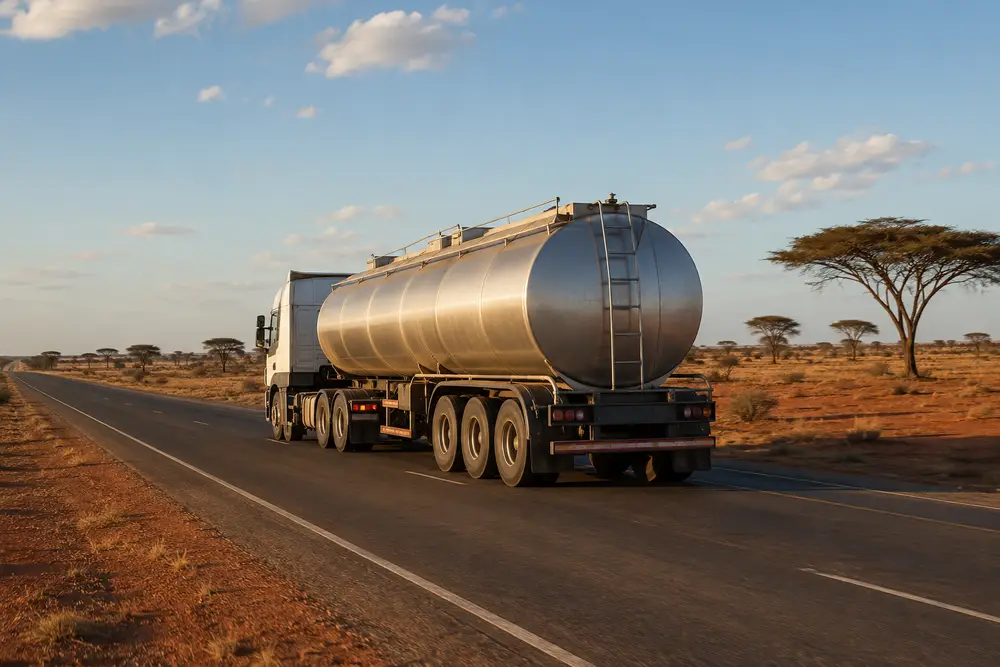 Aluminum fuel tanker trailer on an African highway through dry savanna
West Africa: Nigeria, Ghana, Ivory Coast
Nigeria enforces a gross vehicle weight limit of approximately 30 tonnes for standard configurations. Under that constraint, every kilogram of tare weight directly reduces the fuel you can carry. An aluminum tanker's 2,000+ kg weight savings translates to 2,000+ more liters per trip — a margin that compounds across hundreds of loads per year.
However, the repair picture is mixed. Lagos, Abuja, and Accra have industrial welding workshops capable of TIG aluminum work. But routes into Nigeria's northern states, inland Ghana, or Ivory Coast's western regions move far from those workshops. Operators running predominantly coastal or inter-city routes between major cities benefit from aluminum. Operators serving mining sites or rural fuel depots deep inland should weigh the repair risk.
Import costs are significant. Nigeria applies approximately 27% combined duty and surcharge on the declared value. On a $30,000 aluminum tanker, that adds roughly $8,100 in import taxes — compared to $5,700 on a $21,000 carbon steel unit. Factor this into the total cost comparison.
East and Southern Africa: Kenya, Tanzania, South Africa
South Africa allows up to 56 tonnes gross combination mass on certain configurations under the National Road Traffic Act formula. At that ceiling, an aluminum tanker's weight savings converts directly into additional legal payload — there is headroom to fill.
Kenya currently caps at 48 tonnes for 6-axle combinations but is transitioning to the East African Community's 56-tonne standard under the EAC Vehicle Control Act 2016. Tanzania already operates at the 56-tonne limit. Operators purchasing tankers now for Kenyan routes should size for the incoming higher limit — aluminum positions you to capture the full payload increase once the transition takes effect.
South Africa also has the strongest aluminum welding infrastructure on the continent. Johannesburg, Durban, and Cape Town all have TIG-capable workshops charging ZAR 400–450 per hour. East African cities (Nairobi, Dar es Salaam, Kampala) have growing but more limited capability.
South Africa's tanker construction and testing falls under SANS 1518, which governs design, fabrication, and maintenance of road vehicles transporting dangerous goods. If your tanker will operate in South Africa, confirm that your manufacturer can supply documentation certifying compliance with this standard. DEKRA certification, renewed on 12-month cycles, is the operational permit requirement.
Middle East and GCC: Saudi Arabia, UAE
The Gulf Cooperation Council market has a clear aluminum preference, driven from the top. Saudi Aramco specifications for petroleum transport tankers call for aluminum alloy 5454 with air suspension systems, in capacities typically ranging from 32,000 to 42,000 liters.
Desert operating temperatures give 5454 an additional edge over 5083. While both alloys perform well in standard petroleum service, 5454's stability at elevated temperatures (rated for sustained service above 65°C and intermittent exposure approaching 150°C) means the tank material does not degrade from thermal cycling between cool nights and extreme daytime heat.
GCC countries follow SASO (Saudi Standards, Metrology and Quality Organization) and GSO (GCC Standardization Organization) technical regulations for petroleum transport. ADR-equivalent certification is recognized in some GCC states, but separate SASO type-approval may be required. Check with your local compliance authority before assuming ADR certification transfers automatically.
Southeast Asia
Tropical humidity and coastal salt exposure accelerate corrosion on uncoated carbon steel. Operators in Indonesia, Vietnam, the Philippines, and coastal Malaysia face the same problem as West African coastal operators: bare carbon steel deteriorates faster than the manufacturer's quoted lifespan suggests.
The repair infrastructure is better here. Thailand and Vietnam both have well-developed industrial welding sectors with TIG capability widely available in Bangkok, Ho Chi Minh City, Hanoi, and Jakarta. This makes aluminum a practical option even for operators running non-highway routes, provided they stay within reasonable distance of urban repair facilities.
Choosing the Right Material by Cargo Type
The fuel tanker trailer material decision also depends on what goes inside the tank. Different cargoes interact with different materials in ways that override the cost and weight analysis:
| Cargo | Recommended Material | Key Reason |
|---|---|---|
| Gasoline / petrol | Aluminum 5083 or 5454 | No spark on impact, lightweight, fully compatible |
| Diesel | Aluminum or carbon steel | Both compatible; aluminum saves weight on long hauls |
| Kerosene / jet fuel | Aluminum 5083 | Standard aviation-supply material, clean inner surface |
| Crude oil (light) | Aluminum or carbon steel | Both work; carbon steel preferred for sulfur-rich grades |
| Crude oil (heavy/sour) | Carbon steel with lining | High sulfur compounds attack aluminum; lined steel lasts ~5 years longer in this service |
| Bitumen / asphalt (140–180°C) | Carbon steel only | Aluminum softens above 150°C; stainless used for outer jacket only |
| Corrosive chemicals | Stainless steel 316L | DOT-412 / ADR Class 8 compliance; no other material survives |
| Edible oils / dairy | Stainless steel 304 | FDA / 3A sanitary compliance required |
| Liquid fertilizer | Stainless steel 316L | Chloride and ammonia resistance needed |
| LPG / pressurized gas | Specialized pressure vessel steel | Entirely separate engineering category (MC-331 / EN 12493) |
Two entries on this table deserve emphasis. First, heavy crude oil with high sulfur content corrodes aluminum aggressively — operators in oilfield service report aluminum tanker lifespans of only about 5 years in crude service, compared to 15–20 years in refined fuel service. Second, bitumen transport at 140–180°C categorically excludes aluminum, which begins to lose structural strength above 150°C.
For operators running mixed-cargo fleets, the material decision should be driven by the most demanding cargo in the rotation. A tanker that occasionally hauls corrosive additives needs stainless steel even if 90% of its loads are standard diesel.
Safety Features Influenced by Material Choice
Static Electricity and Spark Risk
Every fuel loading and unloading operation creates potential for static electricity discharge — and in a flammable vapor environment, a single spark can cause ignition.
Aluminum's electrical conductivity is roughly 60% that of copper, making it one of the most conductive structural metals. This property means static charge dissipates through the tank body more readily than through steel, reducing the risk of localized charge accumulation at loading valves and manholes.
Carbon steel requires a dedicated grounding system to achieve the same effect. The standard calls for grounding cable resistance below 10 ohms, tested before every loading operation per API RP 2003. Inter-compartment bonding must measure below 1 ohm. These systems work when maintained, but a corroded grounding clamp or a damaged cable — common after months of rough-road operation — creates a false sense of safety.
Both materials must be grounded during loading. The difference is that aluminum provides a continuous conductive path as a backup, while steel relies entirely on the external grounding system.
Baffles and Surge Control
Baffles inside a fuel tanker suppress liquid surge during braking and cornering. The material choice for baffles follows the tank material — aluminum tankers use 5454 or 5182 alloy baffles at 5–6 mm thickness; steel tankers use carbon steel baffles of the same gauge.
The physics are straightforward but the consequences are not. During hard braking, a partially loaded tanker generates surge forces up to 8,000 pounds (3,600 kg) of forward pressure against the front compartment wall. The highest-risk fill level is 50–70% of capacity, where the liquid has maximum room to move but enough mass to generate dangerous momentum.
Baffles with 30–50% open aperture area allow fuel to flow between sections during normal driving while restricting surge amplitude during sudden deceleration. Each baffle needs a minimum 550 mm inspection access hole for internal inspection per DOT and ADR maintenance requirements.
Rollover Prevention
Fuel tankers roll over more frequently than dry-van trailers because liquid cargo shifts the center of gravity dynamically. The single most effective design countermeasure is the elliptical cross-section, which lowers the center of gravity ratio to 0.79 compared to 1.0 for a circular cross-section.
Aluminum's lighter tare weight provides a secondary rollover benefit: the overall vehicle center of gravity sits lower when the tank itself weighs less, even when fully loaded. The effect is modest — measured in centimeters rather than dramatic shifts — but on a highway curve taken 5 km/h too fast, centimeters matter.
Learn more about the mechanical systems in our guide to how tanker trailers work.
Regulatory Standards by Region
United States: DOT 406, 407, 412
Although most readers of this guide operate outside the US, DOT specifications are worth understanding because they are referenced globally and some African and Middle Eastern import regulations use them as benchmarks.
| Specification | Cargo Type | Standard Material | Maximum Allowable Working Pressure |
|---|---|---|---|
| DOT-406 | Gasoline, diesel, jet fuel | Aluminum | 2.65–4 psig |
| DOT-407 | Solvents, mild corrosives | Stainless steel or aluminum | ≥25 psig |
| DOT-412 | Strong corrosives (acids) | Stainless steel or lined carbon steel | ≥5 psig |
| MC-331 | LPG, propane, ammonia | Carbon/alloy steel (pressure vessel) | 100–500 psig |
DOT-406 is the relevant specification for petroleum fuel tankers. It mandates baffles per 49 CFR 178.346-3, emergency internal valves that close within 30 seconds, and electrostatic grounding below 10 ohms. Annual external visual inspection and leakage testing are required, with full internal inspection and pressure testing every 5 years under 49 CFR Part 180.
Europe: ADR and EN 13094
ADR (Agreement concerning the Carriage of Dangerous Goods by Road) governs petroleum fuel transport across all 27 EU member states under Directive 2008/68/EC. Petroleum fuels fall under ADR Class 3 (flammable liquids).
Tank construction follows EN 13094:2020+A1:2022. ADR requires separate inspection body certification — a DOT-inspected tanker does not automatically qualify for ADR markets, and vice versa. Driver certification under ADR requires a vocational training certificate renewed every 5 years.
Africa: SANS 1518, SON, KEBS
South Africa operates the most formalized framework under SANS 1518 (design, construction, testing, and approval of road vehicles for dangerous goods) and SANS 10231 (operational requirements). DEKRA certification is the standard inspection regime, with 12-month permit renewals.
Nigeria transitioned to destination inspection in 2024. Conformity certification is verified after arrival rather than at the port of origin. Processing takes 7–10 days at the Nigerian port, and importers should budget for this holding time.
Kenya and Tanzania require Pre-Export Verification of Conformity (PVoC) through accredited inspection bodies before shipment. Route A (5–10 working days, $500–$1,000) covers single-shipment verification. Missing documentation in Tanzania incurs a 15% penalty on declared cargo value — a costly oversight on a $30,000 trailer.
How HUAYU Validates Material Quality
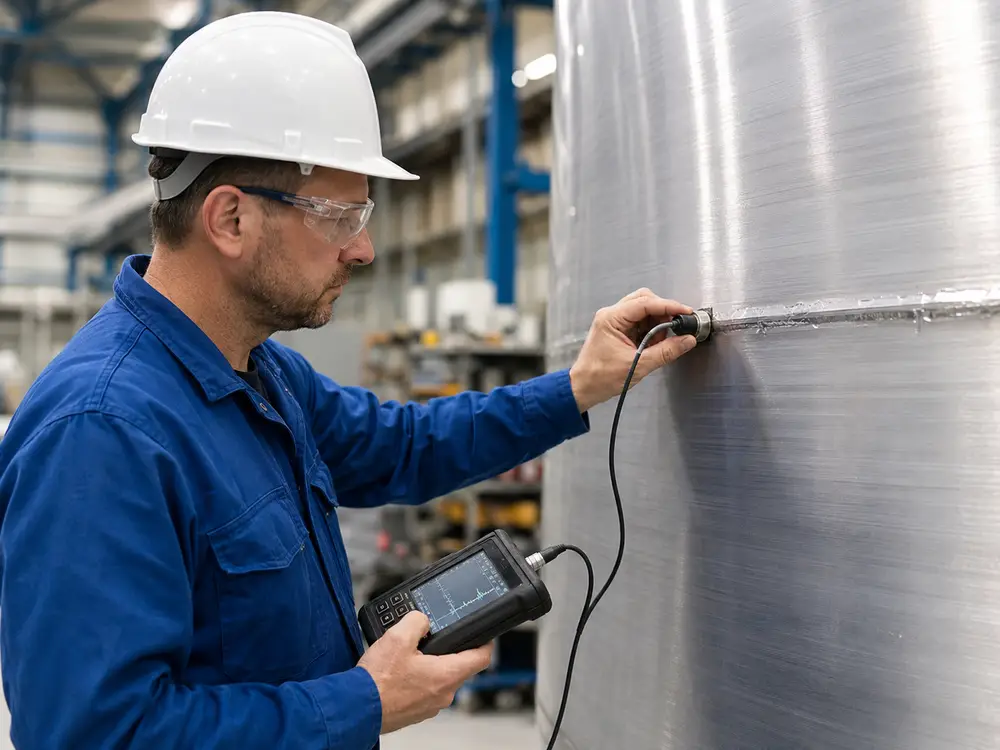 Ultrasonic weld inspection on an aluminum tanker body
We manufacture both carbon steel and aluminum alloy fuel tanker trailers on separate production lines. Every tank body goes through four non-destructive testing methods before leaving the factory:
X-ray inspection captures internal weld defects invisible to visual examination. Each weld seam is imaged and reviewed against acceptance criteria — porosity, incomplete fusion, and crack indications are flagged for rework. Equipment cost: $50,000–$200,000 per unit, which is why this level of inspection is uncommon at smaller manufacturers.
Ultrasonic testing measures wall thickness and detects subsurface flaws using sound waves at 2–10 MHz. On aluminum, ultrasonic penetration reaches up to 150 mm (6 inches) with ±0.5 mm sizing precision — sufficient to map the entire shell thickness in a single pass.
Magnetic particle inspection (carbon steel only) detects surface and near-surface cracks by magnetizing the weld zone and applying iron powder. Sensitivity: down to 0.025 mm (0.001 inch) crack width. This method does not work on aluminum, which is non-ferromagnetic.
Dye penetrant testing catches surface-breaking defects on both materials. It is the simplest method — a penetrating dye seeps into cracks and is revealed under UV light — but it complements the other three by covering geometries that are difficult to access with ultrasonic probes.
After welding inspection, every tanker undergoes hydrostatic or pneumatic pressure testing to verify the assembled tank's integrity under load. The tank is pressurized above its rated working pressure for a prescribed hold time, and any pressure decay or visible deformation results in rejection.
These are the same inspection protocols described in our quality inspection guide. The difference between a well-inspected tanker and a poorly inspected one does not show up on delivery day — it shows up 18 months later when a weld seam fails on a loaded highway run.
Frequently Asked Questions
The FAQ section above covers the six most common buyer questions. For additional guidance on tanker trailer capacity and sizing, the buying process for first-time importers, or our full product range of aluminum, carbon steel, and stainless steel tanker trailers, follow the links to detailed pages on each topic.
If you need help selecting the right material for your fleet, the engineering team can walk you through a specification review based on your routes, cargo, and regulatory requirements. Send us an inquiry with your fleet size, preferred capacity, and primary operating country, and we will send back a material recommendation with a detailed quotation within 24 hours.